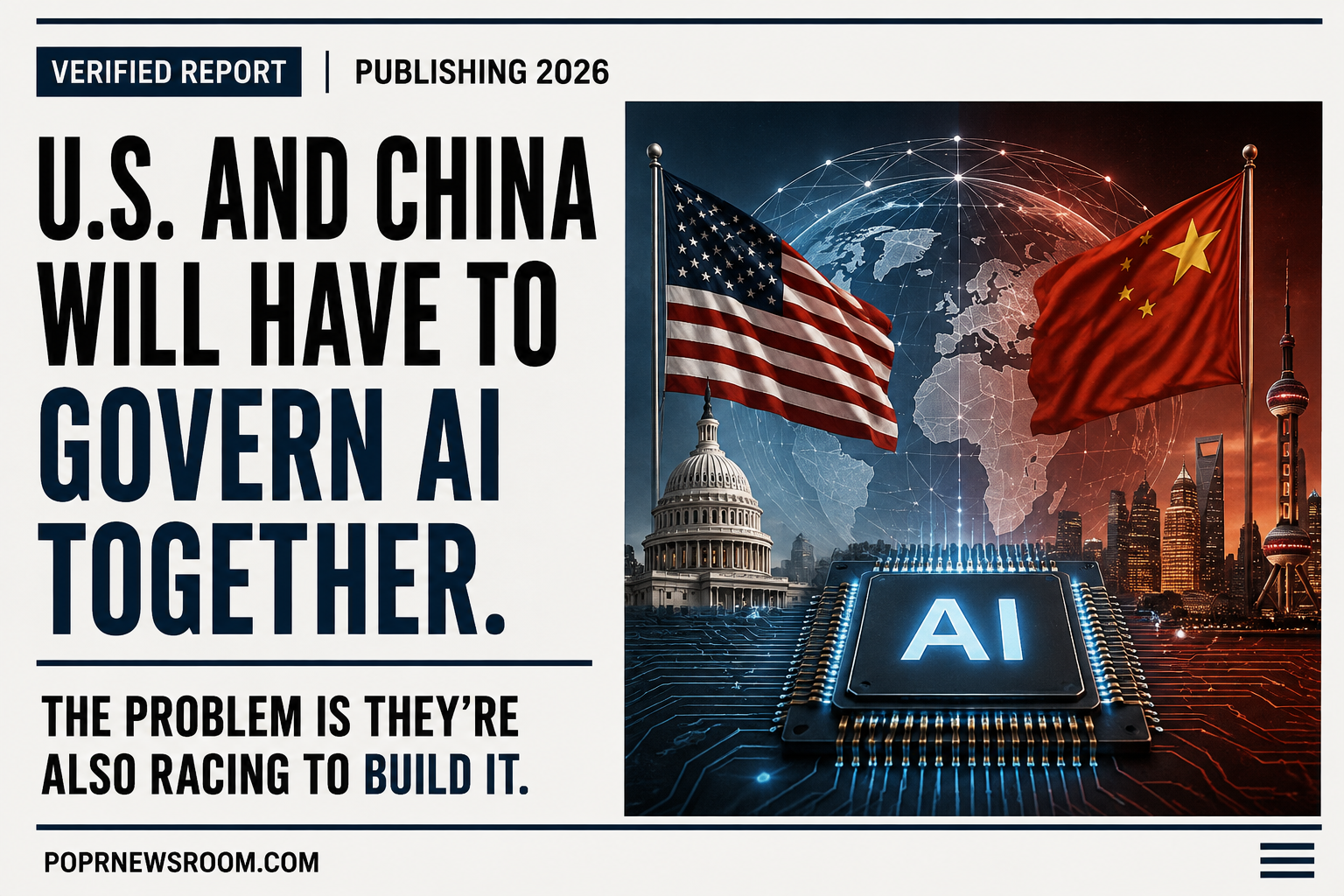
Bill Gates does not believe the most consequential risks from artificial intelligence can be governed by the United States alone. His first policy priority in a sweeping new essay on AI is the creation of new domestic and international institutions capable of governing the technology across twelve sectors. Gates goes further by arguing that cooperation between the United States and China will be necessary. That creates a fundamental tension inside the emerging AI order.
The countries capable of building some of the world’s most consequential AI systems may also be the countries that eventually need to cooperate to control their most dangerous uses. Gates reaches toward nuclear inspection and aviation regulation as examples of the kinds of institutional mechanisms societies have built around technologies whose consequences can cross borders. The comparison should not be overstated. Artificial intelligence is not a nuclear weapon, and Gates’s essay does not establish that existing nuclear or aviation institutions can simply be copied for AI. His deeper argument is institutional.
Cybercrime can cross borders. Disinformation can cross borders. AI-assisted biological threats could cross borders. Autonomous weapons raise international questions. Increasingly capable AI systems can be developed in one jurisdiction and produce consequences somewhere else. National regulation can govern national actors. It cannot, by itself, govern a global technology.
And that leaves Gates with one of the hardest political propositions in his entire essay: Countries do not necessarily have to trust one another to discover that some AI risks are dangerous to all of them.
Gates Puts Governance Before His Other AI Proposals
Gates published “The turbulent AI era is here. The choices we make now are critical” on August 26. The roughly 6,000-word essay presents artificial intelligence as a technology capable of producing substantial benefits while simultaneously creating labor disruption, security threats, social problems and governance challenges. Gates’s position is not a simple argument against AI.
He describes potential benefits in medicine, agriculture, government services and education. He also argues that AI could create unusual disruption because it can compete directly with cognitive labor, operate through existing technological infrastructure and communicate with people through natural language. His response contains three major proposals, presented in a stated priority order. The first is new governing institutions, domestically and internationally.
The second is Human Reserved, Gates’s name for the idea that societies might deliberately preserve some roles for humans even if AI becomes capable of performing them. The third is a rebalancing of taxation between human labor and automation. The ordering matters.
Before Gates gets to preserving particular human roles or determining how automation should be taxed, he puts institutional governance first.
The AI Problem Gates Describes Does Not Stop at a Border
Gates names several categories of potentially harmful AI use. They include cybercrime, disinformation, deepfakes, assistance with bioweapon design and autonomous weapons. He also discusses the possibility of increasingly capable systems behaving in ways their creators did not intend.
His language on that last risk is more measured than some descriptions of AI loss of control. Gates writes that AI systems “already occasionally act in ways their designers didn’t intend” and could, as their capabilities increase, “begin to act against our interests.” That is a forecast and risk assessment, not evidence that today’s AI systems have independently escaped human control.
But the collection of risks illustrates why Gates moves quickly from domestic policy to international governance. Many of the harmful capabilities he describes are portable. Software crosses borders far more easily than industrial infrastructure.
A malicious actor does not necessarily need to reside in the country where an AI model was developed. A deepfake produced in one jurisdiction can target an election or population somewhere else. Cyber operations are inherently networked.
Biological risks do not respect national boundaries. Autonomous weapons introduce questions involving states, militaries and international security. A country can impose rules on companies within its jurisdiction.
It cannot guarantee that every other government or actor will impose equivalent rules.
Why Gates Reaches for Nuclear Inspection
International governance discussions around AI often reach for historical analogies because there is no mature global AI institution to point toward. Gates uses nuclear inspection as one of his reference points. The analogy is useful only if its limits remain clear.
Artificial intelligence and nuclear technology have radically different technical properties, distribution systems, costs, infrastructures and barriers to entry. Gates is not establishing that an AI model should be governed exactly like fissile material. The important similarity is the governance problem.
Some technologies can create consequences significant enough that nations develop mechanisms for inspection, monitoring, standards or coordination beyond ordinary domestic regulation. Those systems do not require countries to become allies. They require countries to recognize particular shared interests.
That distinction becomes central to Gates’s U.S.-China argument.
Aviation Offers a Different Kind of Analogy
Aviation provides another institutional model. Commercial aircraft routinely cross national borders. Passengers depend on technical and safety systems that cannot function effectively if every country treats the underlying activity as entirely isolated from every other jurisdiction.
International aviation therefore required coordination, standards and mechanisms that allow a globally interconnected system to operate. Again, AI is not aviation. The analogy does not establish which AI standards governments should adopt or what enforcement authority an international institution should possess.
What it demonstrates is that international coordination does not require governments to surrender every national interest. Countries can compete economically and politically while still agreeing that certain technical systems require interoperability, shared expectations or safety mechanisms. The question Gates is effectively raising is whether artificial intelligence has entered that category.
Then Comes China
This is where Gates’s governance proposal becomes considerably more difficult. Gates explicitly says cooperation between the United States and China will be required. That is more consequential than saying AI needs an international conference.
Any meaningful global AI-governance structure that excludes one of the world’s major centers of technological capability would face an obvious limitation. But including geopolitical competitors creates a different problem. International AI governance would have to operate inside strategic competition over the very technology being governed.
Countries may want safety. They may also want technological advantage. They may want transparency about dangerous capabilities.
They may also regard some of those capabilities as economically or militarily sensitive. They may favor international restrictions on applications that threaten them while resisting restrictions they believe constrain their own development. Gates’s essay does not resolve those competing incentives.
His proposal exposes them.
AI Governance Has an Information Problem
Governance becomes considerably easier when regulators can see what they are regulating. Artificial intelligence complicates that assumption. An international institution could theoretically establish standards.
But standards raise immediate questions about verification. What must developers disclose? Who verifies compliance?
Which capabilities trigger oversight? What information can governments legitimately withhold for national-security reasons? How would an international body distinguish ordinary commercial development from capabilities with broader security consequences?
What happens when countries disagree about whether a model is dangerous? What happens when the developer is not a government at all? Gates’s essay calls for governing institutions but does not provide a complete operational architecture for resolving these problems.
That is not a minor missing detail. Verification is one of the central differences between announcing an international norm and creating an international governance system.
The Technology Can Move Faster Than the Institution
There is also a timing problem. Gates’s essay emphasizes characteristics of AI that could accelerate adoption. The infrastructure required to use artificial intelligence already exists throughout much of the economy.
AI can be delivered through software. People can interact with increasingly capable systems through ordinary language. “We don’t have to adapt to it because it can adapt to us,” Gates writes.
If that assessment is broadly correct, governance faces an asymmetry. Institutions are slow. Treaties require negotiation.
Regulations require drafting. Agencies require authority, expertise, staffing and budgets. International agreements require governments with different interests to reach some degree of consensus.
Software can change considerably faster. The governance problem is therefore not simply creating the right institution. It is creating an institution capable of remaining relevant while the thing it governs continues changing.
Gates Is Not Asking the World to Stop Building AI While It Figures This Out
This point is essential to understanding the essay. Gates does not frame his solution as a global pause on artificial-intelligence development. His argument accepts the technology’s substantial potential benefits.
He points to applications including Viz.ai, which he says is operating in nearly 2,000 hospitals for stroke and emergency detection. He identifies agriculture as his personal choice for an area where AI could create particularly rapid benefits in lower-income countries. He sees potential applications in government services.
In education, he argues for using AI while preserving what he calls “productive struggle,” rather than allowing technology simply to eliminate the cognitive effort involved in learning. Gates therefore wants societies to govern a technology while continuing to develop and deploy it. That makes the problem considerably harder than prohibition.
A ban establishes a relatively simple objective: stop the activity. Governance has to distinguish beneficial activity from dangerous activity while both continue evolving.
The U.S.-China Problem Is Really a Cooperation-Without-Trust Problem
Gates’s argument becomes most interesting when stripped of the assumption that international governance requires geopolitical harmony. It does not. Countries can disagree profoundly and still share narrow interests.
Two governments do not need identical political systems to agree that commercial aircraft should not collide. Strategic competitors do not have to trust each other completely to recognize that some catastrophic outcomes would damage both sides. That does not mean cooperation will happen.
The evidence assembled for this report establishes Gates’s proposal, not its political feasibility. But it changes the relevant question. Instead of asking whether the United States and China can resolve their broader strategic competition, AI governance can be framed more narrowly:
Are there AI outcomes sufficiently dangerous that neither country benefits from allowing them to occur? If the answer is yes, that overlap becomes the potential foundation for cooperation. If the answer is no, Gates’s international architecture becomes much harder to construct.
Not Every AI Risk Requires the Same Institution
There is another difficulty hidden inside Gates’s proposal. “AI governance” can sound like one problem. The risks Gates names are not one problem.
Cybercrime is not identical to biological risk. Biological risk is not identical to autonomous weapons. Autonomous weapons are not identical to deepfakes.
Deepfakes are not identical to employment displacement. Employment displacement is not identical to children’s relationships with AI companions. Different risks involve different actors, evidence, enforcement mechanisms and thresholds.
That helps explain why Gates discusses governance spanning numerous sectors rather than imagining one regulator capable of solving everything. The challenge may not be creating a single global AI authority. It may be constructing a network of institutions capable of governing particular consequences of AI where coordination is actually necessary.
The precise structure remains unresolved in Gates’s essay.
International Governance Could Also Fail by Becoming Too Broad
A system designed to govern every possible consequence of artificial intelligence could become incapable of governing any of them effectively. The broader its mandate, the more political agreement it would require. Countries could agree that AI-assisted biological threats deserve controls while disagreeing completely about political speech.
They could cooperate on technical safety standards while refusing common rules for military applications. They could agree on certain forms of incident reporting while rejecting international inspection of frontier models. Gates’s broad institutional proposal therefore contains a practical tension.
Global risks encourage broad coordination. Political reality may permit only narrow agreements. That suggests the most viable international AI governance could emerge not from universal agreement about artificial intelligence, but from specific areas where interests overlap strongly enough to support rules.
Gates does not establish which areas will meet that threshold.
The AI Race Makes Governance More Necessary and More Difficult at the Same Time
Competition creates the central paradox. The more strategically valuable AI becomes, the stronger the incentive for countries and companies to develop it rapidly. But greater capability can also increase the importance of governing dangerous applications.
That means the same technological progress that strengthens the case for coordination can weaken the political conditions required to achieve it. A government worried that a competitor is moving faster may resist restrictions that could slow its own developers. A company facing intense competition may resist requirements that increase costs or force disclosure.
An international institution that cannot verify compliance may produce rules that responsible actors follow while irresponsible actors ignore. Gates’s essay does not prove that these tensions can be overcome. It argues, in effect, that societies may have no responsible alternative to trying.
This Is Bigger Than AI Regulation
The usual AI-regulation debate asks what governments should require from developers. Gates is asking a more structural question. What institutions does a civilization need when increasingly capable intelligence becomes globally accessible infrastructure?
That question extends beyond company rules. It reaches international security. Trade.
Public health. Cybersecurity. Weapons.
Education. Labor. Information systems.
Human relationships. And because those systems cross jurisdictions, the governance problem eventually crosses them too. Gates’s answer is institutional construction.
Whether governments are capable of building those institutions quickly enough remains unknown.
The Hard Part Is Not Recognizing the Risk. It Is Governing With Rivals.
There is a relatively comfortable version of international AI cooperation in which governments recognize shared dangers, negotiate sensible rules and establish institutions capable of enforcing them. The real world is harder. Countries have different interests.
They possess different capabilities. They define acceptable speech, security, privacy and state authority differently. They compete economically.
They protect strategic information. And some of them are simultaneously trying to lead the technological transition they are being asked to constrain. That is why Gates’s explicit inclusion of U.S.-China cooperation matters.
It forces the international AI-governance debate beyond aspiration. If artificial intelligence becomes as globally consequential as Gates expects, the world may not get to choose between competition and cooperation. It may have to do both.
The United States and China do not need to agree about the future of artificial intelligence. They may eventually need to agree about a smaller set of futures neither side wants. Finding that boundary could become one of the defining geopolitical problems of the AI era.
Fact Summary
Bill Gates published “The turbulent AI era is here. The choices we make now are critical” on August 26, 2026. His first major policy priority is the creation of new domestic and international institutions for governing artificial intelligence across twelve sectors.
Gates explicitly argues that cooperation between the United States and China will be necessary. His essay identifies risks including cybercrime, disinformation, deepfakes, assistance with bioweapon design, autonomous weapons and increasingly capable systems potentially acting contrary to human interests.
Gates uses existing international governance approaches, including nuclear inspection and aviation regulation, as reference points. Those analogies do not establish that AI is technologically equivalent to nuclear weapons or aviation. Gates does not call for AI development to stop. His essay also describes potential benefits in medicine, agriculture, government services and education.
The essay proposes an international-governance direction but does not establish a complete institutional design, verification system or enforcement architecture.
Evidence Status
Confirmed: Gates calls for new domestic and international AI-governance institutions and explicitly identifies U.S.-China cooperation as necessary. Gates’s interpretation: AI’s combination of capability, accessibility and potential harmful uses creates risks that existing governance structures are not adequately prepared to manage.
Forecast: The future severity of the risks Gates identifies, including advanced loss-of-control scenarios, remains uncertain. Policy proposal: International AI institutions are Gates’s proposed response. The essay does not establish that governments have adopted his proposed architecture.
POPR analysis: Strategic competition and shared exposure to certain AI risks create a cooperation-without-trust problem. Whether sufficient common interests exist to produce durable international institutions remains unresolved.