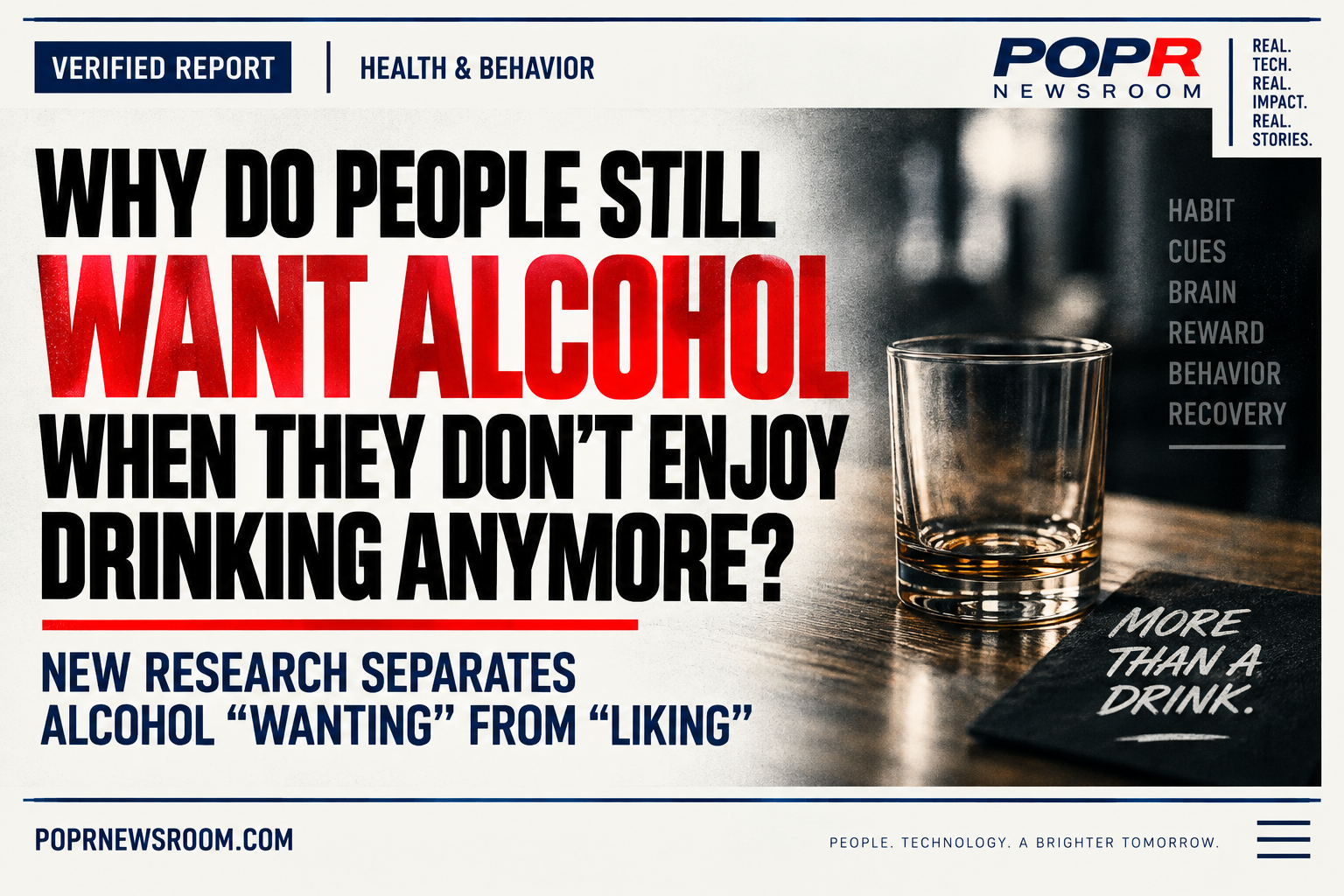
A person can want alcohol without enjoying it because wanting and liking are not necessarily the same process. A 2026 study of 446 adults found that self-reported wanting was more closely associated with drinking motives, especially coping, than liking. Wanting was also associated with stronger intentions to reduce alcohol use.
Why can someone still want alcohol when drinking is no longer enjoyable?
The confirmed finding is that motivational pull and pleasure can separate. Someone may drink in response to stress, negative emotion, habit, social pressure, a learned cue or anticipated relief even when alcohol no longer produces the pleasure it once did.
The study does not say that one mechanism explains every case of alcohol use disorder. It offers a narrower explanation for a common recovery question: “Why do I still want this if I do not even enjoy it anymore?”
What did the researchers find?
Researchers L. Filep, Zsolt Demetrovics and Domonkos File examined self-reported data from 446 adults. Participants answered questions about alcohol wanting and liking, drinking motives, imagined drinking situations, alcohol-related problems and intentions to reduce alcohol consumption.
Wanting was associated with all four drinking-motive categories in the study’s structural model: coping, enhancement, social and conformity. Liking was associated with enhancement and social motives, but not coping or conformity. In situation-specific analyses, wanting was particularly associated with coping and enhancement, while liking was associated only with social motivation.
These are associations from a cross-sectional survey. They are not proof that wanting causes problematic drinking.
Can someone want alcohol and want to stop at the same time?
Yes. Stronger wanting was also associated with stronger intentions to reduce alcohol consumption. Higher problematic alcohol-use scores and stronger coping motives were associated with greater intentions to change as well.
That means a person can feel pulled toward a drink and still genuinely want to stop. A craving does not automatically reveal a person’s values, future decision or commitment to recovery.
Does this study prove dopamine changes or neuroplastic recovery?
No. The researchers did not scan participants’ brains, measure dopamine, test receptor sensitivity, measure synaptic change or establish neuroplastic recovery. The study was exploratory, cross-sectional and based on self-report.
The results are compatible with incentive-sensitization theory, which distinguishes the motivational pull attached to a substance or cue from the pleasure obtained from it. Compatibility is not proof. The study did not directly measure incentive sensitization or establish the direction of effect.
How does this connect to The Sober Brain Reset?
The connection is narrow. The Sober Brain Reset already uses the term “reward recalibration” within its recovery framework. The wanting-versus-liking finding adds a complementary psychological question about motivational pull, cues, coping and alternative rewards.
It does not prove the book’s dopamine-receptor claims or validate the framework as a treatment. The study’s psychological measures and the book’s neurochemical discussion are related questions, not the same evidence.
What does this mean for people in recovery?
A craving can be treated as information to understand rather than as a verdict. The useful next question may be, “What is making alcohol feel wanted right now?” Stress, fear, loneliness, environment, habit, social pressure and anticipated relief are different questions from whether alcohol still feels pleasurable.
The study did not follow sober people longitudinally, so it cannot establish what happens to wanting during abstinence. It also does not provide an individualized recovery plan. People dealing with alcohol use, withdrawal risk or a crisis should seek qualified professional or emergency support.
What remains unknown?
The study did not measure trauma, so trauma cannot be presented as the cause of wanting on the basis of this research. A trauma-to-coping-to-wanting pathway remains a future research direction.
The study also cannot tell us whether wanting leads to problematic drinking, problematic drinking strengthens wanting, a third factor drives both, or the relationships operate in both directions. Those are central limits, not footnotes.
The confirmed takeaway is more precise than the headline: wanting alcohol does not necessarily mean liking alcohol, and wanting alcohol does not necessarily mean that a person has abandoned the desire to stop.