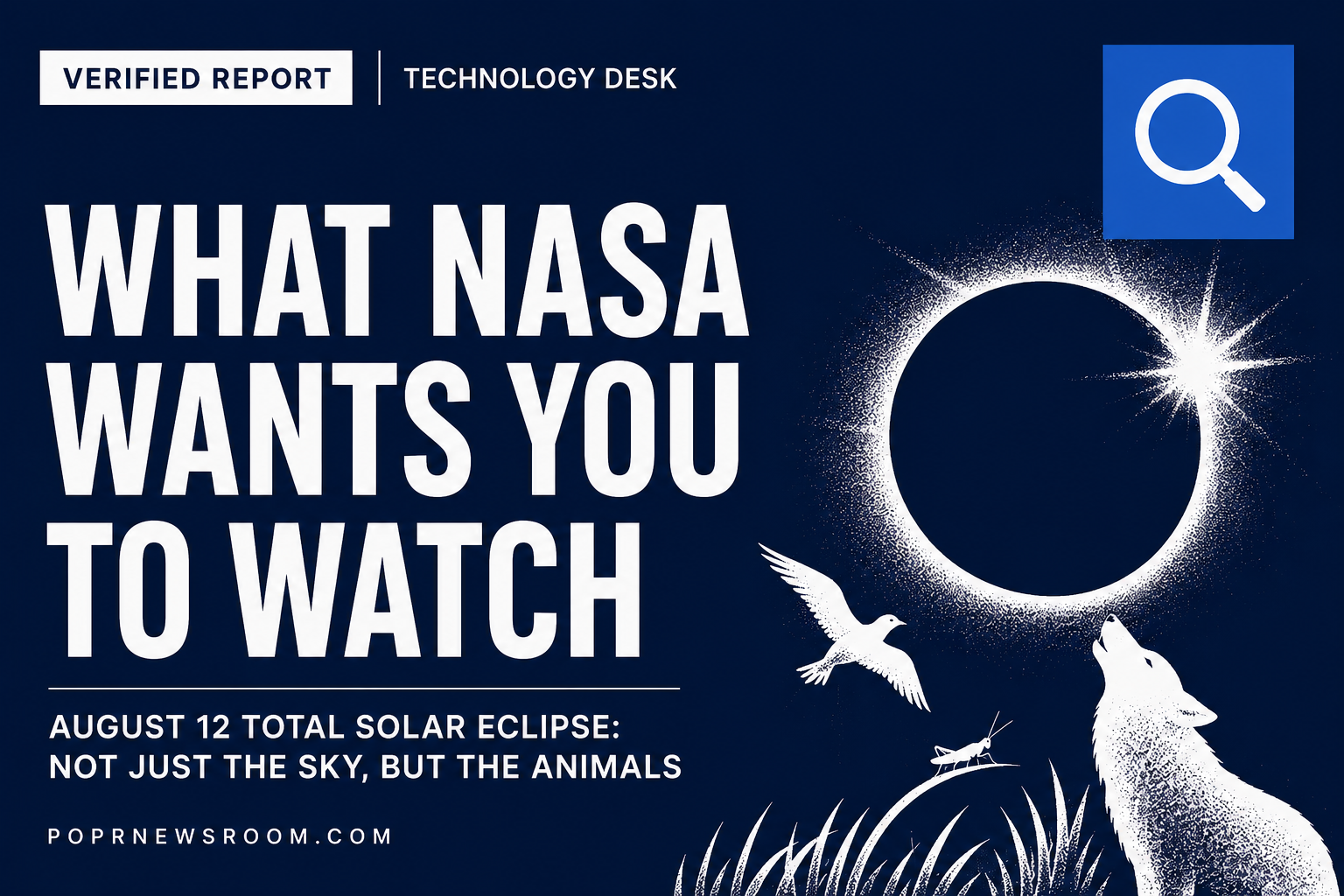
NASA is using the August 12, 2026 total solar eclipse for more than astronomy. Alongside tracking the eclipse itself, NASA is running a citizen-science effort asking the public to observe how animals respond when daylight suddenly collapses into temporary darkness. The project turns tomorrow's only total solar eclipse of 2026 into both a celestial event and a live behavioral experiment.
Tomorrow's eclipse will draw millions of eyes upward, but NASA is also asking people to look around them. The August 12, 2026 total solar eclipse is the only total solar eclipse of the year. Its path of totality begins along Siberia's northern coast near the North Pole, moves through the Arctic and North Atlantic, crosses Greenland and western Iceland including Reykjavik, then reaches northern Spain before totality ends at sunset in the western Mediterranean. For most people, that geography is the story. NASA is pursuing another question at the same time: what happens to animals when daytime abruptly behaves like night?
The agency is operating a citizen-science initiative tied to eclipse observation that asks members of the public to document animal behavior during the event. The effort gives tomorrow's eclipse a scientific dimension that extends beyond measuring the geometry of the Sun, Moon and Earth. The eclipse therefore becomes a natural experiment. Animals experience daylight, temperature and environmental cues that normally change gradually across a day. During totality, the visual environment can shift dramatically within minutes. NASA wants observers to pay attention to what happens next.
What Is NASA Studying During the August 12 Eclipse?
NASA is actively supporting citizen observation of animal behavior during the eclipse through a current citizen-science initiative connected to the agency's eclipse work and its Dynamic Eclipse Broadcast effort. The premise is straightforward. When day briefly turns into darkness, animals may change what they are doing. The project asks the public to help document those responses. That turns ordinary eclipse watchers into observers contributing to a larger scientific record.
The sealed research does not establish a universal behavioral response across species, and the program should not be reduced to claims that every animal will suddenly behave as though night has begun. The scientific value lies in observation. NASA is asking people to record what actually happens.
Why Use an Eclipse to Study Animal Behavior?
A total solar eclipse creates an environmental transition that does not resemble an ordinary sunset. The change is rapid. For a short period, sunlight disappears across the narrow path of totality even though the event is occurring during normal daytime hours. That gives researchers and citizen scientists an unusual opportunity to observe how biological systems respond to a sudden change in a major environmental signal.
The project is especially well suited to public participation because the phenomenon covers a large geographic area and affects animals living in many different environments. One observer may watch birds. Another may notice insects. Others may observe pets, livestock or wildlife near the path. The value comes from many observations occurring during the same astronomical event.
Where Will NASA's August 12 Eclipse Be Total?
The path of totality begins along Siberia's northern coast near the North Pole and moves southward through the Arctic and North Atlantic. It crosses Greenland, western Iceland including Reykjavik, and northern Spain before ending at sunset over the western Mediterranean. A partial eclipse will be visible across a much larger area, including parts of Canada, the northern contiguous United States, the United Kingdom, mainland Europe and Africa.
In the United States, the eclipse will be partial rather than total. The sealed astronomical record identifies maximum partial-eclipse coverage at approximately 1:40 p.m. local time in Toronto and 1:54 p.m. in New York City. Those outside the path of totality can still experience the eclipse, but they will not see the Sun completely covered.
Why Is the August 12 Eclipse Total?
The eclipse occurs approximately 2.2 days after lunar perigee, which occurred August 10. Perigee is the point in the Moon's orbit when it is closest to Earth. Because the Moon is relatively close to Earth during this eclipse, its apparent size in the sky is larger than average. That geometry allows the Moon to completely cover the visible disk of the Sun along the path of totality. The total phase lasts approximately two minutes depending on location. The event is therefore brief at any one point even though the eclipse itself travels across a vast geographic path.
Why Is Spain One of the Biggest Stories of This Eclipse?
Spain has waited more than 120 years for this moment. The country has not experienced a total solar eclipse since 1905. Tomorrow's eclipse therefore represents more than another astronomical event for northern Spain. It ends a national total-eclipse drought extending across generations. That makes Spain one of the most historically significant locations along the 2026 path. It also explains why the country has become a major destination for eclipse observers. The event reaches Spain late in its journey before totality ends at sunset over the western Mediterranean.
Why Is Iceland Important?
Western Iceland including Reykjavik lies along the path of totality. That gives the Icelandic capital something unusual for a major urban area during a total solar eclipse: direct access to totality without requiring observers to travel into a remote location. The path then continues toward northern Spain. The geographical sequence is one of the more unusual features of the 2026 eclipse because it connects high-Arctic environments with populated European viewing locations during the same event.
How Long Will Totality Last?
Maximum totality during the August 12 eclipse lasts roughly two minutes. That is substantial enough to create a complete daytime blackout along the central path, but it is relatively brief compared with the next total solar eclipse. The next one occurs August 2, 2027. That eclipse will cross southern Europe, North Africa and the Middle East and will produce totality lasting as long as 6 minutes 23 seconds. That is nearly three times the maximum totality available during the 2026 eclipse. The comparison is useful because not all total solar eclipses provide the same experience. The geometry of the Moon, Earth and Sun changes from event to event, producing different paths and different durations.
Why Do Scientists Still Care About Solar Eclipses?
Solar eclipses have a long scientific history. National Geographic's eclipse coverage cites physics and astronomy professor Jason Steffen discussing the importance of early twentieth-century eclipse expeditions used to measure the apparent positions of stars during totality as a way to test Einstein's theory of gravity. That history shows why eclipses are more than visual spectacles. The temporary blocking of the Sun can create observational conditions that are otherwise unavailable.
The scientific questions have changed over time. Earlier eclipse expeditions helped test fundamental physics. Modern eclipse work includes advanced solar observation, visualization and public citizen-science programs. NASA's animal-behavior initiative belongs to that longer tradition of using a rare astronomical event to ask questions that would be difficult to study under ordinary conditions.
What Is NASA's Scientific Visualization Studio Doing?
NASA's Scientific Visualization Studio has produced visualizations of the August 12 eclipse path, providing a detailed representation of how the Moon's shadow moves across Earth. These visualizations help explain a phenomenon that can otherwise seem counterintuitive. The entire planet does not become dark. The Moon's central shadow traces a relatively narrow path across Earth. Observers inside that path experience totality. Observers farther away experience only a partial eclipse. NASA's visualizations make the moving geometry visible and help observers understand why a location only a comparatively short distance outside the totality path can experience a substantially different eclipse.
Why Does NASA Need Citizen Scientists?
An eclipse occurs across too large a geographic area for a small research team to observe every biological response directly. Citizen science allows many people to gather observations at once. For animal-behavior research, that scale matters. Different species live in different environments. Different locations experience different degrees of eclipse coverage. Observers spread across the affected region can collectively provide a broader observational picture than one research site could produce alone.
The strength of the approach is not that every observation becomes a scientific conclusion. It is that many observations can create a larger dataset for researchers to examine. NASA's current initiative therefore turns the public from spectators into potential participants.
What Should People Actually Watch?
The scientific premise is behavioral observation. Rather than assuming what an animal is going to do, observers can pay attention to whether behavior changes as the light level falls and then returns. The sealed research does not prescribe a particular animal, species or expected reaction. That restraint is important. The point is not to prove that animals behave strangely during eclipses. The point is to observe whether they do. That is the difference between watching an eclipse for entertainment and watching it as a citizen scientist.
Is Weather the One Thing NASA Cannot Tell Us Yet?
Yes. The path of totality is calculable with extraordinary precision. Tomorrow's local cloud cover is not. The sealed research specifically identifies real-time weather and cloud conditions as unresolved because they remain forecast-dependent until the event itself. That distinction matters for eclipse planning. Astronomy tells observers exactly where totality will occur. Weather determines whether they will actually see it. A perfectly positioned observer under heavy cloud cover can experience a very different eclipse from someone under clear skies only a short distance away. The eclipse path is confirmed. Viewing conditions remain variable.
Tomorrow's Eclipse Is More Than a Viewing Event
The August 12 eclipse will inevitably produce photographs, travel stories and viewing guides. Those are legitimate parts of the event. NASA's work reveals another layer. An eclipse is a temporary alteration of the environment occurring across an enormous geographic region at a precisely known time. That makes it an opportunity to observe systems other than the Sun. Animals are one of them.
The agency's citizen-science initiative asks the public to notice something that can easily disappear amid the spectacle. While everyone else is looking upward, the living world around them is experiencing the eclipse too. Tomorrow, that behavior becomes part of the science.