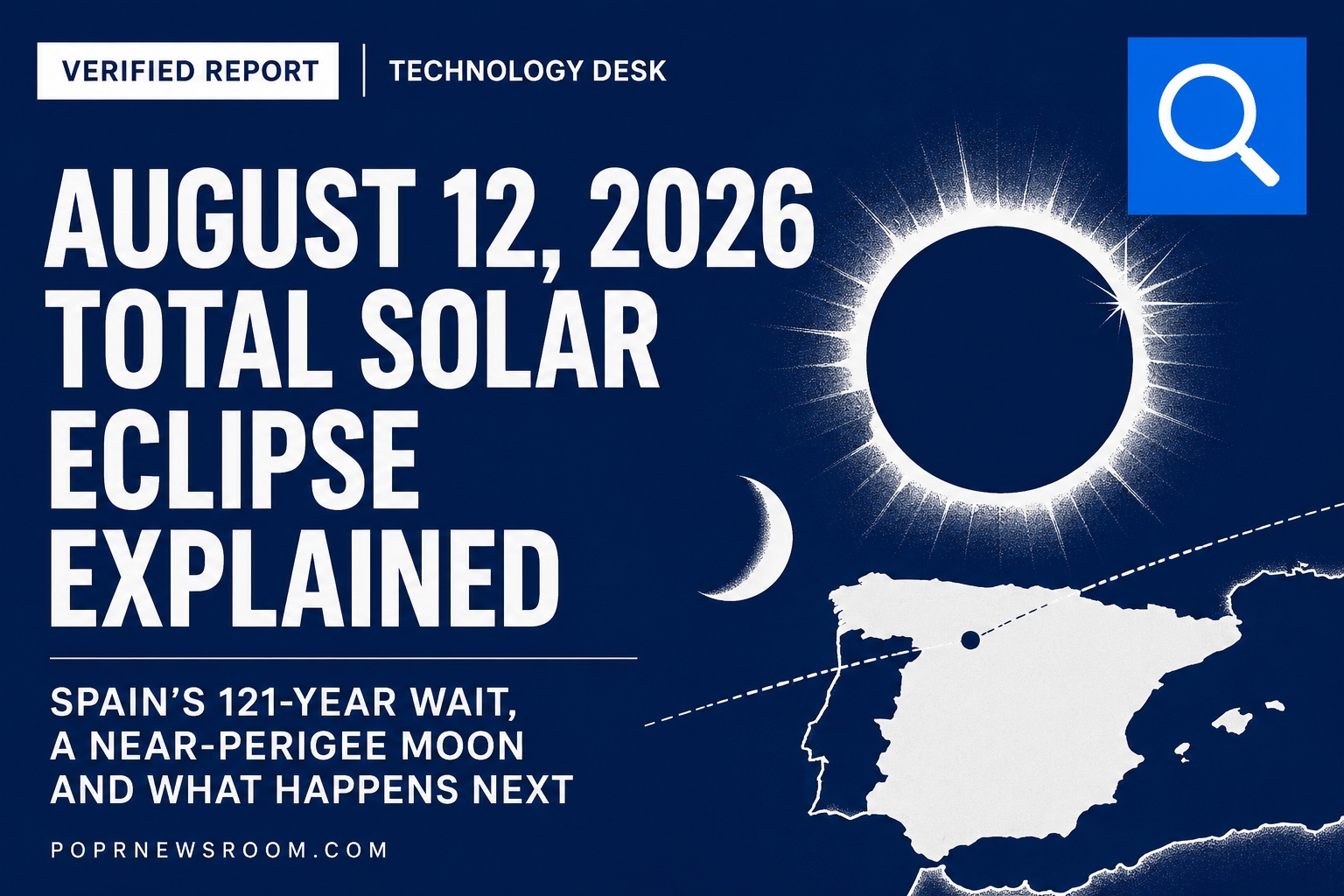
The August 12, 2026 total solar eclipse is unusual for reasons that go well beyond where to stand. It will be Spain's first total solar eclipse since 1905, the Moon will be near perigee and therefore appear larger than average, totality will last approximately two minutes, and the next total eclipse in 2027 will be nearly three times longer at up to 6 minutes 23 seconds.
Tomorrow's total solar eclipse is being covered across the world as a viewing event, but some of its most interesting features are easier to miss. The August 12 eclipse is the only total solar eclipse of 2026. Its path begins along Siberia's northern coast near the North Pole, crosses Greenland and western Iceland including Reykjavik, then reaches northern Spain before totality disappears at sunset over the western Mediterranean. That route alone is unusual. But the deeper story includes a country that has waited more than 120 years to see totality return, a Moon unusually close to Earth, a relatively short total phase and an immediate comparison with a dramatically longer eclipse arriving less than a year later. Taken together, those details make August 12 more than another date on the eclipse calendar.
Why Is the August 12, 2026 Eclipse Historically Important for Spain?
Spain has not experienced a total solar eclipse since 1905. That means tomorrow ends a gap of more than 120 years. Generations of people have lived entire lives in Spain without experiencing totality from their own country. That makes the Spanish portion of the eclipse especially significant because the event is not simply passing through another point on a global map. It is returning totality to a country that has been waiting since the beginning of the twentieth century.
Northern Spain lies near the final portion of the path, with totality ending at sunset over the western Mediterranean. The timing gives the Spanish event another visual characteristic: the total phase arrives late in the eclipse's journey rather than near the beginning. The sealed research does not establish local weather conditions for tomorrow, so visibility remains dependent on what the atmosphere actually does when the eclipse arrives. The astronomical event itself, however, is fixed. Spain's wait ends tomorrow.
Why Does the Moon's Distance Matter?
The eclipse occurs approximately 2.2 days after lunar perigee on August 10, 2026. Perigee is the point in the Moon's orbit when it is closest to Earth. Because the Moon is relatively close during this eclipse, its apparent size in the sky is larger than average. That helps explain why the Moon can completely cover the Sun along the path of totality.
A solar eclipse depends on apparent size, not simply physical size. The Sun is vastly larger than the Moon, but it is also vastly farther away. From Earth, the two objects can appear similar enough in angular size for the Moon to cover the visible solar disk. Tomorrow's near-perigee geometry gives the Moon a favorable apparent size for totality.
How Long Will Totality Last?
Maximum totality during the August 12 eclipse will last roughly two minutes. That is enough time for day to transition into total eclipse conditions along the central path, but it is not an exceptionally long total eclipse. The comparison with 2027 makes that clear.
The next total solar eclipse occurs August 2, 2027, less than a year after tomorrow's event. It will cross southern Europe, North Africa and the Middle East and produce totality lasting as long as 6 minutes 23 seconds. That is nearly three times the maximum duration of the 2026 eclipse. The comparison demonstrates why the phrase "total solar eclipse" does not describe one uniform experience. Every eclipse has its own geometry. The distance between Earth and the Moon changes. Earth's distance from the Sun changes. The shadow crosses different parts of the planet. The duration of totality changes with those conditions. Tomorrow's eclipse is historically striking. The 2027 eclipse will be striking for a different reason: duration.
Where Does the Total Eclipse Begin?
The path begins along Siberia's northern coast near the North Pole. It then travels through the Arctic and North Atlantic before crossing Greenland. From Greenland, the path reaches western Iceland including Reykjavik before continuing toward northern Spain. Totality then ends at sunset over the western Mediterranean. That gives the eclipse a path connecting extremely different environments. High Arctic regions experience the same moving lunar shadow that later reaches a European capital and then northern Spain.
The path itself provides a reminder that an eclipse is not an event happening simultaneously everywhere. The Moon's shadow moves across Earth. Each location experiences its own moment as that shadow arrives.
Can Reykjavik See Totality?
Yes. Western Iceland including Reykjavik lies inside the path of totality. That makes Reykjavik one of the more accessible populated locations directly inside tomorrow's total-eclipse corridor. Observers there can experience full solar coverage rather than merely a partial eclipse, assuming local conditions allow the Sun to be seen. The Moon's shadow is predictable. Clouds are not.
What Will North America See?
The continental United States is not inside the path of totality. A partial eclipse will nevertheless be visible from parts of Canada and the northern contiguous United States. The sealed research identifies maximum coverage around 1:40 p.m. local time in Toronto and approximately 1:54 p.m. in New York City.
Observers in those regions will see only part of the Sun covered because they remain outside the Moon's central shadow. That distinction is fundamental. A partial solar eclipse and a total solar eclipse are not simply different percentages of the same visual experience. Totality occurs only within the narrow central shadow path. Outside it, some portion of the Sun remains visible.
Why Is This the Only Total Solar Eclipse of 2026?
The August 12 event is the only total solar eclipse occurring during the calendar year. Solar eclipses require the Sun, Moon and Earth to align closely enough for the Moon's shadow to reach Earth. That alignment does not produce a total eclipse every time. The geometry can instead produce partial or annular eclipses depending on the alignment and the Moon's apparent size. Tomorrow's geometry produces totality across the confirmed path. The next opportunity for another total solar eclipse comes on August 2, 2027.
Why Will the 2027 Eclipse Be So Much Longer?
What is confirmed is substantial. The August 2, 2027 eclipse will cross southern Europe, North Africa and the Middle East and produce maximum totality lasting approximately 6 minutes 23 seconds. Tomorrow's eclipse offers roughly two minutes. The difference is more than four minutes at maximum duration. That means someone experiencing both eclipses from optimal locations would encounter two substantially different periods of total darkness. The 2026 eclipse is rare because of where it travels and what it means historically for places such as Spain. The 2027 eclipse is exceptional because of how long totality can last.
What Do Eclipses Have to Do With Einstein?
Solar eclipses have played a genuine role in the history of physics. National Geographic's coverage cites physics and astronomy professor Jason Steffen discussing early twentieth-century eclipse expeditions in which scientists measured the apparent positions of stars near the Sun during totality to test Einstein's theory of gravity. The Sun normally overwhelms nearby stars with daylight. During totality, the solar disk is blocked and stars close to the Sun's apparent position can become observable. That made eclipse conditions useful for measurements related to how gravity affects light.
The historical connection is a reminder that eclipses have never belonged only to spectacle. They have also created experimental opportunities. Tomorrow's eclipse continues that broader scientific tradition, although the questions modern researchers ask can be very different from those pursued more than a century ago.
Why Is Tomorrow's Eclipse Different From an Ordinary Sunset?
A sunset is part of the normal daily light cycle. A total eclipse creates a rapid interruption during daytime. That distinction matters not only to human observers but also to scientists studying environmental responses. Current NASA citizen-science work examines animal behavior during eclipses, a program that received separate POPR coverage. Within the larger eclipse story, it provides another example of why tomorrow is scientifically unusual.
The changing light is not occurring because Earth is rotating normally into night. It is occurring because the Moon's shadow is temporarily crossing the observer. The result is a brief environmental state that does not behave like an ordinary day-night transition.
What Can Be Known Exactly Before the Eclipse?
The geometry. Astronomers can calculate the eclipse path, timing and locations of totality with remarkable precision. NASA's Scientific Visualization Studio maps the movement of the Moon's shadow across Earth. The eclipse path is not a weather forecast or an estimate of where the shadow might go. It is an astronomical prediction based on orbital mechanics. That is why scientists can say in advance that totality will cross Greenland, Reykjavik and northern Spain. The uncertainty appears at a different layer. Whether a person standing in those locations will have a clear view depends on weather.
What Cannot Be Known Yet?
Tomorrow's actual cloud conditions. The sealed research explicitly leaves real-time weather unresolved. That is not a weakness in the astronomical prediction. It is a separate physical system. A person can be positioned exactly inside the center of the totality path and still have the Sun obscured by clouds. Another observer farther along the same path may have a clear sky. That is why late weather changes can matter so much to eclipse travel. The path tells observers where the event happens. The atmosphere determines how much of it they see.
The Eclipse Is Brief, but the Context Spans More Than a Century
Totality lasts minutes. The story surrounding it covers generations. Spain's wait began in 1905. Tomorrow ends it. The Moon reaches perigee only days before the eclipse, giving the event its particular apparent geometry. The shadow then travels from the Arctic to Europe over the course of a single astronomical event. Less than twelve months later, another total eclipse arrives with a radically longer period of darkness. And behind all of that is a scientific history in which eclipses have helped researchers test some of the most important ideas in physics.
It is the only total solar eclipse of the year. Its shadow moves from the high Arctic through Greenland and Iceland into Spain. The Moon is near perigee and appears larger than average. Totality lasts roughly two minutes. Spain experiences its first total solar eclipse since 1905. And less than a year later, the world receives another total solar eclipse whose maximum totality will be nearly three times longer. No one of those details completely defines the event. Together they explain why tomorrow is more interesting than a simple viewing map suggests.