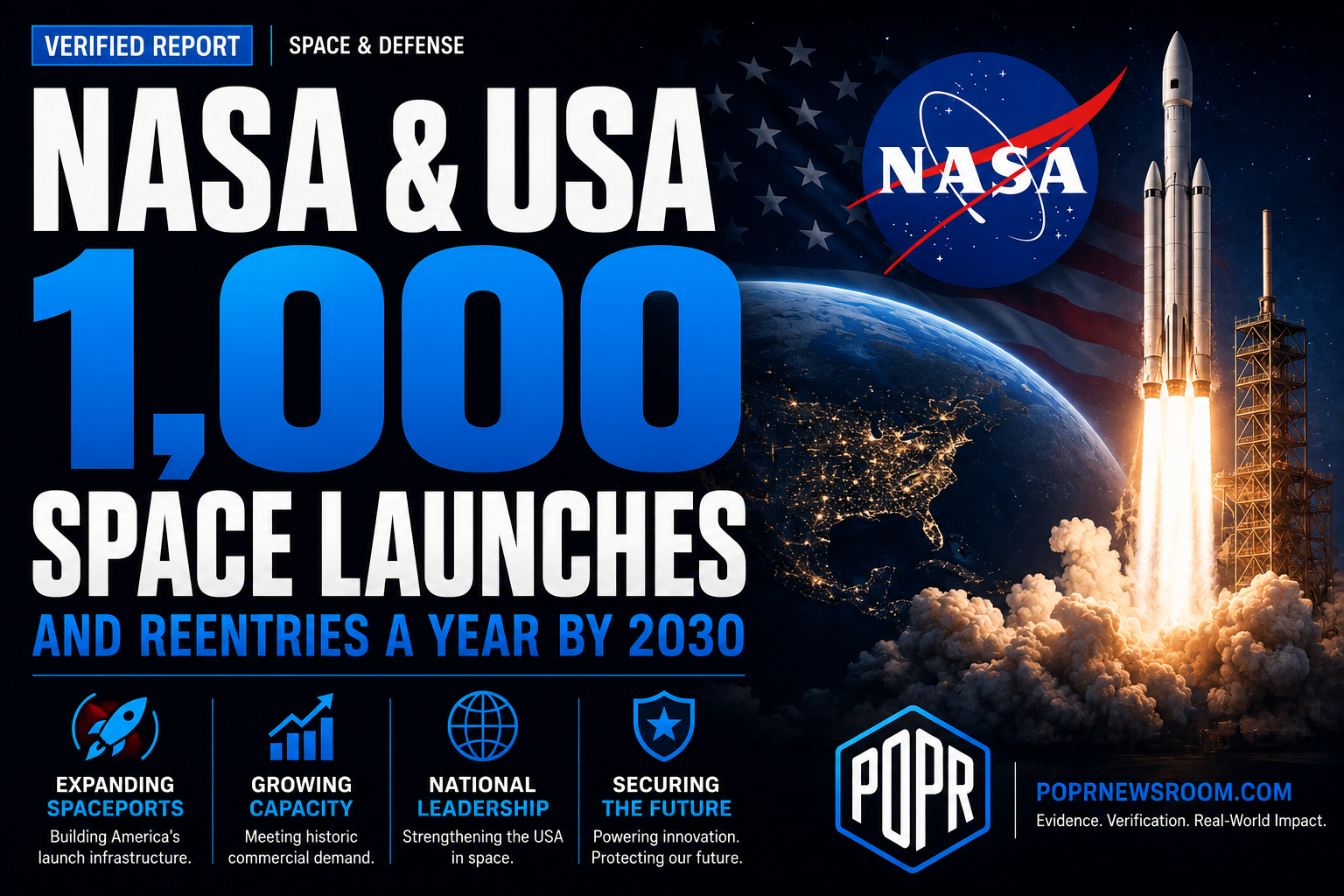
On August 20, 2026, the White House issued a new National Space Transportation Policy with an unusually concrete infrastructure objective: by 2030, American space transportation ranges are supposed to support more than 1,000 launches and reentries annually. That number needs to be understood precisely. The federal target is not 1,000 commercial rocket launches. It combines launches and reentries across government, national-security and commercial activity.
The policy nevertheless represents an enormous increase in national space-transportation throughput. Depending on how activity is classified, approximately 175 to 181 U.S. orbital launches or attempts occurred in 2025. Even allowing for the fact that the new federal target includes reentries as well as launches, the infrastructure supporting American space activity is being asked to prepare for several-fold greater throughput within the next several years. The most important question may no longer be simply whether the United States can build enough rockets. It is whether the physical system underneath those rockets can keep up.
The White House Has Turned Launch Cadence Into Industrial Policy
The August 20 National Security Presidential Memorandum replaced the 2013 National Space Transportation Policy and explicitly connected space transportation with the American industrial base. The memorandum calls for a “vibrant, competitive, and resilient U.S. space transportation industrial base” and directs federal agencies to incentivize co-development of space transportation infrastructure with private-sector partners. White House National Space Transportation Policy This is significant because a thousand-launch-and-reentry economy is not simply a rocket-manufacturing problem. A launch vehicle needs a pad. A pad needs roads, power, storage, gases, communications and range access. Vehicles and payloads need to reach the site. Operations have to be scheduled. Spacecraft need components. Launches and reentries need spectrum. Returning vehicles need places to land or be recovered.
The new federal policy recognizes part of that larger system explicitly. It also puts deadlines behind the reentry side of the equation. The Secretary of the Interior must identify federal land for a designated reentry site within 90 days. The Department of Transportation must evaluate reentry safety criteria within 180 days. Commerce must produce a site-development plan within 240 days. Reentry is therefore not a distant conceptual addition to the American space economy. It is now a deadline-driven federal infrastructure category.
How Many U.S. Launches Actually Happened in 2025?
There is no single clean number, and pretending otherwise creates more confusion than clarity. Credible 2025 counts range from approximately 175 to 181 U.S. orbital launches or attempts depending on the methodology used. The difference can arise from whether a source classifies activity according to where a rocket physically launches, the nationality of the launch provider or the licensing jurisdiction involved. Rocket Lab demonstrates the problem. Space analyst Jonathan McDowell explains in his 2025 annual report that Rocket Lab is counted as a U.S. launch provider in one table, while launches from Mahia, New Zealand are assigned to New Zealand in another context consistent with United Nations registration documents. Jonathan McDowell’s Space Activities in 2025 report Those are different classification questions, so they legitimately produce different answers. The defensible conclusion is therefore not that one number is correct and every other count is wrong. It is that approximately 175 to 181 U.S. orbital launches or attempts occurred in 2025 depending on the counting methodology. Either way, the scale of the 2030 infrastructure challenge remains clear.
NASA Was Warning About Capacity Before the New White House Target
The timing is remarkable. On June 22, 2026, roughly two months before the new federal policy, NASA’s Office of Inspector General released an audit of NASA launch infrastructure. Its conclusion was direct: based on current launch projections, Kennedy Space Center and Wallops Flight Facility are expected to operate near capacity during the 2028-to-2029 period. NASA OIG: NASA’s Launch Infrastructure, Report IG-26-010 That means the federal government now has two important documents sitting beside each other. One says American ranges must grow to support more than 1,000 launches and reentries annually by 2030. The other says major existing launch infrastructure is already expected to approach capacity before then. That tension is the industrial story.
Kennedy and Cape Canaveral Went From 31 Launches to 109 in Five Years
The growth is already visible. According to NASA’s inspector general, launches supported by Kennedy Space Center and Cape Canaveral Space Force Station increased from 31 in 2020 to 109 in 2025. That is a 252 percent increase. Current projections cited by the audit put the number at 268 by 2030. Wallops experienced an even larger percentage increase from a much smaller base. Launches grew from three in 2020 to 17 in 2025, a 467 percent increase, and are projected to reach 44 by 2030. The infrastructure challenge is therefore not being created entirely by a future policy target. Existing activity has already been rising rapidly. And rockets are only one visible part of that growth.
One of the Space Economy’s Bottlenecks Is a Road
Kennedy Space Center recorded 1,956 heavy-truck trips in 2019. By 2025, that number had reached 8,752. That represents a 347 percent increase. NASA’s inspector general projects approximately 19,000 additional annual truck trips as launch cadence continues growing. This is the terrestrial side of the space economy that receives less attention. Rockets, satellites and astronauts are visually synonymous with spaceflight. Heavy trucks are not. But launch hardware, fuel systems, construction materials, spacecraft, support equipment and other industrial inputs still have to move through a physical transportation network. As launch cadence rises, ordinary infrastructure can become space infrastructure. Road capacity becomes launch capacity.
NASA Has Identified More Than $1 Billion in Kennedy Infrastructure Needs
Infrastructure expansion also requires capital. NASA officials identified more than $1 billion in required infrastructure investment at Kennedy Space Center. Approximately $250 million was obtained through H.R. 1 reconciliation legislation. Against the confirmed infrastructure requirement, that leaves a shortfall of roughly $750 million. The timing again matters. That funding gap existed before the August 20 national policy established the new 2030 throughput objective. There is another structural complication. Approximately 70 percent of launches supported by NASA since 2020 have been commercial missions, according to the NASA inspector general. Yet statutory funding restrictions and existing cost-recovery practices prevent commercial partners from contributing equitably toward some shared infrastructure. NASA has sought authorization for an Infrastructure Investment Fund that could receive both public and private contributions for shared infrastructure. The enabling legislation had not passed at the time of the audit. The United States therefore faces not only a question of how much infrastructure needs to be built, but how shared government-commercial infrastructure should be financed.
A Nitrogen Pipeline Has Already Become a Launch-Scheduling Problem
One of the clearest examples of an infrastructure bottleneck involves gaseous nitrogen. Kennedy’s gaseous nitrogen pipeline extends to Cape Canaveral Space Force Station and supports launch operations. But the existing system cannot simultaneously support high-flow operations for Blue Origin’s New Glenn, United Launch Alliance’s Vulcan Centaur and NASA’s Space Launch System. This is not a hypothetical modeling exercise. The nitrogen limitation created a documented major scheduling challenge ahead of the New Glenn-1 launch in January 2025. NASA has also warned about potential one-to-two-month nitrogen-pipeline blackout periods surrounding future Space Launch System operations.
A proposed supplemental nitrogen system was estimated to cost as much as $25 million and remained unfunded at the time of the NASA audit. The significance goes beyond nitrogen itself. It demonstrates what happens when launch cadence begins colliding with shared infrastructure. The constraint can migrate. A country may have a rocket ready. A payload may be ready. A launch provider may be ready. A pad may appear ready. But if a shared industrial system cannot support simultaneous operations, infrastructure becomes the schedule.
The Emerging Space Economy Is Really Five Connected Economies
The 1,000-launch-and-reentry objective becomes easier to understand when the industrial system is separated into five connected layers. The first is the launch economy: vehicles, engines and pads. The second is the spaceport economy: roads, industrial gases, power, storage and recovery infrastructure. This is currently the best-documented infrastructure constraint because NASA’s own audit provides direct evidence of rising traffic, capacity pressure, nitrogen limitations and funding needs. The third is the spacecraft economy: satellites, solar power systems, semiconductors and payloads. The fourth is the network economy: spectrum, RF systems, communications and data infrastructure. The new federal policy specifically directs Commerce and the FCC toward reliable spectrum access for launch, reentry, recovery and on-orbit operations. Evidence available here does not establish that U.S. ground-station capacity itself is currently a comparable bottleneck, so that stronger claim should not be made. The fifth is the return economy: reentry, recovery, refurbishment and landing infrastructure. That final economy may become increasingly important because the new federal policy does not describe a 1,000-launch economy. It describes a 1,000-launch-and-reentry economy.
The Semiconductor Story Is More Complicated Than “Space Needs Special Chips”
Higher spacecraft production logically raises questions about the electronics and power systems that go into those spacecraft, but the evidence requires precision. Modern low-Earth-orbit spacecraft frequently use commercial off-the-shelf and COTS-plus components rather than relying universally on traditional radiation-hardened silicon. Space electronics therefore cannot accurately be described as a market where ordinary commercial silicon is automatically unusable. Radiation-hardened semiconductor production remains real, with market estimates around $1.5 billion across multiple research sources, but that is an approximate market estimate rather than a single audited figure. Radiation-hardened work also exists at mature process nodes while separate radiation-tolerant development is occurring at 22nm and 14nm. The space semiconductor market cannot be reduced to one simple process-node range. There is, however, a verified federal industrial-policy example directly relevant to spacecraft production.
The Federal Government Was Already Investing in Space-Grade Production Before the New Policy
On November 25, 2024, the U.S. Department of Commerce finalized a CHIPS Incentives award of up to $23.9 million for Rocket Lab, the parent company of SolAero Technologies. The preliminary agreement had been announced on June 11, 2024. The award supports expansion of compound-semiconductor and space-grade solar-cell production at Rocket Lab’s Albuquerque facility, with a target of increasing production capacity by 50 percent within three years. NIST: CHIPS Incentives Awards Including Rocket Lab The chronology matters. This investment predates the August 2026 National Space Transportation Policy by nearly two years. It should therefore be understood as evidence that federal industrial policy was already supporting parts of the space-component supply chain, not as a reaction to the new 1,000-launch-and-reentry objective.
AST SpaceMobile Shows What Commercial Launch Demand Can Look Like
Commercial satellite deployment provides another view of the demand side. AST SpaceMobile launched BlueBird 6, its first next-generation Block 2 direct-to-device satellite, on December 23, 2025. The spacecraft launched aboard an ISRO LVM3 from the Satish Dhawan Space Centre in India. AST SpaceMobile has publicly stated a target of launching between 45 and 60 Block 2 BlueBird satellites by the end of 2026, using multiple launch providers at a cadence of roughly one launch every one to two months. This does not establish what the entire U.S. launch economy will look like. It demonstrates how one commercial satellite program can create recurring demand for launch services as constellation deployment scales. Multiply that basic industrial pattern across government, national-security and commercial programs and the importance of throughput becomes easier to see.
More Rockets Do Not Automatically Create More Launch Capacity
The central mistake in thinking about a high-cadence space economy is to treat rocket production as synonymous with launch capacity. It is not. A launch system exists inside another system. Vehicles require pads. Pads require roads. Operations require gases and electrical capacity. Launches require range scheduling and spectrum. Commercial and government users share infrastructure. Returning spacecraft create recovery and reentry requirements. Spacecraft manufacturing creates separate component and production demands. NASA’s audit provides direct evidence that some of these supporting systems are already experiencing pressure. The nitrogen example is especially revealing because it shows the mechanism in operation. A shared utility can become a scheduling constraint. A road can become a throughput constraint. A funding mechanism can become an infrastructure constraint. The rocket can be ready while the system around it is not.
The Spaceport May Become as Economically Important as the Rocket
This changes where investors, policymakers, contractors and industrial companies may need to look when thinking about the next phase of American space growth. The spectacular part of the industry remains the launch. The less spectacular part may determine how many launches can actually occur. NASA’s evidence currently makes the spaceport economy the strongest confirmed secondary economy in the 1,000-launch-and-reentry thesis. Roads are carrying dramatically more heavy traffic. Launch facilities are approaching projected capacity. Kennedy faces more than $1 billion in identified infrastructure requirements. A shared nitrogen system has already created scheduling pressure. Commercial missions account for approximately 70 percent of NASA-supported launches since 2020, while the government is still working through how public-private infrastructure contributions should function. These are industrial-base problems. And they exist before the United States reaches anything close to 1,000 annual launches and reentries.
What We Still Do Not Know
The evidence does not justify turning every adjacent space industry into a declared bottleneck. There is evidence for infrastructure pressure at major launch facilities. There is evidence for industrial-gas constraints. There is evidence for increasing road traffic. There is evidence for major infrastructure investment requirements. There is evidence for federal support of space-grade compound-semiconductor and solar-cell production. There is evidence that spectrum access is part of the federal transportation policy. But the available evidence does not establish that semiconductor availability or ground-station capacity has already become a binding constraint comparable to the physical infrastructure problems NASA documented. That distinction matters. A plausible future bottleneck is not the same thing as an observed bottleneck. The strongest case for America’s emerging high-cadence space economy does not require turning possibilities into facts. The confirmed infrastructure story is already large enough.
The 1,000-Launch-and-Reentry Economy Is an Infrastructure Story
The White House has now placed a number on the ambition: more than 1,000 launches and reentries annually by 2030. NASA has placed numbers on the physical reality underneath it. Kennedy and Cape Canaveral supported 109 launches in 2025 and are projected to reach 268 by 2030. Wallops supported 17 in 2025 and is projected to reach 44. Kennedy’s heavy-truck traffic has risen 347 percent from 2019. More than $1 billion in Kennedy infrastructure investment has been identified, with roughly $750 million remaining after the confirmed federal allocation.
A shared nitrogen pipeline has already constrained simultaneous high-flow operations. And major NASA-supported facilities are projected to approach capacity in 2028 or 2029. That is the real industrial signal. America’s next space expansion cannot occur exclusively in factories producing rockets and satellites. It also has to occur on roads, inside pipelines, across electrical systems, at spaceports, throughout range infrastructure and eventually across a much larger reentry and recovery network. The rocket may remain the symbol of the space economy. But if the United States seriously intends to support more than 1,000 launches and reentries every year, the infrastructure beneath the rocket may determine how large that economy can actually become.
Fact Summary
What is the new U.S. 2030 space transportation target? The August 20, 2026 National Space Transportation Policy says U.S. space transportation ranges must grow to support more than 1,000 launches and reentries annually by 2030. The number combines launches and reentries and includes government, national-security and commercial activity. How many U.S. orbital launches occurred in 2025? Approximately 175 to 181 launches or attempts depending on whether classification is based on launch territory, provider nationality or licensing jurisdiction. Are U.S. launch sites already approaching capacity? NASA’s Office of Inspector General says Kennedy and Wallops are expected to operate near capacity in the 2028-to-2029 period based on current projections.
How quickly is Kennedy and Cape Canaveral activity growing? Launches supported by Kennedy and Cape Canaveral increased from 31 in 2020 to 109 in 2025 and are projected to reach 268 in 2030. What infrastructure problems has NASA documented? Confirmed pressures include heavy-truck traffic, infrastructure funding, shared gaseous-nitrogen capacity and launch scheduling. How large is Kennedy’s identified infrastructure need? NASA officials identified more than $1 billion in required infrastructure investment. Approximately $250 million was obtained through H.R. 1 reconciliation legislation, leaving roughly $750 million based on those confirmed figures.
Are most NASA-supported launches commercial? Approximately 70 percent of launches supported by NASA since 2020 have been commercial missions. Are semiconductors already a confirmed bottleneck? Not from the evidence available here. Spacecraft electronics and space-grade semiconductor production are part of the industrial base, but a binding semiconductor bottleneck comparable to NASA’s documented spaceport constraints has not been established. Are ground stations already a confirmed bottleneck? Not from the available evidence. Reliable spectrum access is explicitly addressed by federal policy, but a specific U.S. ground-station capacity constraint has not been established. Why are reentries important? The federal objective explicitly combines launches and reentries, and the new policy establishes 90-, 180- and 240-day federal actions involving reentry land, safety criteria and site development.
Sources / Works Cited
The White House. “The National Space Transportation Policy.” National Security Presidential Memorandum, August 20, 2026. Read the National Space Transportation Policy The White House. “Fact Sheet: President Donald J. Trump Launches the Golden Age of Space Transportation.” August 20, 2026. McDowell, Jonathan. “Space Activities in 2025.” Jonathan’s Space Report, revised January 2026. Read Space Activities in 2025 NASA Office of Inspector General. “NASA’s Launch Infrastructure.” Report IG-26-010, June 22, 2026. Read NASA’s Launch Infrastructure audit SpaceNews. “NASA’s inspector general warns launch sites nearing capacity.” June 22-23, 2026. National Institute of Standards and Technology / U.S. Department of Commerce. “Biden-Harris Administration Announces CHIPS Incentives Awards with BAE Systems, Inc., and Rocket Lab.” November 25, 2024. Read the NIST CHIPS award announcement SpaceNews. “Indian rocket launches AST SpaceMobile’s next-gen BlueBird 6 satellite.” December 24, 2025.