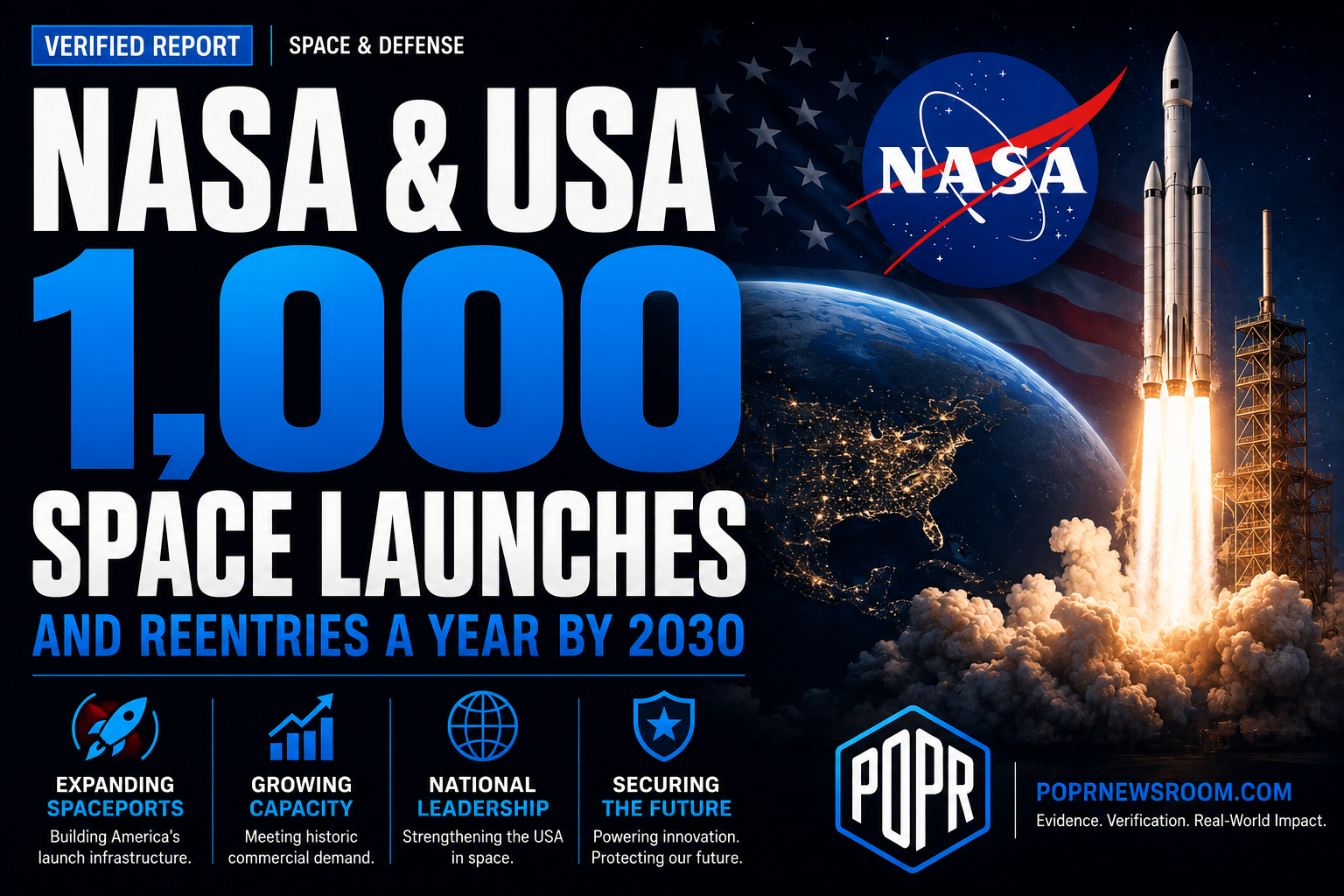
The White House has directed U.S. space transportation ranges to support more than 1,000 launches and reentries annually by 2030, making the physical capacity behind American spaceflight a near-term national policy question.
The August 20 National Space Transportation Policy is specific about the scale of the objective but should not be simplified into a goal for 1,000 commercial rocket launches. The target combines launches and reentries across government, national-security and commercial activity. It also directs federal agencies to address the infrastructure, commercial-access and reentry questions that come with substantially higher activity.
What is confirmed is that the existing system is already under pressure. NASA’s Office of Inspector General reported in June that Kennedy Space Center and Wallops Flight Facility are expected to operate near capacity in the 2028 to 2029 period under current launch projections. Kennedy and Cape Canaveral supported 109 launches in 2025, up from 31 in 2020, while the audit projects 268 launches there by 2030.
The constraints are not limited to launch pads. NASA documented higher heavy-truck traffic, more than $1 billion in identified Kennedy infrastructure needs, and a shared gaseous-nitrogen system that cannot simultaneously support certain high-flow operations. The audit also reported that commercial missions accounted for about 70 percent of NASA-supported launches since 2020, raising unresolved questions about how shared public and commercial infrastructure should be financed.
The policy gives reentry equal weight with launch activity. It calls for federal action on a designated reentry site, safety criteria and site-development planning. That matters because a higher-throughput space economy depends on recovery, range access, roads, utilities and scheduling as well as rockets.
It remains unclear how quickly the new federal targets will translate into funded construction, which facilities will absorb the greatest additional demand, and whether the government will change the rules that limit private participation in certain shared infrastructure investments. The policy identifies the direction. NASA’s audit shows why implementation will be difficult.
For the underlying evidence, context and the boundaries of what has not been established, read the full Deep Report below.