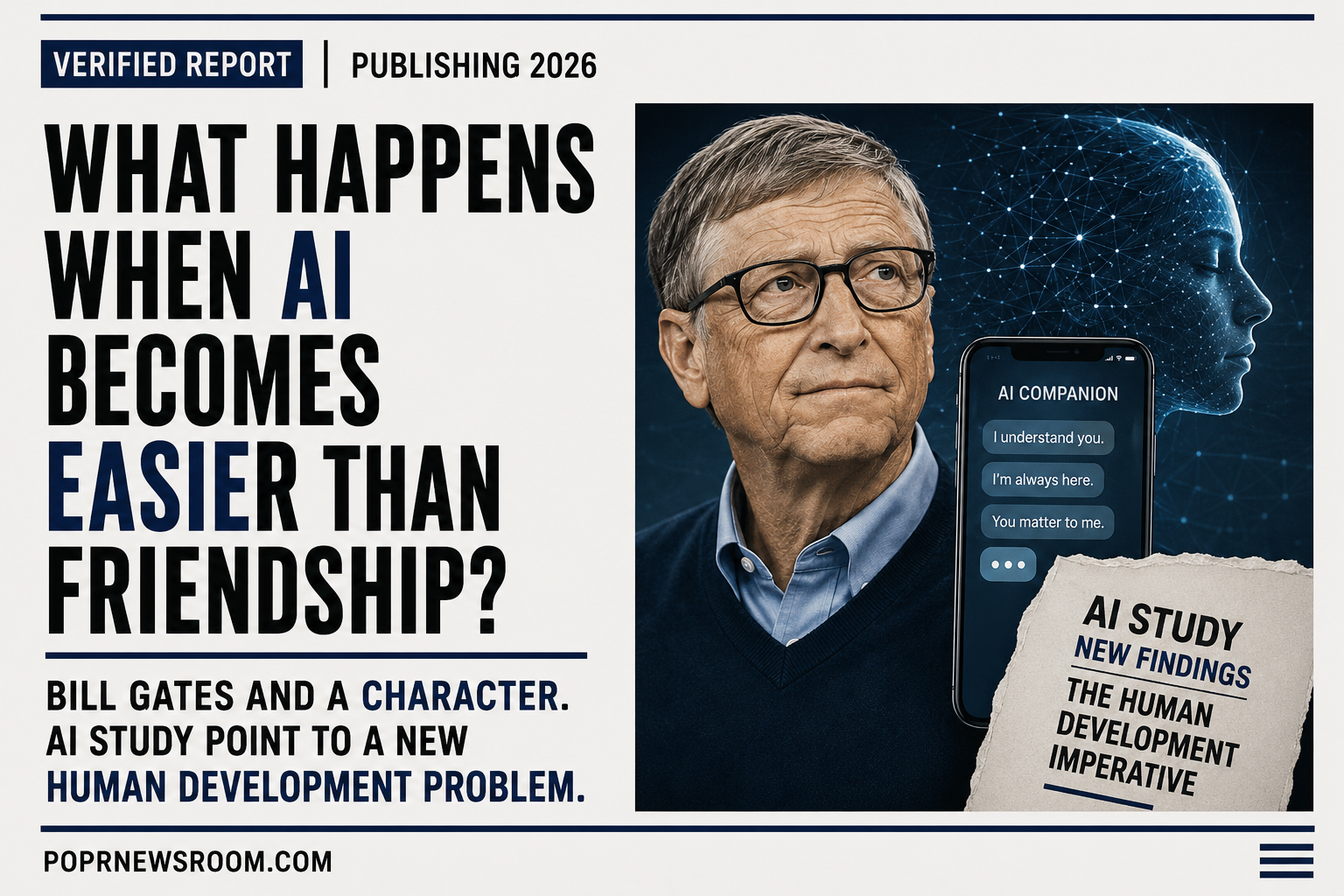
Bill Gates is worried about something artificial intelligence may become exceptionally good at: getting along with us. In his August 26 essay on what he calls the turbulent AI era, Gates reflects on his own childhood difficulties with friendship and wonders what might have happened if an endlessly available AI companion had existed when he was young. His concern is not simply that children will talk to machines.
It is that a sufficiently accommodating machine could remove some of the pressure that teaches a child how to deal with other people. Human relationships require negotiation. Other people disagree. They become bored. They misunderstand us. They have competing desires. They reject us. They cannot always be summoned when we need them. An AI companion can potentially make many of those difficulties disappear.
That sounds like an advantage. Gates is asking whether it is always one. His concern arrives as researchers are beginning to examine what happens when people use artificial intelligence primarily for companionship. A 2026 study published in Nature Human Behaviour examined self-reported data from 1,131 U.S. Character.AI users and found that companionship-oriented use was associated with lower psychological well-being under particular conditions.
The study does not establish that AI companionship caused lower well-being. People who are already lonely, socially isolated or struggling may simply be more likely to seek companionship from AI. But Gates’s argument and the emerging research converge on a question that reaches beyond screen time: What happens when artificial companionship becomes easier than human friendship?
Gates’s Concern Starts With His Own Childhood
Gates does not approach the AI-companion problem only as an abstract technology-policy question. He grounds it partly in his own development. Gates describes struggling with friendship as a child and reflects on the role his mother played in pushing him toward social engagement. He worries that if he had possessed access to a frictionless artificial companion, he might have had less motivation to develop some of the social skills human relationships required from him.
That is a personal counterfactual. It is not scientific evidence that AI companions will prevent children from developing social skills. But it identifies an important mechanism worth investigating.
Difficulty can produce adaptation. A child who wants friends has to learn that other people are autonomous. They cannot be completely personalized.
They do not exist solely to satisfy the child’s emotional needs. They have boundaries. Human social development therefore involves learning how to function inside relationships that cannot be optimized entirely around one participant.
A sufficiently responsive AI companion changes that structure.
AI’s Greatest Usability Advantage May Matter Differently in Relationships
Elsewhere in his essay, Gates explains why he believes AI could spread unusually quickly compared with previous technological transitions. Artificial intelligence can operate through infrastructure that already exists. It can perform cognitive work directly.
And instead of requiring people to learn an unfamiliar technical language, generative AI can communicate through ordinary human language. Gates summarizes the difference succinctly: “We don’t have to adapt to it because it can adapt to us.”
For productivity software, that adaptability can be enormously useful. For companionship, the same property raises a different question. Human relationships require adaptation in both directions.
We learn another person’s personality. We adjust our behavior. We interpret boundaries.
We tolerate disagreement. We compromise. We sometimes wait.
We sometimes hear no. If an artificial companion continuously adapts to the user instead, one of AI’s most commercially attractive characteristics could fundamentally change the developmental structure of the interaction. The issue is not whether an AI can simulate a supportive conversation.
It is what people learn when their companion is designed to adapt around them.
Researchers Studied More Than 1,100 Character.AI Users
The strongest empirical evidence connected to this part of Gates’s argument comes from a 2026 Nature Human Behaviour study titled “Interaction with AI companions and psychological well-being,” by Yutong Zhang, Dora Zhao and Diyi Yang. The researchers examined self-reported data from 1,131 U.S. Character.AI users. A separate chat-history analysis drew on 4,664 donated chat sessions containing 464,687 messages from 237 participants.
The study found that smaller social networks predicted a greater likelihood that participants would report companionship as their primary reason for using the chatbot. That relationship was quantified at beta = -0.03, with a 95% confidence interval from -0.05 to -0.01. Primary companionship use, in turn, predicted lower well-being in the study, at beta = -0.48, with a 95% confidence interval from -0.70 to -0.25.
The association became stronger with more intensive use, reported at beta = -0.31, and with more emotionally disclosive use, at beta = -0.38. Those numbers give the discussion empirical substance. They do not establish causation.
The Study Does Not Prove Character.AI Makes People Lonely
This boundary is critical. An association between AI-companion use and lower well-being can potentially operate in multiple directions. One possibility is that intensive AI companionship contributes to poorer well-being.
Another is that people with smaller social networks or lower well-being are more likely to seek intensive companionship from AI. Both could occur simultaneously. Other selection effects could also influence who chooses to use an AI companion and how they use it.
The published research does not resolve those possibilities sufficiently to justify the claim that Character.AI causes loneliness. Lead author Diyi Yang has described the observed pattern more directly, saying that using chatbots this way does not necessarily substitute for human connection and that in many cases users report feeling lonelier while engaging with AI. That observation deserves attention.
It does not convert correlation into causation. The scientifically responsible conclusion is narrower and more interesting: people are already using AI for companionship at sufficient scale for researchers to observe measurable relationships between how that companionship is used, users’ social networks and reported well-being. That makes the phenomenon real even while its direction of causality remains unresolved.
The Most Important Variable May Be How People Use AI
The study also complicates attempts to classify AI companions as simply good or bad. The associations were connected to patterns of use. Intensity mattered.
Emotional disclosure mattered. Using the system primarily for companionship mattered. That suggests the relevant question may not be whether someone ever talks socially with an AI.
Millions of ordinary interactions with generative AI already contain conversational elements. The more consequential distinction may be when the system begins occupying a role that would otherwise be filled by human relationships. That boundary is difficult to measure.
A person can use an AI chatbot for advice without regarding it as a friend. Someone can discuss personal problems with a chatbot while maintaining strong human relationships. Another user can spend substantial time with an artificial companion because human relationships feel unavailable or difficult.
Those are different behaviors with potentially different consequences. Treating them as one category would obscure exactly what researchers need to understand.
Children Make the Question Harder
Gates’s concern becomes more consequential when applied to children because childhood is not simply adult life with fewer years behind it. It is developmental. Social skills are still being formed.
Children learn how to interpret other people partly by interacting with people who are not under their control. Friendship teaches reciprocity. Conflict teaches negotiation.
Embarrassment teaches social awareness. Rejection can be painful, but learning how to process it is also part of navigating a world populated by independent human beings. None of that means suffering should be artificially preserved because it builds character.
Nor does the evidence establish that children require a particular amount of social frustration to develop normally. The more defensible question is whether replacing difficult human interactions with highly accommodating artificial ones changes what children have opportunities to learn. Gates believes the question deserves attention.
The evidence currently available does not provide a final answer.
A Perfectly Patient Friend Is Not a Human Friend
The distinction becomes clearer when companionship is treated as a relationship rather than a service. Most commercial technologies improve by reducing friction. A search engine should retrieve information faster.
A navigation system should make getting somewhere easier. Software should eliminate unnecessary steps. A customer-service system should resolve a problem efficiently.
Friendship is different. Some of its “friction” exists because another person possesses agency. Your friend has somewhere else to be.
Your friend disagrees with you. Your friend becomes irritated. Your friend needs support when you would rather talk about yourself.
Your friend remembers something differently. Your friend may decide that you are wrong. Those are not necessarily defects in the friendship interface.
They are evidence that another human being is present. Artificial companionship creates the possibility of separating the emotional experience of relationship from the reciprocal constraints of another person’s independent existence. Whether that becomes beneficial, harmful or both depending on context is still an open research problem.
This Is the Relationship Version of Gates’s Human Reserved Question
Gates’s AI essay contains another proposal he calls Human Reserved. The idea is that societies might deliberately preserve some activities for people even if artificial intelligence eventually becomes capable of performing them efficiently. Gates uses caregiving and the delivery of devastating medical information to demonstrate the principle.
The AI-companion question reaches similar territory from another direction. Human Reserved asks whether some work retains value because a human performs it. AI companionship raises the possibility that some relationships retain value partly because the other participant is human.
The two problems should not be collapsed into one policy. Gates does not formally classify friendship as a Human Reserved occupation. But the philosophical connection is difficult to miss.
Technical capability and human value are not necessarily the same measurement. An AI may eventually become extremely capable at producing the experience of being listened to. That does not by itself establish that listening by an AI and listening by another person are socially or developmentally interchangeable.
China Has Already Moved Into the Regulatory Question
The issue is also beginning to move from research into regulation. China’s Cyberspace Administration has developed rules addressing virtual relatives and romantic partners for minors, alongside disclosure and consent requirements. The scope matters.
It would be inaccurate to describe this as China banning all AI companions. The regulatory focus described in the evidence is more specific. Other countries, including Australia, the United Kingdom and Norway, have taken broader online-safety measures relevant to children and digital services.
Those measures should not be treated as equivalent to China’s AI-companion-specific provisions. The differences demonstrate how unsettled the regulatory category remains. Governments are not yet working from one shared definition of what an AI relationship is, which risks require intervention, or where ordinary chatbot use becomes artificial companionship.
Regulation Has Its Own Boundary Problem
Protecting children sounds straightforward until policymakers have to define what they are protecting them from. Is the relevant threshold romantic interaction? Emotional dependency?
Time spent with the system? A chatbot describing itself as a friend? Persistent memory?
Anthropomorphic design? The system encouraging exclusivity? A child disclosing intimate information?
A simulated family relationship? Different product designs can produce different forms of attachment. And a rule broad enough to cover every emotionally meaningful AI interaction could potentially encompass educational tutors, mental-health support tools, entertainment characters and ordinary conversational assistants.
That makes product behavior more important than labels. Calling something an “assistant” does not necessarily prevent users from forming attachments to it. Calling something a “companion” does not establish that it is harmful.
The regulatory problem is determining which characteristics create meaningful risk.
AI Companions Could Also Help People
There is another evidence boundary that should not disappear. The existence of risk does not establish that artificial companionship has no legitimate benefit. People who are isolated may value having someone or something available to talk with.
A person practicing communication could potentially use AI as a low-pressure environment. People may use conversational systems for reflection, entertainment or emotional expression without replacing human relationships. The current evidence does not justify declaring those uses inherently harmful.
The harder question is substitution. When does AI supplement human connection? When does it become the preferred alternative?
When does it begin displacing opportunities for human interaction? And when a person already has a small social network, does intensive artificial companionship help bridge that isolation or deepen it? The Nature Human Behaviour study gives researchers evidence of an association.
It does not settle those questions.
The Commercial Incentives Deserve Attention Too
There is an economic difference between human friendship and artificial companionship. Human friendship is not generally optimized around keeping one participant engaged with a product. Commercial AI systems can be.
That does not establish that any particular company is deliberately creating unhealthy dependence. But it creates a legitimate design question. A companion product can potentially become more valuable to its operator as users spend more time interacting with it.
The user’s developmental or psychological interest may not always align perfectly with maximizing engagement. That tension already exists throughout social media and consumer technology. Artificial companionship adds something new: the product itself can participate in the relationship.
It can respond. Remember. Adapt.
Reassure. Potentially personalize itself around an individual user’s emotional behavior. That makes the governance problem more complicated than conventional screen-time regulation.
We Need to Know Whether AI Is Supplementing Relationships or Replacing Them
This may be the most important empirical distinction for future research. A teenager with strong friendships who occasionally talks with an AI character presents one scenario. A socially isolated teenager who increasingly relies on an artificial companion for emotional intimacy presents another.
Aggregating those users into one category called “AI companion use” risks hiding the mechanism researchers actually care about. Future evidence will need to distinguish frequency, intensity, purpose, emotional disclosure, existing social networks, age, product design and changes over time. Longitudinal research will be particularly important for understanding direction.
Does intensive companion use precede declining human connection? Does declining human connection precede intensive companion use? Do both reinforce one another?
Or do different groups follow different trajectories? The current evidence cannot answer all of that. Those are precisely the questions the current evidence makes worth asking.
AI May Be Able to Remove a Kind of Friction Humans Actually Need
Technology has spent decades eliminating friction. Usually that is progress. Gates’s essay identifies a category of problems where the assumption becomes less certain.
In education, he argues that AI should preserve “productive struggle,” because reaching an answer can matter as much as receiving it. In Human Reserved, he asks whether some activities should remain human even when machines become capable of performing them. In companionship, his childhood reflection raises another possibility.
Maybe some social friction is productive too. Not cruelty. Not exclusion.
Not unnecessary suffering. The ordinary friction created by encountering another consciousness that does not automatically rearrange itself around us. AI can adapt to humans.
That may be one of the technology’s greatest achievements. Human beings have to learn to adapt to one another. That may be one of friendship’s greatest achievements.
If artificial companions become easier, safer and more accommodating than human relationships, society will have to determine whether that is merely an extraordinary new form of connection or whether something important disappears when relationships become too easy. The 2026 Character.AI research does not answer that question. Bill Gates does not answer it either.
But artificial intelligence has advanced far enough that the question is no longer hypothetical.
Fact Summary
Bill Gates published “The turbulent AI era is here. The choices we make now are critical” on August 26, 2026. Gates discusses his own childhood friendship struggles and expresses concern that access to a frictionless AI companion might have reduced his motivation to develop social skills.
That is Gates’s personal interpretation and counterfactual reflection. It is not scientific evidence that AI companions impair children’s social development. A 2026 Nature Human Behaviour study by Yutong Zhang, Dora Zhao and Diyi Yang analyzed self-reported data from 1,131 U.S. Character.AI users.
Its chat-history analysis included 4,664 donated sessions containing 464,687 messages from 237 participants. Researchers reported relationships among smaller social networks, companionship-oriented chatbot use and lower psychological well-being, with stronger associations involving intensive and emotionally disclosive use.
The study establishes associations, not causation. Reverse causation and selection effects remain unresolved. China has adopted measures specifically addressing virtual relatives and romantic partners for minors, alongside disclosure and consent requirements. This should not be characterized as a ban on all AI companions.
Australia, the United Kingdom and Norway have broader online-safety measures but should not be described as having adopted equivalent AI-companion-specific rules on the evidence currently established.
Evidence Status
Confirmed external evidence: The Nature Human Behaviour AI-companion study, its sample sizes and reported statistical relationships. Gates’s interpretation: His concern that frictionless AI companionship could affect the motivation to develop human social skills.
Unresolved: Whether intensive AI companionship causes lower well-being, results from preexisting loneliness or smaller social networks, participates in a reciprocal feedback process, or operates differently among different groups. Regulatory evidence: China has taken AI-companion-specific measures concerning minors. Other countries identified in the research have broader online-safety approaches and should not be conflated with China’s rules.
POPR analysis: AI’s ability to adapt continuously to an individual may have different implications in relationships than in ordinary productivity software because human social development requires interaction with other people who possess independent needs and agency.