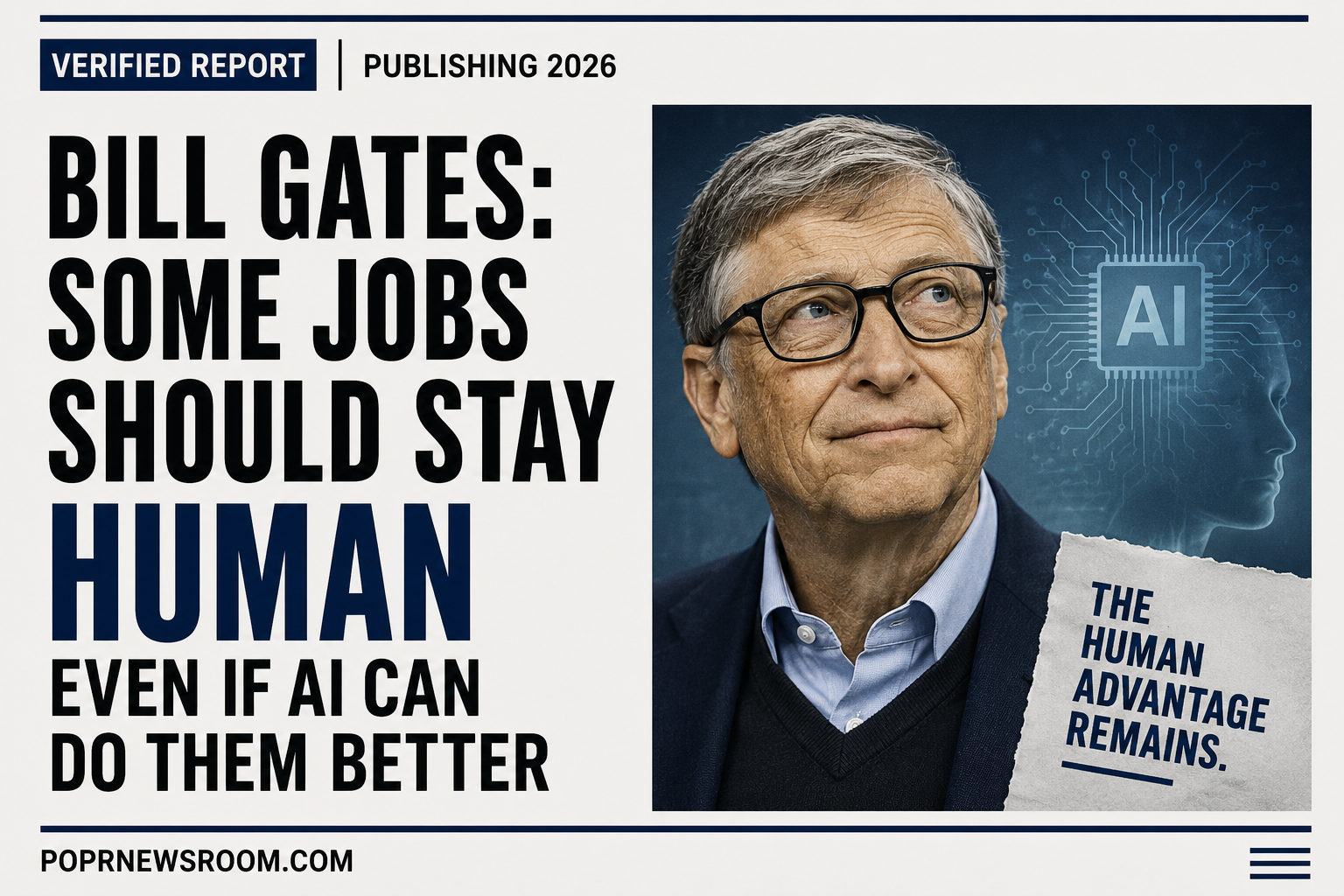
Bill Gates is asking a different question about artificial intelligence. Not what AI will eventually be able to do. What humans should still be allowed to do after AI can do it.
In a roughly 6,000-word essay published August 26, Gates argues that increasingly capable artificial intelligence could bring extraordinary benefits while simultaneously creating labor disruption, security threats, social risks and governance problems that existing institutions are not prepared to manage. Buried inside that much larger argument is an idea Gates says he has “started calling” Human Reserved. The premise is deceptively simple.
Some activities may be valuable precisely because another human being performs them. If AI becomes cheaper, faster, more knowledgeable or technically superior at those activities, Gates argues, society should at least consider deliberately preserving some of them for people. That is not a forecast about what markets will naturally do. It is a proposal about what markets perhaps should not be permitted to decide by efficiency alone.
Gates grounds the idea in intensely personal territory, including his father’s final years and the human meaning of caregiving. He also uses a terminal medical diagnosis to expose the problem at its hardest edge: even if an AI system eventually becomes better at delivering medical information, would a person want the worst news of their life delivered by a machine? The proposal raises an enormous unresolved question. If artificial intelligence eventually becomes capable of doing work that humans once believed required uniquely human judgment, knowledge or communication, is capability sufficient reason to automate it?
Gates’s answer is no.
What Does Bill Gates Mean by “Human Reserved”?
Human Reserved is not a claim that AI will never become capable of certain work. It starts from almost the opposite assumption. Gates is contemplating a future in which AI can perform increasingly sophisticated cognitive tasks and may eventually equal or exceed human performance in activities society currently treats as distinctly human.
Under a conventional economic model, that capability creates a powerful incentive to automate. If a machine can perform a task more cheaply, reliably or efficiently, organizations have reasons to use it. Human Reserved introduces another variable. Human participation itself can have value.
That means the relevant question is no longer simply whether AI can perform the task. It becomes whether society wants the task performed without a human. The difference is fundamental.
A protected human role under this framework would not necessarily exist because machines had failed to master it. It could exist because society had decided that human presence, responsibility, empathy, accountability or relationship remained part of the value being delivered. Gates does not provide a complete list of occupations that should receive this protection. He explicitly leaves important questions unresolved.
That makes Human Reserved more of a proposed governing principle than a finished policy system.
Gates Uses His Father’s Care to Explain What Efficiency Cannot Measure
The emotional center of Gates’s argument comes from his own family. His father, William H. Gates Sr., died in 2020 after living with Alzheimer’s disease. Gates uses the experience of caregiving to illustrate why measuring a service solely through output can miss something important.
Care is not simply a sequence of physical or cognitive tasks. Helping someone eat, move, remember, communicate or navigate illness can certainly be described as work. Those functions can therefore be evaluated for efficiency, cost and potentially automation. But that description does not capture the entire relationship.
Human care can communicate recognition. It can carry affection. It can provide companionship.
It can preserve the feeling that another person has chosen to be present. If a machine eventually becomes technically excellent at the functional components of caregiving, the technological achievement would not by itself answer whether replacing human caregivers is desirable. Human Reserved is Gates’s attempt to give that unresolved value a name.
Would You Want an AI to Tell You That You Are Dying?
Gates pushes the idea into medicine with an even sharper example. Imagine an artificial intelligence system capable of analyzing a patient’s condition accurately and communicating a diagnosis. Now imagine that the diagnosis is terminal.
The technical question might eventually become straightforward: can the AI understand the medical evidence and communicate it correctly? Human Reserved asks something else. Should that conversation belong to a machine?
There is no universal answer embedded in Gates’s essay. Some patients might prefer an extraordinarily capable AI system. Others might insist that certain moments in medicine require another human being regardless of whether a machine could technically deliver the same information. That distinction becomes increasingly important as AI improves.
Many debates about automation implicitly assume that human work survives because machines remain incapable of replacing it. Gates is considering what happens after that defense disappears. If AI becomes capable enough, society may have to defend human participation on grounds other than technical superiority.
Human Reserved Is Really a Challenge to Efficiency as the Final Measure of Progress
The deepest implication of Gates’s proposal extends beyond any single profession. Industrial and technological progress has repeatedly been associated with finding faster, cheaper and more productive ways to perform work. AI intensifies that logic because it targets cognition itself.
Gates argues that this transition differs from earlier technological shifts in several important respects. AI can substitute directly for cognitive work, can run on technological infrastructure that already exists, and communicates through natural language.
As Gates puts it:
“We don’t have to adapt to it because it can adapt to us.”
If that assessment proves broadly correct, the friction that slowed earlier technological adoption could be substantially lower. The consequence is not merely that AI could automate more work. It could make automation possible in areas where the primary obstacle was previously the need for human reasoning, communication or judgment.
Human Reserved is therefore a proposal for a boundary that technological capability alone cannot establish. It says that efficiency may be an important measure of progress without being the only measure.
This Is Not the Same as Saying Humans Will Always Be Better
There is an important distinction in Gates’s argument. Human Reserved should not be confused with claims that humans possess permanent abilities machines can never reproduce. That would make the framework dependent on predicting the limits of artificial intelligence.
Gates is proposing something more durable. Even if AI becomes capable of performing an activity, humans could decide that some roles should remain human anyway. That transforms the question from engineering into governance.
A society does not need to prove that machines are incapable of performing an activity before deciding that machines should not exclusively perform it. Societies already place restrictions around professions, responsibilities and decisions for reasons that extend beyond raw productive efficiency. But the evidence assembled for this report does not establish that Gates invented the underlying concept of protecting human roles from automation.
That historical question remains open. Gates clearly says he has “started calling” the concept Human Reserved. That establishes his terminology. It does not establish that no philosopher, economist, labor scholar, regulator or previous legal framework has articulated a substantially similar principle.
Calling the underlying idea historically unprecedented would therefore go beyond the current evidence.
Human Reserved Could Become More Important as AI Gets Better
There is a paradox inside the proposal. Human Reserved becomes less necessary if AI remains limited. If machines cannot perform highly sensitive human work, technological limitations preserve those jobs automatically.
The framework becomes consequential precisely if AI succeeds. The more capable artificial intelligence becomes, the more society may have to decide whether capability should translate directly into substitution. That distinction could eventually reach far beyond caregiving.
Gates’s essay discusses AI pressure across sales, customer support, paralegal work, loan assessment, data analysis, medical triage and software engineering, while also anticipating competition from physical robotics in fields including construction and hospitality by the end of the decade. He does not place all of those occupations inside Human Reserved. Nor does the essay provide evidence that all of them should be protected.
They demonstrate the scale of the larger problem. As the frontier of technically automatable work expands, the boundary between what can be automated and what should be automated becomes more consequential.
Gates Is Not Calling for AI Development to Stop
Human Reserved can also be misunderstood if separated from the rest of Gates’s essay. Gates is not presenting AI primarily as a technology that should be halted. His argument combines high expectations for AI’s capabilities and benefits with serious concern about disruption and inadequate governance.
He points to existing and potential applications in medicine, agriculture, government services and education. One example is Viz.ai, which Gates says is used in nearly 2,000 hospitals for stroke and emergency detection. He identifies agriculture as his personal choice for where AI could produce especially rapid benefits in low-income countries.
In education, his argument is not simply to give students better automated answers. He emphasizes preserving “productive struggle,” the cognitive work involved in reaching an answer rather than merely receiving one. That educational principle resembles the tension inside Human Reserved. The optimal technological outcome may not always be the one that removes the most human effort.
Sometimes the effort is part of the value.
Human Reserved Raises a Labor Question Gates Has Not Solved
Preserving human work sounds considerably easier in principle than in implementation. Who decides which occupations qualify? Would governments designate protected professions?
Would employers be required to retain humans in particular roles? Would consumers choose? Would protection apply to an entire occupation or only sensitive tasks within it?
How would society respond if human-delivered services became considerably more expensive than automated alternatives? And perhaps most importantly, who pays for preserving human participation when automation is economically superior? The evidence available here does not provide settled answers.
Gates does not present Human Reserved as enacted law or a fully specified regulatory program. That incompleteness is important. The framework identifies a problem before it provides an administrative solution.
There Is Also a Question of Choice
Protecting human work can sound inherently humane. It can also become paternalistic if implemented carelessly. If an AI physician eventually becomes demonstrably better at certain forms of diagnosis, should a patient be prevented from choosing it?
If an older person prefers an AI companion or robotic caregiver, should public policy override that preference in order to preserve human employment? If AI tutoring becomes more effective for some students, where should “productive struggle” end and unnecessary difficulty begin? Human Reserved cannot resolve these problems simply by privileging humans.
It would have to distinguish between protecting human participation and restricting human choice. Gates’s essay opens that debate rather than closes it.
AI Companions Show Why the Human Question Is Already Becoming Real
One of the strongest pieces of external research connected to Gates’s broader argument concerns AI companionship. A 2026 study published in Nature Human Behaviour examined self-reported data from 1,131 U.S. Character.AI users. Researchers also analyzed 4,664 donated chat sessions containing 464,687 messages from 237 participants.
The researchers found that smaller social networks predicted a greater likelihood of reporting companionship as the primary use for the chatbot. That use was, in turn, associated with lower psychological well-being, with the association becoming stronger among more intensive and emotionally disclosive users. The study does not establish that AI companions caused lower well-being. Reverse causation remains possible. People experiencing loneliness or reduced well-being may be more likely to seek intensive AI companionship in the first place.
That boundary matters. But the association is relevant to Gates’s larger concern because it shows that the human-substitution question is no longer confined to factories and office work. Artificial intelligence is entering relationships.
Gates connects this issue to his own childhood. He describes struggling with friendship and social development and worries that access to a frictionless AI companion could have removed some of the pressure that forced him to develop human social skills. Whether that concern generalizes to other children is a separate empirical question. The underlying dilemma is already visible.
Technology can remove friction. Human development sometimes requires it.
The Real AI Scarcity May Eventually Be Human Beings
For decades, technology markets have been organized around technological scarcity. Computing was expensive. Software was difficult to create. Expertise was limited. Information was difficult to retrieve. Skilled cognitive labor was costly. Generative AI is attacking several of those scarcities simultaneously.
If cognition, analysis, explanation, software production and increasingly sophisticated communication become abundant, something unusual happens. The scarce component of a service may eventually be the human being. A human teacher.
A human physician. A human caregiver. A human counselor.
A human creator. A human being willing to spend time with another human being. That conclusion is not a forecast Gates establishes empirically in his essay. It is an implication of the Human Reserved problem.
And it may be the most commercially and socially important question his essay raises. The AI economy is overwhelmingly focused on making machine intelligence more abundant. Human Reserved asks whether the next premium resource could be authentic human participation.
The Question Is No Longer Just What AI Can Do
Most AI benchmarks move in one direction. Can the model reason better? Can it code better?
Can it diagnose better? Can it operate autonomously? Can it communicate more naturally?
Can it replace a larger portion of human work? Those questions matter. But none tells society what to do when the answer becomes yes.
Human Reserved introduces a different benchmark. What do we value enough to keep human? Gates does not have a complete answer.
Neither does the evidence examined for this report. That uncertainty is not a weakness in the question. It is the reason the question matters now. Artificial intelligence does not need to become universally superior to humans before societies confront it. It only needs to become good enough, cheap enough and available enough that substitution becomes economically attractive.
At that point, refusing automation will itself become a choice. Gates has given that choice a name. Whether Human Reserved becomes a serious policy framework, remains a philosophical concept, or eventually acquires another name is unresolved.
But the boundary it describes is becoming increasingly difficult to avoid: There is a difference between work that requires a human because AI cannot do it and work we choose to keep human even after AI can. That may be one of the defining distinctions of the AI era.
Fact Summary
Bill Gates published “The turbulent AI era is here. The choices we make now are critical” on August 26, 2026. Gates describes a concept he has “started calling” Human Reserved, under which society could deliberately preserve certain activities for humans even as artificial intelligence becomes capable of performing them.
He grounds the concept partly in his father’s experience with Alzheimer’s disease and uses the delivery of a terminal medical diagnosis as another example of work where human presence may carry value beyond technical performance. Human Reserved is a proposal, not enacted law.
The available evidence establishes that Gates is using the term. It does not establish that the underlying concept of legally or socially protecting human roles from automation is historically unprecedented. Gates’s larger essay is neither a call to stop AI development nor a claim that AI is purely beneficial. It combines substantial expectations for AI’s benefits with concerns about labor displacement, harmful uses, relationships, children and inadequate governance.
A 2026 Nature Human Behaviour study involving 1,131 U.S. Character.AI users found an association between AI-companion use and lower psychological well-being under particular conditions. The study does not establish that AI companionship caused those outcomes.
Evidence Status
Confirmed external evidence: Gates’s essay and its stated proposals; the published Nature Human Behaviour AI-companion study and its reported associations. Gates’s interpretation: His assessment that AI differs materially from previous technological transitions, his expectations regarding affected occupations, and his argument for preserving some human roles.
Forecast: Predictions about the eventual scale, speed and occupational consequences of increasingly capable AI remain forecasts rather than established outcomes. Policy proposal: Human Reserved is a proposed framework. It is not an existing general legal category and should not be described as enacted policy.
Open question: Whether Human Reserved represents a historically new policy concept or Gates’s new terminology for principles with meaningful precedent in existing professional regulation, labor policy or automation ethics remains unresolved by the current evidence.