EDITORIAL DISCLOSURE: The subject of this report is an external product with which POPR Newsroom has a commercial relationship. POPR Technologies uses Kling AI in its own production workflow and reports from that first-party experience. POPR is a paying customer and referral participant. This is promotional affiliate-supported editorial, not independent third-party validation, and our conclusions remain our own.
AFFILIATE DISCLOSURE: POPR Newsroom may earn a commission if you purchase, subscribe, or sign up through certain links in this article. Affiliate relationships do not determine which products we cover or our findings, ratings, comparisons, or editorial conclusions.
COMMERCIAL RELATIONSHIP DISCLOSURE: POPR is proud to use Kling as a production tool and to participate in its referral program. We are not claiming that Kling or Kuaishou formally partners with, sponsors, endorses, or advertises through POPR. This article contains no paid placement or outside advertiser relationship. It is intentionally promotional because POPR is showing a tool it uses and wants readers to try, while keeping the limits and uncertainties visible.
Try Kling With POPR's Referral Code
If you want to test the workflow described here, visit the official Kling AI site and enter POPR's referral code: 7B7BDSZ8CDD5. The dated POPR account terms recorded in August 2026 stated that a qualifying new paid subscriber could receive 10 percent extra credits in the first month, capped at 1,500 bonus credits, while POPR could receive Kling credits. Check the current offer before subscribing because referral terms, prices and benefits can change.
This referral callout is part of the article, not a hidden footer disclosure. POPR may benefit if you subscribe through the code. You may receive the stated introductory credit bonus if the current Kling offer still applies. Our editorial conclusions are our own.
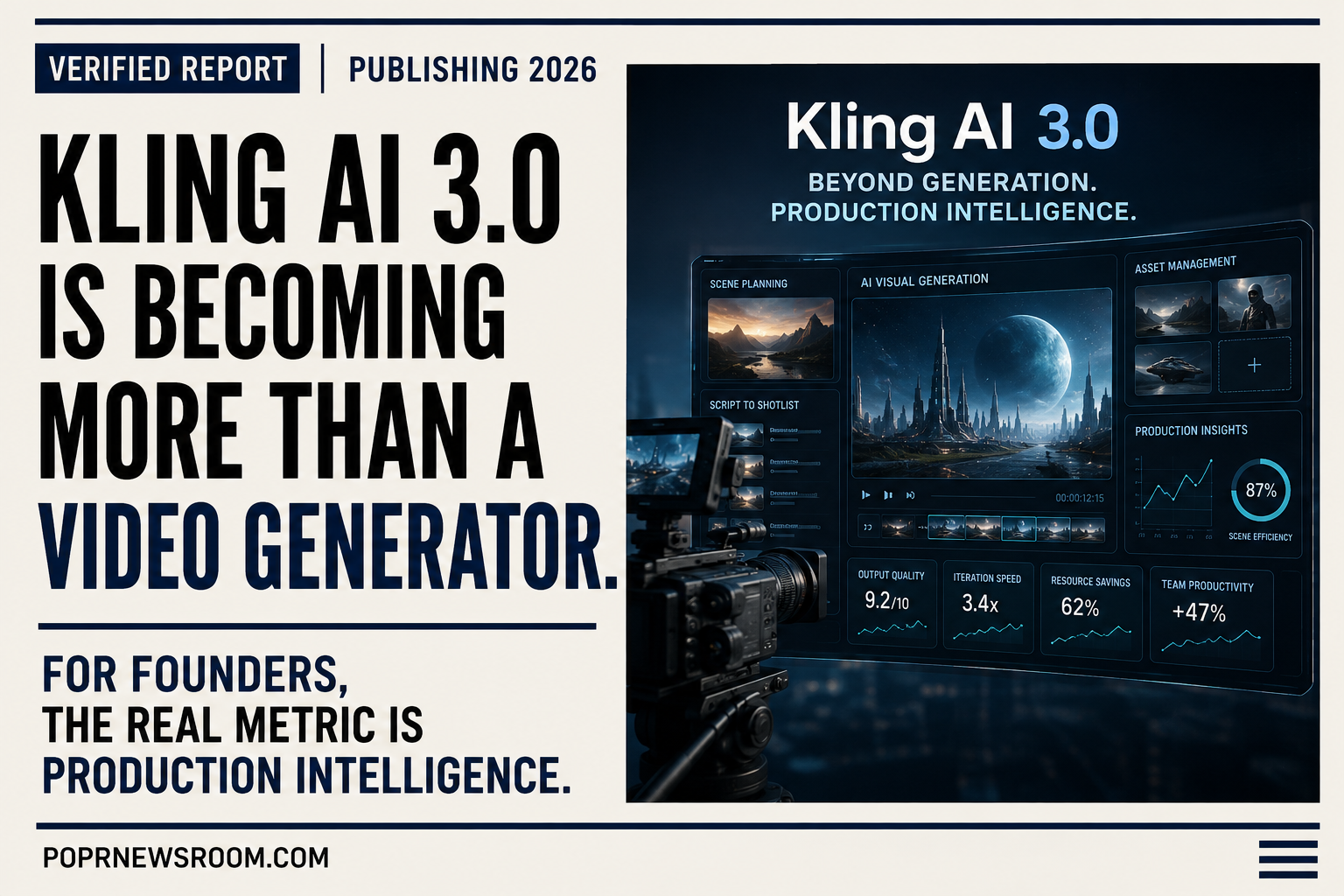
Kling 3.0 Omni is becoming a candidate home base for a small AI cinema operation because it combines reusable character and voice references, shot-level direction, native audio, image generation, editing, higher-resolution output and new agent-orchestration paths in one platform. POPR's firsthand experience building Meta Tron World suggests the practical opportunity is not one impressive clip. It is a repeatable workflow that protects identity, controls iteration cost and still leaves room for human direction and post-production.
What Is the Real Kling 3.0 Omni Story?
The crowded version of the story is that Kling makes good AI video. The more useful version is operational. A creator who wants to make a sequence, campaign or cinematic world has to solve continuity, voice, framing, audio, reference selection, retries, resolution, asset management and cost.
Kuaishou officially launched Video 3.0 Omni as part of the Kling 3.0 family on February 5, 2026. Kuaishou describes 3.0 as an all-in-one framework spanning text, image, audio and video. The documented architecture includes video understanding, generation and editing, with text-to-video, image-to-video, reference-to-video and in-video editing paths.
That does not make Kling objectively the best AI video platform. “Home base” is POPR's operational recommendation based on the concentration of features in the workflow we are building. It is not a Kuaishou product category or an independent industry ranking.
Why Is Character Continuity the Hardest Problem?
The failure point in a longer AI-video project is usually not a single ugly generation. It is the tenth generation looking like a different character than the first. Faces drift, wardrobe changes, rooms rearrange themselves and voices stop matching. A model can produce a strong isolated shot while failing to preserve the identity that makes a story recognizable.
Kling 3.0 Omni's response is its Element and reference system. Creators can define reusable characters, products, items, animals and other recurring subjects. Supported character Elements can also carry voice identity. A creator can build an Element from multiple still angles or from a short video in which Omni extracts appearance and voice characteristics.
The point is to make identity live in a reusable asset instead of re-describing the character from scratch in every prompt. Kling also documents binding up to three Elements in supported start-frame and start-end-frame workflows, which can allow a shot to carry a character, prop and location reference together.
POPR's production hierarchy is:
- Canon character asset.
- Clean multi-angle or video Element.
- Bound voice when the scene needs it.
- Shot-specific prompt.
- Camera, performance and dialogue direction.
- Review for drift.
- Approved output.
This does not solve continuity. It gives the director a real lever to fight for it. Our Meta Tron World experiments still require review, retries and disciplined reference management. Reference systems reduce a class of failures; they do not abolish generated-video drift.
How Many References Can Omni Accept?
Kling's current Video 3.0 Omni guide gives workflow-specific limits rather than one universal reference count. Without video input, the guide states that creators can supply up to seven images or Elements. With video input, the guide states that one video may be supplied and total image or Element inputs are capped at four.
The same guide lists image inputs of at least 300 pixels in width and height, a maximum file size of 10 MB per image and JPG, JPEG or PNG formats. Video input is documented as one three-to-ten-second video with a maximum size of 200 MB and resolution up to 2K. Kling documents a three-to-eight-second single-character video workflow for a video Character Element.
For voice binding, Kling's guide recommends a five-to-30-second single-person speech sample with a clean background, moderate speaking speed and a consistent voice, emotion and style. These are current documented workflow instructions, not guarantees that every reference package will produce a usable character.
Why Should Directors Think in Beats Instead of Movies?
Omni supports Multi-Shot generation, and Custom Multi-Shot lets a creator specify shot by shot: duration, shot size, perspective, narrative content and camera movement. Kling's examples include wide establishing shots, close-ups, medium shots, shot-reverse-shot dialogue, cross-cutting, voice-over, push-ins and tracking shots.
The common mistake is to ask the model to “make a movie.” That gives the system too much responsibility at once. POPR's rule is to break the movie into beats first. For each beat, define who is present, what must stay canonically fixed, what changes visibly, who speaks, what sound exists, where the camera begins, how the camera moves and where the shot ends.
The three-to-15-second generation window works better as a story-beat container than as an instruction to always use 15 seconds. Kling's own guidance says that a focused six-second shot can be more efficient than an unfocused 15-second scene. A short approved beat also gives the director a smaller unit to review before credits multiply across a sequence.
POPR is applying this discipline to a one-scene continuous-shot film inside Meta Tron World. The working concept locks one character, one room and one camera idea, then uses beat structure rather than raw duration to guide the production.
What Does Native Audio Actually Add?
Kling 3.0 supports native dialogue, sound effects, ambience and synchronized lip movement in supported workflows. The 3.0 series documents Chinese, English, Japanese, Korean and Spanish, along with dialect and accent support. Kling recommends specifying the speaker, the line, the language and the delivery or tone.
POPR's finding is narrower than a claim that native audio always works. Native sound can be valuable when environmental audio and spoken dialogue are part of the scene. It is less reliable when exact typography, captions, URLs or a precise call to action are required. Kling handles picture, motion and scene sound where the output earns that role. Deterministic post-production handles exact text, brand marks, captions, music timing and other elements that must be pixel-perfect.
This division of labor is not a rejection of Kling. It is a production assignment. A feature being available does not mean every project should give that feature control of the final asset.
How Much Does an Omni Shot Cost?
The current no-video-input rates independently re-verified against Kling's published cost guide on September 14, 2026 are:
| Setting | Credits per second |
|---|---|
| 720p, native audio off | 6 |
| 720p, native audio on | 9 |
| 1080p, native audio off | 8 |
| 1080p, native audio on | 12 |
That makes a five-second 720p silent test 30 credits. A 10-second 720p silent generation is 60 credits. A 15-second 720p silent generation is 90 credits. A five-second 1080p generation with native audio is 60 credits, while a 15-second version is 180 credits.
Kling's guide lists higher rates when video input is used: 12 credits per second at 720p and 16 credits per second at 1080p. Native audio with video input is listed as not supported in the current guide. Those with-video-input figures were sourced from the current guide but not independently rechecked by Clark on September 14.
These are generation-cost calculations, not the cost of a finished film. A serious budget must reserve credits for prompt tests, reference tests, failed generations, continuity corrections, dialogue retries, camera corrections and final-quality passes.
How Can a Small Creator Avoid Burning Credits?
The cheapest generation is the generation that does not have to be redone. POPR's low-cost Omni doctrine is:
- Lock the story and dialogue before rendering.
- Lock the character reference before spending on motion.
- Test at 720p unless a higher resolution is genuinely needed.
- Keep native audio off while debugging framing and motion.
- Use short test beats instead of spending on unfocused long scenes.
- Escalate only the shot that has already been approved.
- Treat native 4K as a finishing path, not an iteration format.
- Finish exact typography, URLs and calls to action in post.
Audio raises the no-video-input rate from six to nine credits per second at 720p and from eight to 12 at 1080p. A 15-second 1080p native-audio generation costs six times as much as a five-second 720p silent generation before retries. The difference is large enough to make a staged workflow part of the creative process, not merely an accounting preference.
What Do Kling's Paid Plans Mean for a Small Operation?
Kling's July 28 first-party credit guide recorded the following visible membership structure:
| Plan | Visible first-subscription offer | Listed monthly credits | Listed next renewal |
|---|---|---|---|
| Standard | $6.99 per month | 660 | $8.80 |
| Pro | $25.99 per month | 3,000 | $32.56 |
| Premier | $64.99 per month | 8,000 | $80.96 |
| Ultra | $127.99 per month | 26,000 | $159.99 |
The guide listed commercial-use outputs as included on those paid tiers and listed basic or free access as non-commercial. It also listed 1080p generation, watermark removal, image upscaling and video extension among paid-plan benefits, with priority access to new features on some higher tiers.
These prices and benefits are time-sensitive. They were sourced to Kling's July 28 guide and were not independently rechecked in the September 14 verification pass. Check the live membership panel before relying on any price, allowance, commercial-use condition or renewal amount.
At the documented rates, a 660-credit Standard allowance could theoretically produce about 22 five-second 720p silent generations or 11 10-second 720p silent generations if every credit were devoted to that one configuration and there were no retries or other use. A 3,000-credit Pro allowance could theoretically produce about 50 10-second 720p silent generations under the same unrealistic conditions.
Those are raw-generation ceilings, not finished-video counts. Production budgets must include the shots that fail, the references that need rebuilding and the approved outputs that require higher-resolution or audio passes.
What Does Image 3.0 Omni Add?
Kling's 3.0 family also includes a connected still-image layer. First-party documentation describes Image Series Mode for coherent narrative image sequences, text-to-image series, image-to-image series, multi-image-to-image series and batch or coherent scene work. Kuaishou's 3.0 launch materials describe Image 3.0 and Image Omni as supporting 2K and 4K output.
That creates a possible path from concept to character to storyboard still to video to audio to editing and iteration inside one platform. It reduces the number of separate generative environments a small operation needs to coordinate. It does not remove the need for a human to choose references, reject drift and finish the work.
Does Native 4K Make Kling Professional?
Native 4K is a meaningful positioning signal because Kuaishou describes direct 4K output for professional use. Resolution alone does not make a production system professional. Professional work also requires control, reliability, consistency, color and sound workflows, asset management, editing and delivery standards.
POPR's position is to use 4K where the final exhibition or detail requirement warrants it, not as the default format for discovering whether a shot works. The higher-resolution path can be valuable at the end of a successful iteration. It is a poor substitute for solving identity, action, framing or text problems at the beginning.
What Are MCP and CLI Supposed to Change?
Kling and Kuaishou now document MCP and CLI tooling that can let compatible AI agents organize and batch Kling generation work, track tasks and retrieve results. Kuaishou's second-quarter results confirm that MCP and CLI were launched to let AI agents orchestrate Kling for batch content creation.
That changes the architectural possibility. A production workflow could prepare a creative brief, select approved references, organize prompts, request controlled variations, track tasks and pass selected outputs into later editing stages. The human still decides what gets approved and scaled.
POPR has not run its own Kling MCP or CLI production workflow. We cannot yet report reliability, failure rate, human intervention, credit behavior or usable-output rate from firsthand testing. Automation can reduce repetitive setup, but it can also multiply credit consumption if tasks are submitted without human approval and budget controls.
See the Real POPR Example
We are using Kling inside the production lane for Meta Tron World, POPR's live creative website and cinematic universe. The site is the real public destination for the video and story work referenced in this report. It is not a claim that Kling autonomously created Meta Tron World. The workflow remains human-directed around story, canon, character references, concept art, keyframes, motion, sound, music, editing and publication.
The important example is not a single showcase clip detached from a process. It is a live website where generated video sits inside a broader creative system. That system is still being built, and the public work should be evaluated as ongoing production rather than as proof of perfect continuity, commercial success or completed feature-length filmmaking.
If you want to try the same platform, visit the official Kling AI site and use POPR's referral code: 7B7BDSZ8CDD5. POPR may receive Kling credits if the qualifying account terms are still active, and the referred subscriber may receive the stated first-month bonus. The current offer must be checked before sign-up.
What Are Kling 3.0 Omni's Real Limitations?
Omni does not eliminate continuity drift, bad generations, hand and body errors, unwanted performance changes, dialogue mistakes, prompt ambiguity, credit waste, post-production or human direction. Reference systems reduce a class of consistency problems; they do not abolish them.
POPR's own production testing found Kling's generated typography underwhelming and its text-to-speech performance underwhelming in our workflow. Those are first-party observations, not universal performance findings. A marketing asset with a broken URL or misspelled call to action is not finished merely because the motion looks cinematic.
Kling's Terms of Service give the company broad authority to restrict, suspend or terminate accounts for violations, in some cases at its discretion. Kling AI's current privacy policy identifies Kling AI Pte. Ltd. as the contracting entity and states that user data, including uploaded photographs, images, audio, video and other user content, is stored on servers located in Singapore, while support, engineering and moderation teams may operate globally.
Creators should review the current terms and privacy policy before uploading confidential client material. A public product image and an unreleased client asset do not carry the same confidentiality risk. POPR would not treat a generative-video upload box as a default destination for sensitive material without that review.
Is Kling Becoming a Small-Creator Production Home Base?
The strongest POPR synthesis is not “better model equals better videos.” It is:
Reusable identity, reusable voice, reference-driven scenes, shot-level storyboarding, native audio, image generation, a higher-resolution final path, agent orchestration and credit-aware iteration.
That combination makes Kling a reasonable candidate home base for the small AI cinema operation POPR is building. It does not prove Kling is objectively best. It does not prove that all documented tools are reliable at scale. It explains why one platform can become strategically useful when the creator needs to move from isolated clips to a repeatable production system.
The practical architecture is:
Story and canon to character bible to Element Library to Image 3.0 concept art to Omni reference package to Custom Multi-Shot plan to 720p silent motion test to continuity review to native audio or voice pass to approved higher-resolution pass to edit, captions, music and call to action to master asset library.
Kling remains a shot-generation and creative-production environment. A longer film is assembled from approved shots and scenes. The director, editor and producer remain responsible for deciding what is usable.
What Is the Verified Bottom Line?
Kuaishou has built Kling 3.0 Omni as more than a basic text-to-video surface. The documented system combines reference-driven identity, Elements, voice binding, Multi-Shot direction, native audio, image generation, editing, higher-resolution output and agent-oriented MCP and CLI paths.
POPR's firsthand production experience supports a narrower conclusion. Kling can be useful inside a human-directed, credit-aware production system, and Meta Tron World gives readers a real public website where POPR's creative video work is being developed. The platform does not guarantee continuity, perfect typography, reliable speech, a finished movie from one prompt or an economical result without review.
The recommendation is therefore transparent and conditional. If you want to experiment with a tool that concentrates many AI-cinema stages in one place, visit Kling AI and use POPR's referral code 7B7BDSZ8CDD5. The code may benefit POPR, the current offer may benefit a qualifying new paid subscriber, and both parties should confirm the live terms before relying on them. This is promotional affiliate-supported editorial, and the commercial relationship is disclosed because readers deserve to know it.
Fact Summary
Kling is built by Kuaishou Technology. Kuaishou's February 2026 investor-relations material reported more than 60 million creators, more than 600 million generated videos and more than 30,000 enterprise clients. Kuaishou CEO Cheng Yixiao later said on the August 19, 2026 earnings call that Kling's global user base had surpassed 100 million as of June 2026 across 224 countries and regions. That user figure is a first-party executive statement reported from the call, not a figure in the written second-quarter release.
Kuaishou's written second-quarter results reported Kling revenue above RMB 850 million, up more than 200 percent year over year. The same results confirmed Kling 3.0 Turbo, native 4K and MCP and CLI support. Kuaishou's launch materials and Kling's documentation support the 3.0 Omni reference, multimodal, audio and Multi-Shot capabilities described here.
POPR uses Kling in its own Meta Tron World production workflow. POPR has found generated typography and text-to-speech underwhelming in its own work. POPR has not tested MCP or CLI. Membership prices, with-video-input rates, input limits and referral terms are time-sensitive and must be checked against live Kling materials or the POPR account before publication or purchase.
Evidence Status
Confirmed: Kling 3.0 Omni exists within the Kling 3.0 family. Kuaishou and Kling documentation describe reference-driven workflows, Elements, voice control, Multi-Shot, native audio, multimodal input and output, native 4K, image generation, MCP and CLI. The no-video-input 720p and 1080p credit rates in this report were independently re-verified against Kling's published guide on September 14, 2026.
POPR firsthand experience: POPR uses Kling in the Meta Tron World production workflow. POPR found generated typography and text-to-speech underwhelming in its own work.
Sourced but not independently rechecked on September 14: Membership prices and allowances, with-video-input credit rates, Omni input limits, voice-sample guidance details and the reported festival award claims.
Not yet tested by POPR: Kling MCP and CLI orchestration. This report does not describe those features as a tested POPR workflow.
Dated account evidence: POPR's referral code is 7B7BDSZ8CDD5. The August 2026 account terms showed a possible 10 percent first-month bonus for a qualifying new paid subscriber, capped at 1,500 bonus credits, and possible credits for POPR after a qualifying first-time paid-plan purchase. Those terms can change by account, campaign or date.
Not established: That Kling is objectively the best AI-video platform, that Omni guarantees perfect identity continuity, that a single prompt creates a feature film, that MCP or CLI is production-ready for POPR, or that any generated output guarantees commercial performance.
Try Kling With POPR's Referral Code
POPR Technologies uses Kling AI in its own production workflow. This article contains the referral code 7B7BDSZ8CDD5. If the current Kling offer still applies and you qualify, using the code may provide a 10 percent bonus credit allowance in your first month, capped at 1,500 bonus credits, while POPR may receive Kling credits. Visit the official Kling AI site to check the current terms before subscribing.
AFFILIATE DISCLOSURE: POPR Newsroom may earn a commission or platform credits if you purchase, subscribe, or sign up through certain links or the referral code in this article. Affiliate relationships do not determine our findings or editorial conclusions. This article is promotional and is not sponsored content, paid placement or a claim of a formal Kling partnership.