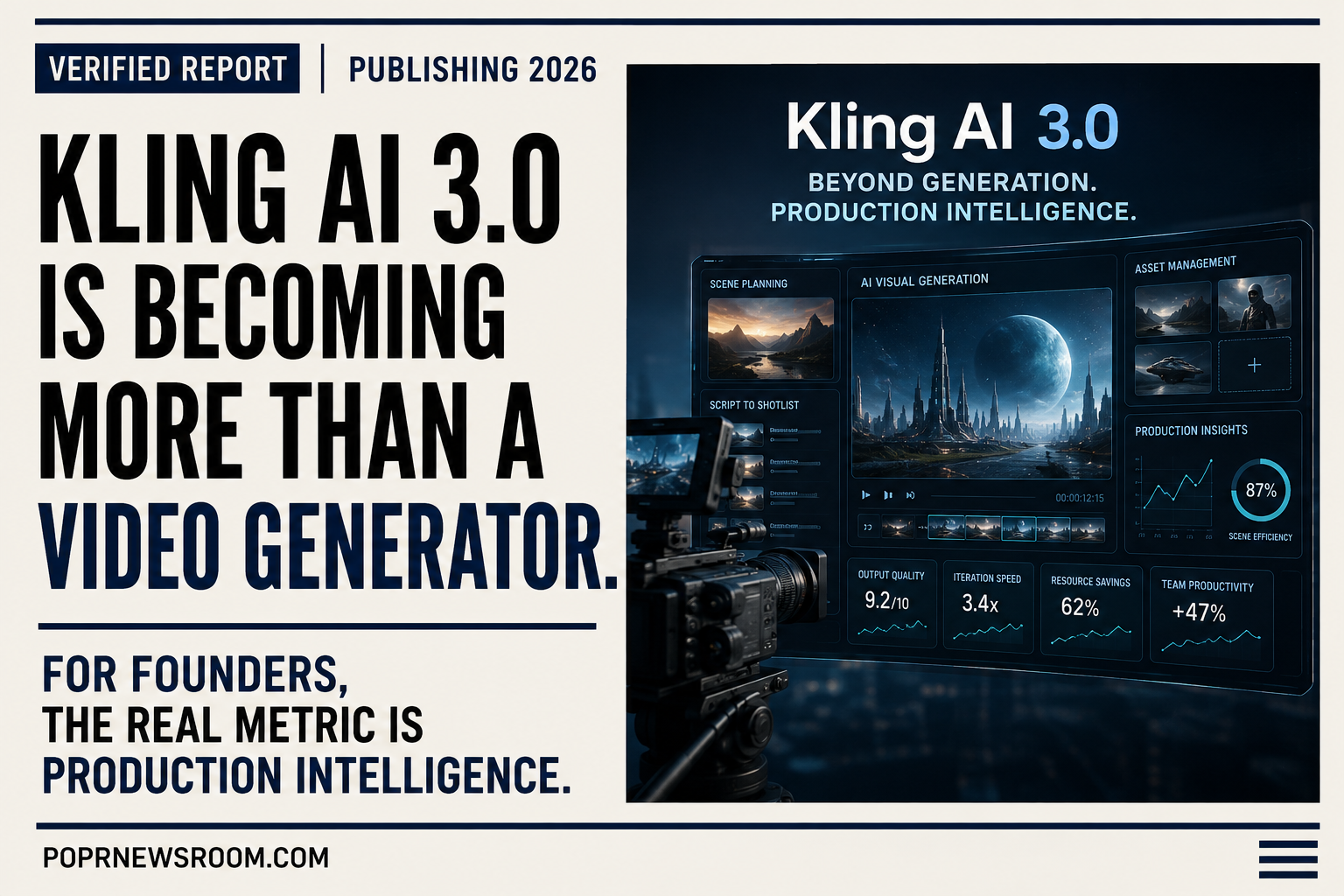
Kling AI 3.0 is becoming more than a text-to-video model because Kuaishou is adding native audio, longer clips, native 4K output, a lower-cost Turbo path, persistent reference workflows, and official MCP and CLI tooling. For founders, the practical question is not which model makes the prettiest clip, but which production system turns ideas into repeatable, controllable, usable media.
Disclosure: POPR Technologies uses Kling AI in its own production workflow. This article contains a Kling referral code. If you subscribe through our referral, you get a 10% bonus credit allowance in your first month, and POPR may receive Kling credits. Our editorial conclusions are our own.
POPR Kling referral code: 7B7BDSZ8CDD5
The referral terms shown to POPR in August 2026 state that a successful qualifying referral provides POPR with 200 Kling credits when a new user makes a first-time purchase of an eligible individual monthly, quarterly or annual paid plan. The referred subscriber receives a 10% bonus on the first month’s credit allowance, capped at 1,500 bonus credits. Those terms are dated account evidence, not a permanent Kling-wide promise, and may change by account, campaign or date. POPR is a paying Kling customer and referral participant. We are not claiming a formal partnership with Kling or Kuaishou.
What changed around Kling 3.0?
The important development is not only the Kling 3.0 model. Kuaishou has added a surrounding production layer that addresses speed, output quality and software orchestration.
Kling 3.0 arrived on February 5, 2026. The confirmed release expanded the system across text, images, video and audio, extended generations to as much as 15 seconds, and added native multilingual audio. Kuaishou’s second-quarter 2026 reporting then confirmed Kling 3.0 Turbo, native 4K direct output, and official MCP and CLI support.
Those additions solve different production problems. Turbo is aimed at creative efficiency and lower production cost while maintaining quality and synchronization. Native 4K addresses professional output. MCP and CLI make it possible for AI agents and software systems to orchestrate Kling for batch content creation. Together, they move evaluation away from a single prompt and a single clip.
The breaking-news angle is therefore architectural. Kling is accumulating the pieces of a production system around its generation model, even though that does not establish that Kling will dominate AI video or that every new workflow is reliable today.
How large is Kling already?
Kling is already operating at substantial commercial scale rather than as a small experimental product. Kuaishou said in February 2026 that Kling served more than 60 million creators worldwide, had generated more than 600 million videos, and had worked with more than 30,000 enterprise clients.
Kuaishou CEO Cheng Yixiao later said during the company’s August 19, 2026 second-quarter earnings call that Kling’s global user base had surpassed 100 million as of June 2026 across 224 countries and regions. That is a first-party executive statement reported from the call, not a figure contained in Kuaishou’s written second-quarter press release. Kuaishou’s written results separately reported Kling revenue above RMB 850 million, representing growth of more than 200% year over year.
These figures do not prove that Kling is the world’s best AI-video model. They establish something different: Kuaishou has a video-generation platform with meaningful global reach, enterprise activity and revenue. For founders deciding whether generative video belongs in a production stack, that commercial scale changes the procurement question.
Why does AI video need a production-system scorecard?
A model leaderboard cannot answer the business question a founder actually faces. A single extraordinary clip is useful as a demonstration, but a production operation needs tomorrow’s video, next week’s variations, a revised opening, a different aspect ratio, a cleaner call to action and another campaign that preserves the same visual identity.
The unit of value therefore changes from generation to production. A model that occasionally creates the most impressive image may be less useful than one that offers stronger reference control, predictable iteration, lower-cost experimentation, image-to-video workflows, integrated audio and easier automation.
POPR’s production-intelligence framework evaluates the combined system rather than one showcase result:
- Visual quality: Does the output meet the creative standard?
- Prompt adherence: Does the system produce what was requested?
- Temporal consistency: Do subjects, objects and environments remain coherent through motion?
- Control: Can creators constrain characters, objects, scenes, motion and frames?
- Iteration efficiency: How quickly can a team discover what works?
- Production cost: How much experimentation is required to obtain a usable asset?
- Audio capability: How much of the sound layer can be generated natively when useful?
- Finishing burden: How much repair is required outside the model?
- Repeatability: Can the workflow produce a campaign rather than one lucky generation?
- Orchestration: Can the model participate inside an automated production system?
“Production intelligence” is POPR’s analytical framework. It is not a Kuaishou product metric, and it does not identify a universal winner. It is a way to ask whether an AI-video tool reliably converts creative intent into usable media at a cost and level of control a small organization can sustain.
What did POPR learn from using Kling?
POPR’s firsthand experience is that Kling becomes more useful when the creative problem is decomposed rather than handed to the model as one enormous request. A team can establish the concept, determine the visual language, create or select a reference image, use image-to-video or controlled-frame generation for motion, iterate economically, and reserve higher-quality rendering for concepts that survive.
The division of labor matters. The generative model can solve imagery, movement, transformation, atmosphere and visual storytelling. Deterministic editing tools can handle exact typography, logos, URLs, timing and final finishing. This is not a rejection of Kling. It is a narrower and more practical assignment of responsibility.
POPR has found Kling’s on-screen text handling underwhelming in its own work. That limitation matters in advertising because a beautiful video with a misspelled headline, broken URL or malformed call to action is not a finished marketing asset. Generative video solves a probabilistic visual problem, while brand typography is usually deterministic.
POPR has also found Kling’s text-to-speech performance underwhelming in its own workflow. That is a firsthand observation, not a universal performance finding. Native audio is valuable when it is good enough for the project, but native capability does not make a feature mandatory. A production stack is stronger when the creator can decide which stages the model has earned the right to control.
What can Kling 3.0 actually do?
The confirmed feature set is broader than basic text-to-video. Kling supports text-to-video and image-to-video generation, reference-based subject and character workflows through its Elements system, motion control, start-and-end-frame control, digital-human and avatar capabilities, native multilingual audio, developer API access, native 4K output, and the newer MCP and CLI paths for agent-driven orchestration.
Kling 2.6, released on December 3, 2025, introduced simultaneous single-pass audio-visual generation with voices, sound effects and ambient audio in clips up to 10 seconds. Kling 3.0 followed on February 5, 2026 with multimodal input and output, clips up to 15 seconds and native multilingual audio.
Generated clips can be extended in repeated four-to-five-second increments to approximately three minutes in total, according to Kling’s own guidance. That capability does not guarantee a coherent three-minute film. Consistency remains dependent on the prompt, reference quality, scene, mode, duration and generation path.
The broader pattern is clear. The product category is moving away from the original idea of entering a prompt and receiving a short silent clip. It now includes references, sound, controlled motion, output resolution, developer access and automation possibilities.
Does native audio eliminate post-production?
Native audio can collapse some production stages, but it does not end post-production. AI video originally required separate systems for visuals, speech, sound effects, ambience and music. Kling 2.6’s simultaneous audio-visual generation and Kling 3.0’s native multilingual audio reduce that separation for rapid concepting, social video and short-form storytelling.
The remaining question is quality and fit. POPR’s own text-to-speech experience has not established that every project should rely on Kling’s generated voice output. A creator may still prefer a separate audio workflow for a particular voice, a precise performance or a client requirement.
The useful architectural principle is optionality. A production system should let creators use native audio when it earns its place and substitute another tool when a different system handles that part of the project better.
How does Kling 3.0 Turbo change iteration economics?
Turbo points toward a two-stage economics model in which experimentation and final rendering do not have to be the same event. Generative mistakes cost both time and credits, so beginning every idea with the most expensive rendering path can make exploration unnecessarily costly.
Kuaishou describes Kling 3.0 Turbo as a path for improving creative efficiency and reducing production costs while maintaining quality and synchronization. A founder can use a faster or cheaper path to test motion, composition, concept and prompt direction, then reserve higher-cost production for ideas that survive.
The more useful metric is usable output per dollar of iteration, not cost per generation. A cheap generation that cannot be used is expensive. An expensive generation that eliminates several rounds of additional production may be cheap if it creates a usable asset and reduces rework.
This is one reason AI-video evaluation should include finishing burden and repeatability. A low headline price does not help a business if every output requires extensive repair or fails to preserve the campaign’s identity.
Why do start-and-end frames and Elements matter?
Start-and-end-frame control looks like a small feature on a comparison chart, but it changes the creator’s relationship with the model. Advertising often begins with a known visual state and needs to reach a specific destination. A product needs to transform, a scene needs to reveal something, a logo animation needs to finish in a predictable composition, or a character needs to move from one designed frame toward another.
Pure text-to-video gives the model substantial freedom. Controlled frames reduce the problem by asking the system to solve movement between two states instead of inventing the entire sequence. That moves AI video toward directed production.
Kling’s Elements system points in a related direction. Elements supports persistent character, item and scene assets along with voice binding. Reference limits vary by mode and generation path, so there is no single universal number that should be treated as the product specification for every workflow.
The commercial concept is persistence. Brands do not want every advertisement to look like it came from a different universe. Characters need continuity, products need recognizable form, environments may need to recur, and visual identity needs to survive across campaigns. Prompt quality still matters, but production systems increasingly need state as well as instructions.
What does native 4K signal about Kling’s direction?
Native 4K signals that Kuaishou is positioning Kling for professional production use, not solely as a social-media novelty. Kuaishou’s second-quarter results describe native 4K direct output as intended for professional use.
Resolution alone does not make a system professional. Professional production also requires control, reliability, consistency, color and sound workflows, asset management, editing and delivery standards. Native 4K makes Kuaishou’s direction clearer, but the real test is whether workflow reliability rises alongside output resolution.
For founders, agencies and small creative teams, the potential value is capability compression. A small organization may gain access to output and workflow options that previously required a larger production budget. That potential remains conditional on the system’s reliability and on the team’s ability to finish what the model produces.
Why might MCP and CLI matter more than another demo?
MCP and CLI may be the least visually exciting Kling developments and the most operationally significant. Kuaishou has confirmed support designed to let AI agents orchestrate Kling for batch content creation and other automated workflows.
POPR has not yet tested Kling’s MCP or CLI capabilities. We therefore cannot tell readers how well they perform in a real POPR production environment, how often they fail, how much human intervention they require, or how their usable-output rate compares with competing systems. Their confirmed existence changes the architectural possibility, not the evidence about current reliability.
An AI-video model traditionally waits for a person to open an interface, enter a prompt and request a generation. An orchestrated system can potentially treat video generation as one step inside a larger software workflow. A campaign system could generate creative briefs, select assets, prepare generation instructions, request variations, organize outputs and pass selected assets into later production stages.
The meaningful question is therefore not whether MCP or CLI can be named in a feature list. It is whether the tooling can support dependable batch production with measured cost, failure rate, human review and repeatable output. AI video is beginning to become programmable, but programmability is not the same as production readiness.
Can programmable video change the economics of a small company?
Programmable generative video could reduce the distance between an idea and a production experiment. A large organization can employ specialists for strategy, copywriting, art direction, motion design, editing and campaign production. A founder usually cannot coordinate that entire structure for every test.
Generative AI has already compressed parts of those workflows. A programmable video system could compress them further by allowing a founder or small team to move from concept to motion asset without coordinating the same number of people, software packages and production stages.
That does not turn one founder into an entire professional studio. Human judgment remains necessary, and generative failures remain common. The advantage is the shorter distance between creative intent and a meaningful experiment. Startups survive through experiments, so that shorter distance can have strategic value even when the output is imperfect.
What are Kling’s real limitations?
Kling has material limitations that should remain visible, especially because POPR has a referral relationship with the platform. POPR’s testing found on-screen text unreliable enough that Kling-generated typography should not be the default finishing method for important marketing assets. POPR also found text-to-speech underwhelming in its own work.
Consistency varies. Generations can fail. Prompting and reference quality matter. Higher-quality experimentation consumes credits, and some workflows still benefit substantially from external editing. Those are practical production constraints, not reasons to describe the system as unusable.
Kling’s Terms of Service also give the company broad authority to restrict, suspend or terminate accounts for violations, including circumstances involving company discretion. Creators working with sensitive client assets should examine the current data-handling terms carefully before using the service.
The commercial relationship does not turn those observations into an advertisement, and it does not turn them into universal test results. The appropriate conclusion is narrower: Kling can be useful in a multi-tool production system, but founders should measure the system’s actual limitations against the demands of their own work.
Where are user assets stored?
Kling AI’s current privacy policy identifies Kling AI Pte. Ltd. as the contracting entity. The policy states that user data, including uploaded photographs, images, audio, video and other user content, is stored on servers located in Singapore, while support, engineering and moderation teams may operate globally.
That does not automatically make Kling inappropriate for commercial work. It does mean that a public product image and an unreleased confidential client asset present different risks. POPR would not treat an AI-video upload box as a default destination for sensitive client material without reviewing the current privacy policy and terms at the time of use, because those documents can change.
Founders should treat data handling as part of production intelligence. A system that produces a beautiful asset but creates unacceptable confidentiality, contractual or review risk may not be the right system for that project.
Should founders use Kling alone?
Choosing Kling does not require believing that Kling should perform every production task. POPR’s emerging workflow argues for assigning each problem to the system best suited to solve it.
A generative model can be strong at motion while another tool is better at exact typography. A specialized editor may be better for timing. A deterministic design system may be better for logos. A separate audio workflow may be better for a particular voice. The intelligent production stack is not necessarily the one with a single magical model. It is the one that combines tools without losing control of the final asset.
Kling’s MCP and CLI development is especially relevant in that context. If video generation becomes one stage in an orchestrated creative system, the question shifts from which model can do everything to how reliably several tools can work together.
Is Kling becoming video-production infrastructure?
The most consequential current development around Kling is the architecture accumulating around the model. Turbo creates an efficiency layer. Native 4K pushes toward professional output. Elements provides persistent reference workflows. Multimodal generation joins image, video and audio. Start-and-end-frame controls increase direction. API access makes Kling available to software. MCP and CLI push toward agent orchestration and batch creation.
Taken together, those developments suggest a transition from a generation product toward production infrastructure. Kling is not alone in participating in that transition, and its current capabilities do not establish that it will ultimately dominate it. Kuaishou is nevertheless building in that direction.
For founders, that may matter more than who wins a monthly model comparison. A model can perform exceptionally on a benchmark while fitting poorly into a particular production system. The best choice may depend on whether the buyer is a filmmaker, advertising agency, solo creator, software company, ecommerce brand or founder building short-form social advertisements.
What remains unresolved?
POPR has not tested every Kling feature, and we have specifically not tested the MCP and CLI orchestration capabilities that may prove most consequential for automated production. The open questions are practical: generation cost, failure rate, human intervention, batch reliability, asset consistency and usable-output rate in a real workflow.
Kling 3.0 is already a capable generative-video platform. The reason founders should pay attention to Kling in 2026 is increasingly what surrounds the model: speed, cost optimization, references, audio, professional output and software orchestration.
If that architecture works reliably at scale, the future competition in AI video will not be decided solely by which model makes the best clip. It will be decided by which systems become the best production machines. That is a larger and more demanding market.
Fact Summary
Kling AI is built by Kuaishou Technology and launched in June 2024. Kuaishou reported in February 2026 that Kling served more than 60 million creators worldwide, had produced more than 600 million videos and had partnered with more than 30,000 enterprise clients.
Kuaishou CEO Cheng Yixiao said during the company’s August 19, 2026 earnings call that Kling’s global user base had surpassed 100 million as of June, covering 224 countries and regions. Kuaishou reported second-quarter 2026 Kling revenue exceeding RMB 850 million, up more than 200% year over year.
Kling 3.0 launched on February 5, 2026 with multimodal text, image, audio and video capabilities, generation durations up to 15 seconds and native multilingual audio. Kuaishou subsequently confirmed Kling 3.0 Turbo, native 4K direct output, MCP and CLI support for agent-driven and batch workflows.
POPR has tested Kling for video production and found its on-screen text and text-to-speech capabilities underwhelming in its own workflows. These are POPR’s firsthand observations, not universal performance findings. POPR has not yet tested Kling’s MCP or CLI functionality.
Kling’s privacy policy states that user content is stored on servers in Singapore and that support, engineering and moderation personnel may operate globally. POPR is a paying Kling customer and referral participant, not a claimed formal partner.
Evidence Status
Confirmed: Kling’s ownership, launch history, major version releases, multimodal capabilities, Kling 3.0 Turbo, native 4K, MCP and CLI availability, Kuaishou-reported revenue and platform-scale figures are represented as confirmed in the sealed research record.
First-party executive statement: The more than 100 million users across 224 countries and regions figure comes from Kuaishou CEO Cheng Yixiao’s August 2026 earnings-call remarks rather than Kuaishou’s written second-quarter press release.
POPR firsthand experience: Kling is being used in POPR’s production workflow. POPR found generated typography and text-to-speech underwhelming in its own testing.
Not yet tested by POPR: Kling MCP and CLI orchestration.
POPR analysis: “Production intelligence” is POPR’s framework for evaluating AI-video systems according to the combined business value of output quality, control, consistency, iteration efficiency, production cost, finishing burden, repeatability and orchestration. It is not a Kuaishou product metric.
Unresolved: How reliably Kling’s newest orchestration capabilities perform in a real automated production environment and how they compare with competing AI-video production architectures.