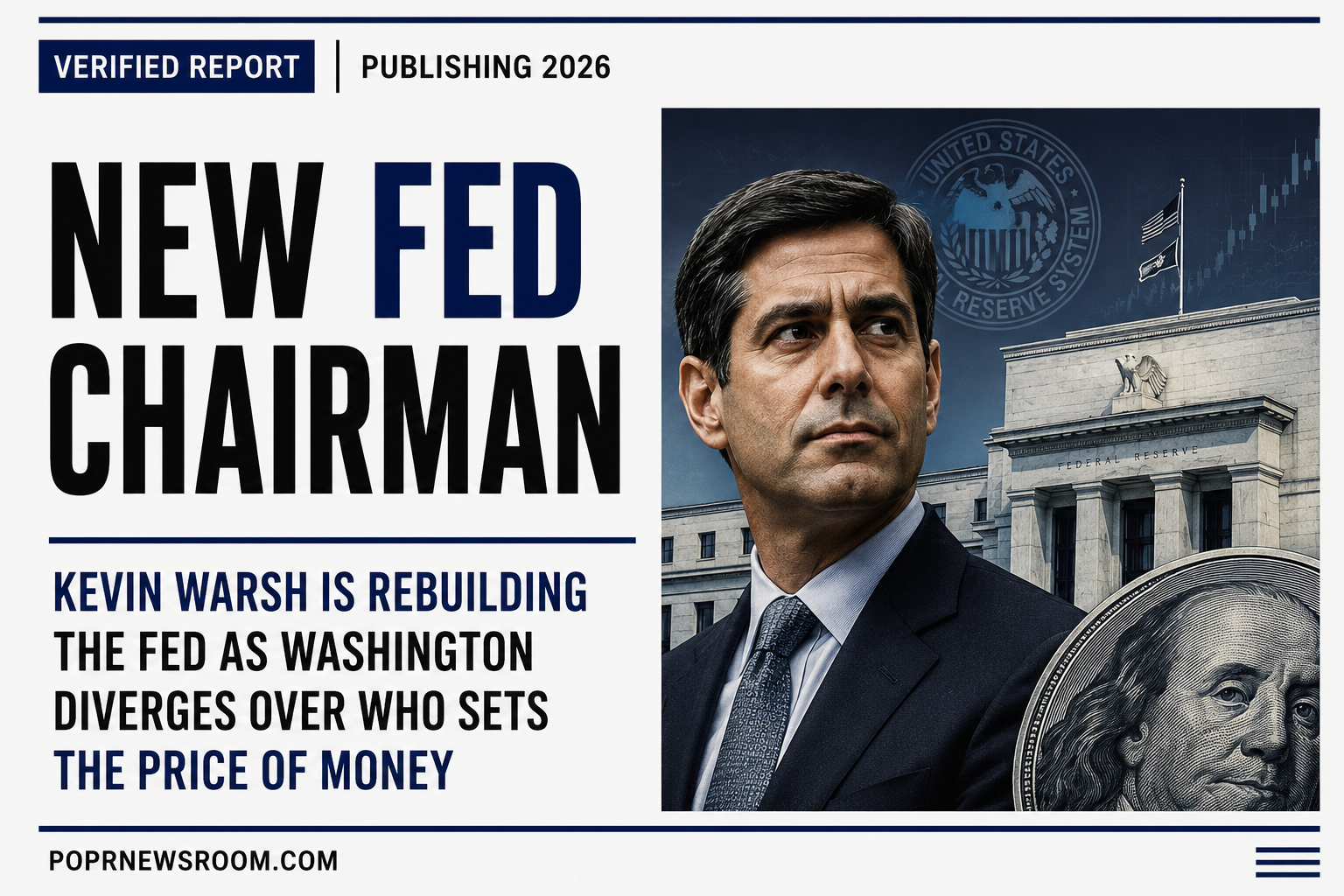
Kevin Warsh's first Jackson Hole speech as Federal Reserve chair did not announce a September rate hike. It did reveal the shape of his emerging Fed: a stronger focus on prices, less routine forward guidance, renewed attention to money, better models and rules, and more market price discovery. Markets reacted immediately, while Washington's wider price-of-money architecture remains divided.
What did Kevin Warsh signal at Jackson Hole?
The confirmed message from Warsh's August 28 speech was that inflation remains above the Federal Reserve's 2 percent target and that prices should be its predominant current focus. He reported 12-month PCE inflation at 3.7 percent, six-month PCE inflation at 4.1 percent and unemployment at 4.1 percent.
Warsh also said 54 percent of the PCE basket had experienced price increases above 3 percent over the preceding 12 months, compared with a 32 percent average during the two decades before the pandemic. Over the most recent six months, 49 percent of the basket exceeded 3 percent inflation on an annualized basis.
His conclusion was direct: “Inflation is running above our 2% target. So the Fed’s predominant focus right now should be on prices.” The speech was a clear signal about the current policy problem. It was not an announcement that the Federal Open Market Committee would raise rates at its next meeting.
Did Warsh announce a September rate hike?
No. Warsh explicitly resisted giving the forward guidance that would allow markets to treat Jackson Hole as a pre-announcement of the September 15 to 16 FOMC decision. The next meeting remains scheduled for those dates, but the public record does not establish its outcome.
Reuters reported that market-implied odds of a September increase rose from roughly 35 percent before the speech into the mid-to-high 50 percent range afterward, with some later readings near 60 percent. Those are time-sensitive market measurements reported across multiple snapshots. They are not a Federal Reserve commitment, a guarantee or a POPR forecast.
The market reaction created an immediate tension inside Warsh's own communication philosophy. He told markets, “We should not indulge a regime in which market participants are looking primarily to the Fed for their next trade.” His speech nonetheless caused traders to reprice the probability of the Fed's next move.
Why does Warsh want a quieter Federal Reserve?
Warsh's proposal is institutional rather than merely rhetorical. He argued that normal-times forward guidance should be limited and circumscribed, and warned about a hall-of-mirrors relationship in which Fed guidance influences market prices, market prices become information for policymakers, and both sides respond increasingly to signals produced by the other.
He separately said that “a quieter Fed, more purposeful in its communications, is better able to meet its objectives.” The confirmed direction is not silence. It is less routine signaling and greater responsibility for markets to evaluate inflation, employment, financial conditions and incoming data without treating every sentence from the chair as a trade instruction.
Warsh paired that communication change with a call for “more reliable models and more robust rules.” The record does not show a complete replacement model for monetary policy. It shows the direction in which he wants the Federal Reserve's analytical and communication machinery to move.
What does Warsh mean when he says money matters?
Warsh said the Federal Reserve should pay renewed attention to money created by both the central bank and the broader banking and financial system, alongside conventional inflation-targeting analysis. “Money matters” is a stated principle in the speech, not evidence that the Fed has already adopted a new operating framework.
That distinction matters. The public record supports a proposal to restore monetary aggregates to a more prominent place in analysis. It does not establish that Warsh has replaced inflation targeting, adopted a single monetary rule or completed a new model of the economy.
The same restraint applies to AI. Warsh said business investment in equipment and intangibles was growing at roughly 9 percent, its strongest pace since 2021, and attributed more than half of this year's capital-expenditure growth to AI-related buildout. AI is therefore relevant to his productivity argument, but it has not made the inflation figures disappear.
Was the Fed already moving toward a more hawkish debate?
Yes, the verified FOMC record shows that the disagreement predates Jackson Hole. Warsh's first meeting as chair, June 16 to 17, ended with a unanimous decision to hold the federal funds rate at 3.50 percent to 3.75 percent. Yet nine of 18 participants projected at least one rate increase before the end of 2026, and six projected two quarter-point increases. The median year-end PCE inflation projection rose to 3.6 percent from 2.7 percent in March.
The June statement was shortened to approximately 130 words from 341 in the previous release, removing language that had indicated an easing bias. Warsh did not submit his own projection to the FOMC dot plot and announced plans for five independent task forces examining Federal Reserve operations.
The July 28 to 29 meeting made the pressure visible in the vote. The committee held rates at 3.50 percent to 3.75 percent by a 9 to 3 vote. Cleveland Fed President Beth Hammack, Minneapolis Fed President Neel Kashkari and Dallas Fed President Lorie Logan each preferred an immediate quarter-point increase. It was the first three-way same-direction dissent since September 2016.
Warsh voted with the majority to hold. The minutes nevertheless recorded that many participants assessed that tightening would likely be necessary if inflation did not decline. St. Louis Fed President Alberto Musalem, a nonvoter, separately stated that he supported a July increase. Bloomberg reported that nonvoting Kansas City Fed President Jeffrey Schmid would also have supported one, but that lower-confidence characterization is not sourced to an equally direct first-party statement.
Warsh described the disagreement as a “good family fight” and said he was heartened that officials were not afraid to raise major policy questions. That quote shows tolerance for visible debate. It does not establish that he agreed with the dissenters' policy conclusion or orchestrated a hawkish takeover.
Why is Warsh reviewing the FOMC calendar?
Warsh proposed reducing the number of scheduled FOMC meetings from eight per year to six, spaced roughly every two months. The July minutes record the proposal, but no decision was made and the remaining 2026 calendar has not changed.
This is one part of a wider institutional pattern. Shorter statements, limited forward guidance, five internal task forces, renewed attention to monetary aggregates, stronger models and rules, and a willingness to let disagreement become visible all point to a chair reconsidering how the Federal Reserve reaches and communicates decisions.
The proposal does not prove that fewer meetings will be adopted. It shows that Warsh is examining the machinery of monetary policy while he is using it.
How does Donald Trump fit into the rate debate?
Trump publicly favored lower rates before Warsh's nomination. Warsh had previously argued that AI-driven productivity gains could permit lower rates without producing the conventional tradeoff between inflation and employment. Other officials disputed that proposition at the time.
Trump announced Warsh as his intended nominee on January 30. The formal nomination was transmitted to the Senate on March 4. Warsh was confirmed to the Board of Governors on May 12 by a 51 to 45 vote and confirmed as chair on May 13 by a 54 to 45 vote. Senator John Fetterman was the only Democrat to cross party lines in both votes. Warsh was sworn in on May 22 as the 17th chair of the Federal Reserve.
After the July decision, Trump said Warsh was brilliant and would love to see lower rates, but that Warsh had a board that wanted to keep rates up. That is the verified public statement. It should not be converted into speculation about a private relationship or a coordinated political conflict.
The public architecture is sufficient: Trump favors lower rates, Warsh entered office with a prior lower-rate productivity argument, and he now chairs a committee where hawkish pressure is visible while he places current inflation above target at the center of policy.
How do Scott Bessent and Warsh differ over the price of money?
Reuters has described an emerging divergence between Warsh and Treasury Secretary Scott Bessent over how much government should influence the market price of money. The evidence supports a difference in approach and emphasis. It does not establish an open conflict, a personal dispute or a rupture in the Treasury-Fed relationship.
Warsh is advocating less routine Fed guidance and greater reliance on market price discovery. Treasury under Bessent has expanded buybacks of longer-dated U.S. government debt as part of an effort to improve market functioning and reduce long-term borrowing costs. Treasury operations do not directly set Federal Reserve interest rates, and they should not be treated as a mechanical equivalent of monetary policy.
The juxtaposition is still consequential. A Fed chair is arguing that markets should carry more responsibility for discovering prices, while Treasury is more actively operating inside long-duration government-debt markets. Washington is debating both the level of rates and the institutions that influence expectations and long-term borrowing costs.
There is also a historical irony. Before becoming chair, Warsh advocated a new Treasury-Fed accord modeled on the 1951 agreement associated with Federal Reserve independence from Treasury financing demands. The chair who once sought clearer institutional alignment is now operating in a reported difference of approach with Treasury.
What does Warsh's biography add to the story?
Warsh was born in Albany, New York, in April 1970. He graduated from Stanford in 1992 and Harvard Law School in 1995. He worked at Morgan Stanley from 1995 through 2002, served on the George W. Bush administration's National Economic Council from 2002 to 2006, and became a Federal Reserve governor in 2006 at age 35, the youngest person ever appointed to the Board.
His first Fed tenure placed him inside the response to the 2008 financial crisis, including the response to AIG and JPMorgan's acquisition of Bear Stearns. He later worked with Duquesne Family Office and the Hoover Institution.
His historical reputation as a monetary hawk is documented, but it is not historically vindicated by definition. Some of his inflation concerns during and after the financial crisis did not materialize as he warned. That counterevidence belongs in the record alongside his current position.
The institutional difference now is authority. Warsh is no longer an outside critic proposing changes to the Federal Reserve. He is the chair, and within three months of taking office the components of his project are visible.
What should the September FOMC meeting test?
The September meeting will be watched for a rate decision, but it will also test Warsh's communication philosophy. If markets are to rely less on guidance from the chair, they will have to assess inflation, employment, financial conditions and incoming data rather than decode a predetermined signal.
The irony is that a speech arguing that traders should not look primarily to the Fed for their next trade made Warsh's own communication extraordinarily consequential. The public record therefore supports two conclusions at once: Warsh is trying to reduce the Fed's routine influence over market expectations, and his first major speech caused markets to assign sharply greater probability to a September hike.
The immediate question is whether the Fed raises rates in September. The larger question is what the Federal Reserve becomes under Kevin Warsh.
What is the verified fact summary?
Fact Summary: Kevin Warsh was sworn in as the 17th chair of the Federal Reserve on May 22, 2026. His first FOMC meeting as chair ended in a unanimous hold in June, although nine of 18 participants projected at least one rate increase before year-end. His second meeting ended 9 to 3 in July, with three regional Fed presidents preferring an immediate quarter-point hike.
At Jackson Hole on August 28, Warsh said inflation remained above the Fed's 2 percent target and that prices should be its predominant current focus. He advocated limited normal-times forward guidance, a quieter Federal Reserve, stronger models and rules, and renewed attention to monetary aggregates. Market-implied September hike probabilities rose from roughly 35 percent before the speech into the mid-to-high 50 percent range afterward, with some later Reuters readings near 60 percent.
Warsh did not announce a September rate hike. The next scheduled FOMC meeting remains September 15 to 16.
What does the evidence establish and leave unresolved?
The confirmed record establishes Warsh's biography, nomination and confirmation chronology, FOMC attendance, meeting votes, policy discussions and September meeting schedule through Federal Reserve and government records. His Jackson Hole inflation figures, communication philosophy, monetary-analysis discussion and AI investment remarks are supported by his speech.
Market-implied probabilities are attributed, time-sensitive market measurements that moved intraday. The description of Warsh's remarks as his clearest and most hawkish stance to date is Reuters' comparative characterization, not an unqualified fact.
Reuters' description of Warsh and Bessent diverging over who should set the price of money is analysis. POPR's description of the wider Trump, Treasury and Fed architecture is synthesis of the verified positions. The record supports a difference in approach, not a coordinated conflict, institutional rupture or certainty about the September decision.