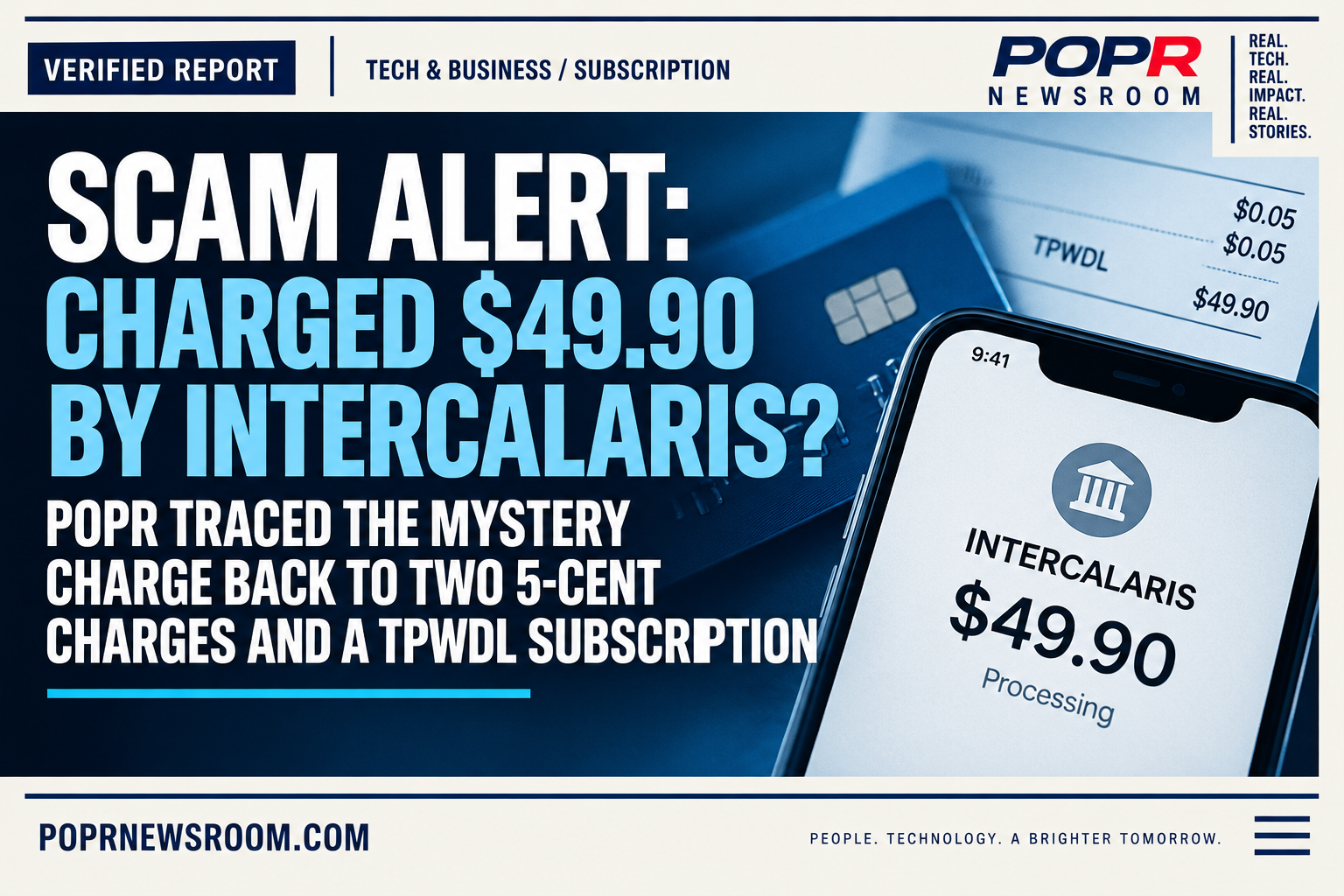
If your bank statement says Intercalaris and you do not recognize the name, the website you used may have had a different consumer-facing identity. I traced one unfamiliar $49.90 authorization backward to two five-cent transactions, a 10-cent TPWDL receipt and a subscription TPWDL later said had automatically converted to PRO.
Why Did Intercalaris Look Unfamiliar?
I did not recognize Intercalaris when a $49.90 authorization appeared against my bank account on September 19, 2026. The bank declined the attempt because it would have exceeded the available SpotMe capacity on the account, but the decline did not explain who was trying to charge me or how the name connected to anything I remembered buying.
I started by searching my bank history for the exact descriptor. The search showed two earlier Intercalaris transactions on July 28 at 8:21 p.m. One was five cents and the other was five cents. Together, they totaled 10 cents, which gave me a precise amount to match against old email and receipts.
The search eventually led to a TPWDL payment receipt for $0.10. The receipt recorded a successful payment and included language telling the recipient how to cancel a subscription by replying “unsubscribe.” The consumer-facing service I remembered was TPWDL. The banking identity I saw later was Intercalaris.
That difference is the heart of the mystery. POPR has not established that TPWDL and Intercalaris are the same legal company, and we do not have the payment processor’s internal transaction identifier tying the receipt directly to the two five-cent bank entries. The amounts and timing correspond strongly, but the processor-level identity link remains open.
What Did the Ten-Cent Receipt Reveal?
The documented transaction structure involved a 10-cent initial payment, a five-day trial or subscription period and later paid subscription billing. My understanding at the time was that I was paying a small amount for a small online digital task. I did not understand myself to be starting the kind of relationship that would later produce an unfamiliar $49.90 authorization under a different name.
When I contacted TPWDL, the service told me that its records showed the trial had ended and had successfully converted into a PRO subscription plan under the trial terms. TPWDL then directed me to a cancellation mechanism. That support statement is direct first-party evidence of what the service told me. It does not establish that every consumer saw identical terms, and it is not by itself a legal finding.
The documented sequence is therefore clear even though the full payment architecture is not. A 10-cent TPWDL receipt corresponded strongly with two five-cent Intercalaris bank entries. The same account later received a declined $49.90 Intercalaris authorization. TPWDL told me that the original trial had converted to PRO.
Why Did the Cancellation Process Become Confusing?
I followed TPWDL’s instructions and signed in using the same email address associated with the transaction. The site recognized my account and displayed a membership area. But the membership page then said that I was not currently subscribed to a membership plan, or that the plan had expired.
That left me with two statements from the same service that I could not reconcile as a consumer. Support said the trial had converted into PRO and directed me to cancel it. The account interface said there was no current subscription or that the plan had expired. Several explanations remain possible, including a system synchronization problem, termination after the declined authorization, an ambiguous use of the word “expired” or a cancellation action that had already processed.
I did not treat the ambiguous screen as enough. I sent another explicit cancellation request and pursued written confirmation. TPWDL eventually confirmed that the subscription had been canceled and that I would not be billed for the product in the future.
That final confirmation matters. I am not reporting that TPWDL made cancellation impossible, refused to cancel me or continued charging me after the written confirmation. I am reporting that it took a full reconstruction of the bank identity, the original receipt, the asserted PRO subscription and the contradictory account information before I could obtain clear confirmation that the recurring relationship was closed.
Are Other Consumers Seeing the Same $0.10-to-$49.90 Pattern?
My records are the foundation of this investigation, but they are not the only evidence. Independent TPWDL consumer reports describe inexpensive photo or digital tasks costing approximately 10 cents or 10 pence, followed by substantially larger transactions around $49.90 or £49.90. Multiple reviewers identify Intercalaris as the descriptor attached to the larger transaction.
Those reports are consumer allegations, not adjudicated findings. POPR has not independently established every detail in every review. Their importance is that material parts of the pattern appear outside my account: a low-cost task, an unclear or unexpected subscription relationship, a later charge under the Intercalaris name and difficulty identifying the original service.
TopPDF complaints describe a parallel pattern involving a small initial payment for a PDF-related task and a later recurring charge, frequently around $49.90. PicMagic complaints describe a similar low-cost-to-larger-charge experience, and some reports identify USTOPPDF as another unfamiliar billing descriptor. These connections warrant further reporting, but POPR has not established that TPWDL, TopPDF, PicMagic, USTOPPDF and Intercalaris share a common owner or are one legal company.
The correspondence in my case displayed the name “MID Business Solutions” because it was my own founder-company and email identity from Meta Is Dope when I replied to TPWDL to cancel the subscription. It is not part of the Intercalaris or TPWDL billing evidence, and it does not establish any corporate relationship among those services. The corporate and payment architecture remains an open investigative branch without it.
What Should Consumers Do With an Intercalaris Charge?
Start with the bank history. Search backward for earlier Intercalaris entries, especially transactions involving a few cents or approximately 10 cents, and write down the exact dates and amounts. Then search email around those dates for TPWDL, TopPDF, PicMagic, “payment successful,” PDF, photo, image, trial, membership, subscription, order and “unsubscribe.”
Compare the receipt amount and date with the bank record. If you identify the original service, sign in using the email associated with the purchase and inspect the membership or subscription status. If you want the subscription stopped, send an explicit written cancellation request through a verified channel, preserve the correspondence and ask for written confirmation. Do not rely only on an account page that says a plan may have expired.
Keep the bank transaction, receipt, screenshots, support messages and cancellation confirmation. If the charge was not knowingly authorized, contact the card issuer or financial institution promptly and ask about dispute options and how to prevent future recurring charges. The purpose of this reconstruction method is to help consumers recover the connection between the bank descriptor and the original service.
Is This Proof of Criminal Fraud or a ROSCA Violation?
No. The evidence does not establish criminal fraud, deliberate descriptor concealment, a common beneficial owner or a violation of the Restore Online Shoppers’ Confidence Act. ROSCA provides relevant federal context for clear material terms, informed consent and workable cancellation in certain online negative-option transactions, but POPR has not reconstructed the July 28 checkout experience well enough to make a statutory finding.
The consumer finding is narrower. I encountered a tiny online transaction, later received an unfamiliar $49.90 authorization under the Intercalaris name, learned from TPWDL that the trial had converted to PRO and encountered contradictory information while trying to cancel. I eventually obtained written cancellation confirmation. That journey is what POPR considers deceptive and misleading.
The conclusion does not require a claim about criminal intent. It does not require POPR to name a legal entity that the evidence has not identified. It does not claim that every consumer experienced the same sequence. It reports what happened to this consumer and why the independent pattern reports deserve attention.
What Did POPR Solve?
We solved the Founder’s case. The bank record documents two five-cent Intercalaris entries on July 28. The TPWDL receipt documents a 10-cent payment and subscription-cancellation language. The later bank record documents a declined $49.90 Intercalaris authorization. TPWDL support then stated that the original trial had converted to a PRO subscription, and the service ultimately confirmed cancellation in writing.
We also identified the consumer reconstruction method: search backward for small Intercalaris transactions, match the amount and date to email, identify the original service, inspect the subscription status, request cancellation explicitly and preserve written confirmation. Outside TPWDL reports describing similar Intercalaris billing experiences make the Founder case part of a broader consumer-warning investigation rather than an isolated unexplained charge.
We did not solve the legal identity behind Intercalaris or prove that TPWDL, TopPDF, PicMagic and USTOPPDF are one corporate operation. MID Business Solutions is my own founder-company identity in the cancellation correspondence, not evidence tying that company to Intercalaris or TPWDL. Those corporate questions remain open. What is no longer mysterious is the documented path through my own account: a tiny transaction, a TPWDL receipt, a later Intercalaris authorization, a PRO-subscription statement, contradictory account information and a final written cancellation.
Read the full POPR investigation for the complete evidence trail, the broader company and descriptor questions, the ROSCA context and the full consumer journey.
[Disclosure: I am Josephe “Pop” Buchanan, Founder of POPR Technologies Inc., which owns POPR Newsroom, and I am also the consumer whose documented transaction initiated this investigation. My account is supported by bank records, transaction receipts, account screenshots and written correspondence with TPWDL. POPR used external consumer reports for corroboration. This article characterizes the documented consumer experience and billing pattern as deceptive and misleading; it does not allege that any company or individual has been adjudicated guilty of fraud, a crime or a violation of subscription law.]