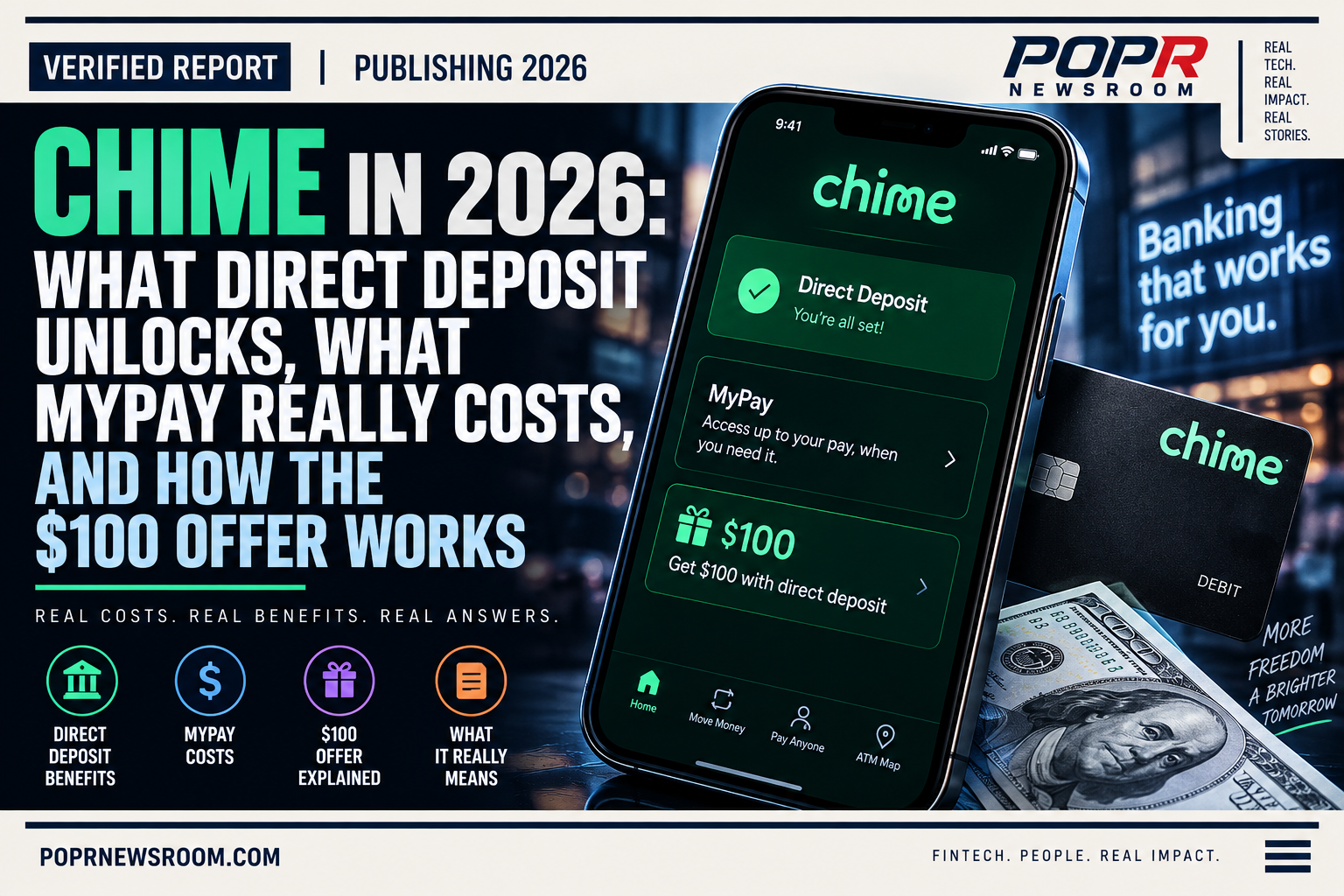
EDITORIAL DISCLOSURE: I use Chime and supplied the referral link in this article. This is affiliate-supported editorial plus personal testimony, not sponsored content or independent third-party validation. The findings remain subject to POPR Newsroom's sourcing, verification and correction standards.
AFFILIATE DISCLOSURE: POPR Newsroom may earn referral compensation if you open and qualify for Chime through the link below. I may receive a referral bonus, and an eligible new member currently receives $100 under Chime's standard program. Offers, eligibility and fees can change.
Try Chime Through the Current Referral Link
The logged-out referral landing page tested September 14, 2026 displayed a $100 new-member offer. The current standard terms require an eligible new member to open through the unique link, receive a qualifying direct deposit of at least $200 within 45 days and activate the physical card within the stated deadline. The referring member's reward varies by offer.
Open Chime through my referral link and read the live terms before applying. The link needs to be used during enrollment, and approval is not guaranteed.
I banked traditionally for a long time. Overdraft fees, minimum-balance requirements and customer service that felt designed to wear people down made the arrangement harder to carry, especially after I lost work during the pandemic. I moved to Chime in July 2023, and its mobile-first structure has fit my life better.
The practical benefit is simple: Chime's core Checking Account has no monthly service fee, no minimum-balance requirement and no overdraft fee. Direct deposit has worked well for me, and SpotMe has provided a buffer. That experience is favorable, but it does not mean Chime is automatically right for everyone.
Is Chime Actually a Bank?
No. Chime is a financial technology company, and eligible banking services are provided through The Bancorp Bank, N.A. or Stride Bank, N.A., Members FDIC. Chime itself is not an FDIC-insured bank.
That structure may change later. In September 2026, Chime agreed to acquire the parent company of Stride Bank for approximately $590 million in cash, subject to regulatory approval. If the deal closes as planned in the first half of 2027, Stride is expected to become Chime Bank, N.A. Nothing changed for members merely because the agreement was announced.
The strategic direction matters because Chime is trying to own more of the infrastructure underneath its consumer platform. Chime says the transaction could reduce partner-bank costs and expand lending, but those are company projections, not outcomes.
What Does Direct Deposit Unlock?
Direct deposit is now the control key to much of the Chime experience. It can support early pay and qualify a member for Plus or Prime, higher savings rates, SpotMe, MyPay, selected cash back and other benefits. Each product has separate conditions, so reaching a deposit threshold does not guarantee every named feature.
Standard currently lists a 0.75% savings APY, Plus lists 2.75% and Prime lists 3.75%, effective July 13, 2026. Those rates are variable. Early pay may arrive up to two days before the scheduled payday when Chime receives the payment file, but payer timing, holidays and first deposits can change the result.
Why Is MyPay My Main Complaint?
MyPay is a line of credit against future income, not free money. The Available Now amount can move up or down because Chime recalculates limits using factors that can include direct-deposit activity, account history, risk criteria and work information.
That variability is the part I do not like. I can see a higher figure and later see less available, which makes MyPay unreliable as fixed cash flow. Chime's own terms explain that future accrual is not guaranteed, but an explanation does not make the product convenient.
The repayment math matters too. If I take $200 before payday, that spending power has already been pulled forward. When the next qualifying deposit arrives, the outstanding amount is repaid under the terms, so the next spendable balance can feel smaller. The money was not simply taken, but the future paycheck has been partially spent.
Standard delivery within 24 hours is currently free. Instant delivery generally costs 3% of the advance, with a $2 minimum and $5 maximum. I treat MyPay as emergency liquidity, not expected income.
What Does Chime Cost Beyond Core Checking?
Chime's core checking fee structure is genuinely useful, but "Chime has no fees" is too broad. The current disclosures include a $2.50 Chime fee for an out-of-network ATM, a 1.75% outbound instant-transfer fee, a possible fee for cash deposits at some retailers, a titanium-colored metal-card option costing up to $50 plus tax and Instant Loans with APRs up to 36.00%.
SpotMe is different from MyPay. It is an optional eligibility-based overdraft feature that can start around $20 and rise for some members, but limits can change and it does not cover every negative-balance transaction. Instant Loans are different again because they are installment debt and can be materially expensive credit.
Is Chime Good for College Students?
Chime can fit an adult student who receives qualifying direct deposit, wants mobile-first banking and does not want a monthly or minimum-balance fee. It is not a dedicated student account, teen account or joint checking product, and it has no traditional branch network.
That means Chase, Bank of America or a credit union may still be better for a student who needs a parent-linked account, in-person service, paper checks, broad wires or cash-heavy support. The comparison should be about the actual workflow, not a blanket claim that one institution is best.
What About Chime's Consumer Record?
An affiliate-supported article should not hide adverse facts. In 2024, the Consumer Financial Protection Bureau took action against Chime over delayed account-closure refunds, saying thousands of consumers waited longer than the stated 14-day policy. The order required at least $1.3 million in consumer redress and a $3.25 million civil penalty.
Chime attributed most delays to a third-party configuration problem dating to 2020 and 2021 and said it corrected the issue. That history does not prove the same problem exists today, but it belongs in an honest consumer-finance review.
What Is the Bottom Line?
I stayed with Chime because the basic account structure worked for me. Direct deposit, the mobile experience and SpotMe fit my life better than the traditional-bank arrangement I had before. MyPay remains the main frustration because its changing availability can interfere with short-term budgeting.
My conclusion is not that everyone should leave a traditional bank. Chime deserves serious consideration if your financial life is mobile-first, you receive qualifying direct deposit, you want a core checking account without monthly or minimum-balance fees and you do not need branches. A traditional bank may be better if you need joint ownership, business banking, cashier services, broad wires, paper checks or predictable in-person support.
The current referral link is here. The live page showed $100 for an eligible new member on September 14, 2026, but qualifying deposit and physical-card requirements apply. POPR Newsroom may receive referral compensation, Chime did not pay for or approve this report, and the relationship does not make the findings independent third-party validation.
Chime is a financial technology company, not a bank. Banking services are provided through The Bancorp Bank, N.A. or Stride Bank, N.A., Members FDIC. This article is general consumer education and is not individualized financial, credit, investment or tax advice.