Students can reach the same score on a physics test while holding materially different misconceptions about the underlying concepts. Research across physics, mathematics and chemistry education increasingly shows why this matters: solving an equation is not necessarily evidence that a student understands the representation, physical relationship or reasoning that produced the answer.
A student gets a physics problem wrong. The simplest interpretation is that the student does not know the answer. But that explanation may reveal surprisingly little about what actually happened. The student may understand the physical concept but make an algebraic error. The student may know the equation but misunderstand what one of its variables represents. The student may correctly manipulate symbols while holding an incorrect mental model of the physical system. Another student may arrive at exactly the same wrong answer through an entirely different misconception.
The reverse can happen as well. Two students can earn the same conventional assessment score while possessing materially different underlying knowledge structures. That distinction sits at the center of an important problem in STEM education. Tests, homework systems and mathematical solvers are very good at determining whether an answer matches an expected result. Understanding why a student produced that result is considerably harder. Research increasingly shows that the space between the question and the answer may contain some of the most important information about whether learning actually occurred.
Can Two Students Get the Same Score and Understand the Physics Differently?
Yes. A 2026 dual-diagnostic study involving 492 high-school students found that students who achieved similar scores on conventional physics assessments could nevertheless retain different underlying misconceptions. That means a numerical score can compress different kinds of understanding into the same visible result.
Imagine two students who both answer seven of ten questions correctly. Their scores are identical. One student may possess a strong conceptual model but struggle with mathematical execution. The other may successfully reproduce equations while retaining incorrect beliefs about the physical relationships those equations describe. A conventional score can record the seven correct answers. It does not necessarily reveal the difference between the two students.
The 2026 study matters because it moves this problem beyond a general criticism of testing. It provides empirical evidence that conventional performance measurements can conceal different misconception profiles. This does not establish that conventional assessments are useless. Nor does it prove that a particular interactive tool or alternative teaching method will resolve those misconceptions. It establishes the narrower and more important point: performance and understanding are related, but they are not identical measurements.
Why Can a Student Know an Equation and Still Misunderstand the Physics?
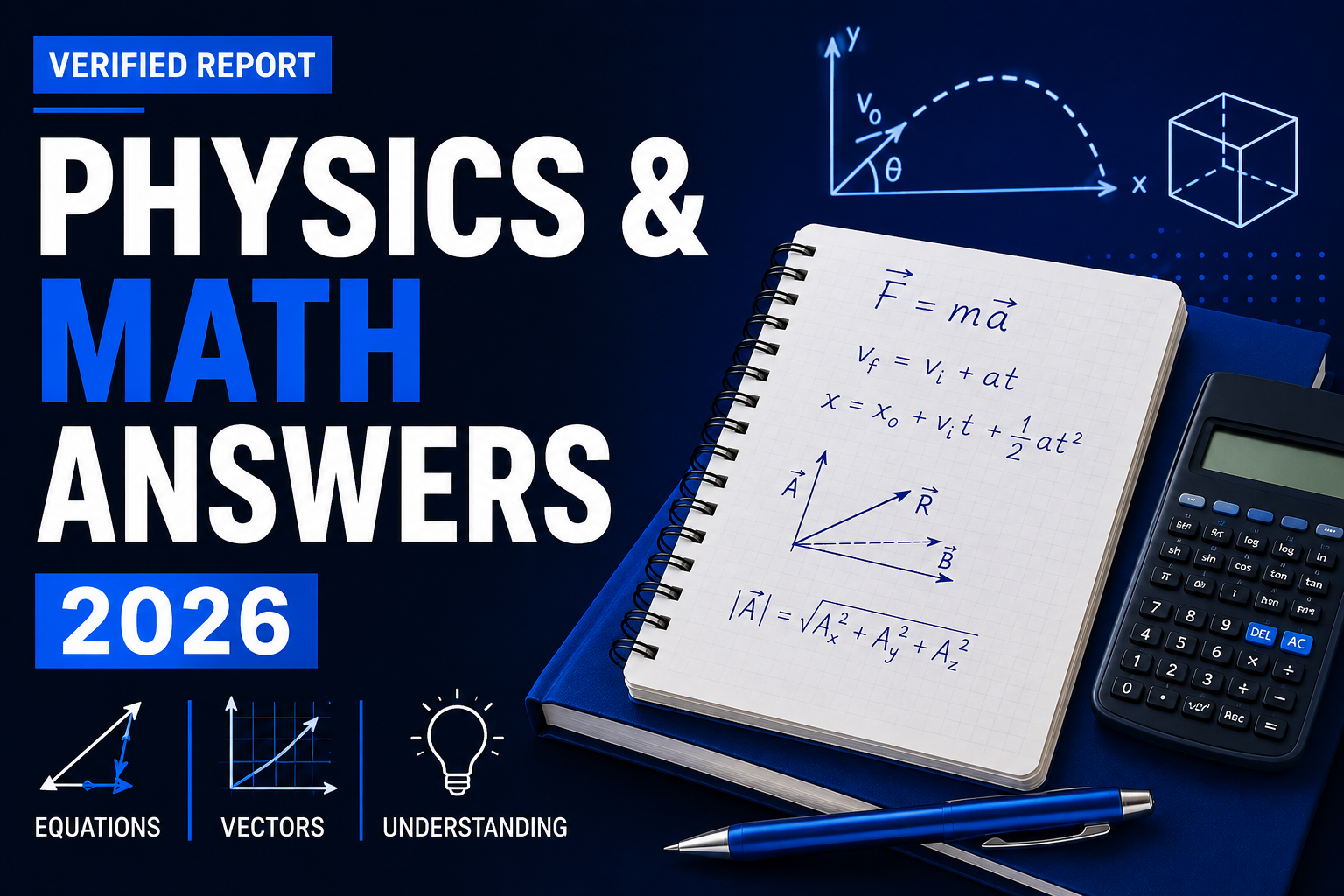
Because mathematical execution and conceptual representation are different cognitive tasks. Projectile motion provides a particularly useful example. Under the standard ideal assumptions used in introductory physics, horizontal and vertical motion can be analyzed independently. Those assumptions include negligible air resistance, constant gravitational acceleration and, when using the familiar flight-time formula, equal launch and landing heights.
The horizontal component of acceleration is:
a_x = 0
The horizontal velocity is therefore:
v_x = v_0 * cos(theta)
and horizontal position evolves as:
x(t) = x_0 + v_0 * cos(theta) * t
Vertical motion follows a different relationship:
a_y = -g
Integrating acceleration gives vertical velocity:
v_y(t) = v_0 * sin(theta) - g * t
and integrating again gives vertical position:
y(t) = y_0 + v_0 * sin(theta) * t - 0.5 * g * t^2
For a projectile returning to its original launch height:
0 = v_0 * sin(theta) * t - 0.5 * g * t^2
which produces the nonzero flight-time solution:
T = 2 * v_0 * sin(theta) / g
The mathematics is straightforward once the model is established. Understanding what the mathematics means is another matter entirely. The derivation is what connects the formula to its physical basis: two separate integrations of a constant acceleration, with the vertical motion alone governing flight time under the stated conditions.
What Does Projectile Motion Reveal About Student Misconceptions?
A 2024 peer-reviewed eye-tracking study examined a specific misconception involving projectile range and flight time. The research found evidence consistent with inhibitory control playing a role when students overcame the mistaken intuition that a projectile traveling farther horizontally must necessarily remain in the air longer.
The scientifically correct relationship is conditional. Under ideal projectile assumptions with negligible air resistance, constant gravitational acceleration and equal launch and landing heights, vertical motion determines the flight time. That is not a universal statement about every projectile in every physical environment. Change the launch height, landing height, gravitational conditions or aerodynamic assumptions and the analysis can change.
This qualification is educationally important. A student who memorizes the statement that horizontal velocity does not affect flight time may reproduce the expected classroom answer while missing the conditions that make the statement true. A student who understands the model instead knows why horizontal and vertical components are separated, what assumptions permit that separation and when the resulting equations apply. That is a deeper form of mathematical understanding than formula recall.
Why Are Vectors So Difficult to Learn?
Vectors expose another gap between symbolic competence and physical understanding. Education research describes vector fields as highly abstract and documents difficulty both in conventional vector representations and in moving between symbolic and graphical forms.
A student might see a vector symbol representing velocity. The same quantity can appear as an arrow with a direction and magnitude. It can then be decomposed into:
v_x = v * cos(theta)
and:
v_y = v * sin(theta)
Those components can become equations of motion, and those equations can then generate a trajectory. Mathematically, these representations describe connected aspects of the same physical system. Educationally, moving between them is not automatic.
The student has to understand that the arrow, magnitude, direction, components, equations and resulting physical motion are not separate pieces of information to memorize. They are different representations of the same underlying relationship. This creates an important distinction between showing mathematics and showing what mathematics represents.
Why Doesn't Putting a Diagram on a Screen Automatically Solve the Problem?
Because representation itself can become part of the learning difficulty. Research reviewed in the sealed evidence base documents difficulties moving not only between symbolic and graphical representations but also between paper-and-pencil and digital environments.
That means digitization alone should not be confused with instructional improvement. A textbook diagram displayed on a laptop is still fundamentally a static diagram. An equation placed inside a web interface is still an equation. An animation is not automatically explanatory merely because it moves. The relevant educational question is whether the representation helps the student connect mathematical operations to the underlying concept. That is a much higher standard than simply moving educational material from paper onto a screen.
Does Chemistry Show Similar Misconception Problems?
The gap between mathematical or verbal familiarity and conceptual understanding is not limited to physics. A 2024 study in the Journal of Chemical Education identified entropy as a threshold concept among first-year undergraduate students and documented persistent alternative conceptions, including inappropriate conservation reasoning and the familiar tendency to equate entropy simply with visual disorder.
That misconception is especially revealing because the phrase entropy equals disorder can function as a memorable educational shortcut. The problem is that a shortcut can become the student's complete model. Once that happens, the student may recognize the word entropy, repeat familiar language about it and possibly perform related calculations while still carrying a distorted understanding of the concept itself. Physics and chemistry therefore expose the same underlying educational challenge from different directions. Knowing the vocabulary is not necessarily understanding the concept. Knowing the formula is not necessarily understanding the model. Producing the answer is not necessarily understanding the reasoning.
Why Does This Matter for the Current STEM Curriculum?
These are not peripheral topics. The current AP Physics 1 framework begins with kinematics and moves through force and translational dynamics, work, energy and power, momentum, rotational mechanics, oscillations and fluids. Kinematics represents approximately 10 to 15 percent of multiple-choice weighting, while force and translational dynamics and work, energy and power each account for approximately 18 to 23 percent. College Board revised the AP Physics frameworks beginning in fall 2024, with another review of clarifications and corrections scheduled for fall 2026.
Current AP Chemistry similarly includes kinetics, thermochemistry, equilibrium, acids and bases, thermodynamics and electrochemistry alongside atomic structure and chemical reactions. The concepts implicated by representation and misconception research therefore sit directly inside mainstream secondary and introductory college STEM education. This is not an argument about obscure mathematical theory. It concerns the foundations students are expected to use repeatedly as their coursework becomes more advanced.
What Is Missing From the Traditional Problem-to-Answer Model?
The simplest mathematical help system can be represented as: Problem to Answer. That structure is efficient. It is also incomplete if the student's difficulty exists somewhere between those two points. The sealed POPR research identifies a candidate alternative: Problem to Concept to Variables to Equation to Derivation to Interactive Representation to Answer to Verification.
This model has not been established through controlled educational-outcome research and should not be represented as proven pedagogy. It is a hypothesis supported by a specific structural observation in the existing literature: misconception research shows that identical scores can conceal different knowledge structures, while representation research shows that moving between mathematical and visual forms can itself be a genuine learning barrier. That creates a legitimate question for educational technology. If the misunderstanding exists inside the reasoning process, should a learning tool expose more of that process?
Where Does POPR Tools Fit Into This?
POPR Technologies operates the POPR Tools Student Hub at poprtools.com/students, a collection of free, no-account student tools covering physics, calculus, chemistry, writing, study support and student-loan calculations. The relationship to the research needs to be stated carefully because POPR owns both this publication and the product. The research does not establish that POPR Tools improves student learning outcomes. No controlled outcome study in the sealed evidence base demonstrates that students using POPR Tools learn more effectively than students using another platform or instructional method.
What can be established is that parts of the live product already implement the candidate architecture discussed above. The Kinematics and Vector Solver shows step-by-step algebraic work. The Vector Components Solver moves between magnitude, angle and component representations. The Projectile Motion Solver provides range, maximum height and time-of-flight calculations with derivation. The Free Body Diagram Builder allows force vectors to be represented graphically. ForceLab combines inclined-plane and friction problems with generated free-body diagrams. The combined FBD and Newton's Second Law Solver connects force representation to mathematical derivation and dimensional checking. The product therefore provides an existing implementation that can be evaluated against the educational hypothesis. It should not be confused with evidence proving the hypothesis.
What Doesn't the Research Establish?
The evidence does not support several broader claims that can sound intuitively appealing. It does not establish that paid homework platforms are inherently bad at teaching students. It does not establish that commercial systems simply tell students they are wrong. Cengage, for example, documents tutorial questions, simulations and study-plan capabilities within some WebAssign products. It does not establish that students abandon physics or chemistry because of a small set of difficult concepts. It does not establish that static textbooks universally fail to explain concepts. And it does not establish that free interactive tools automatically produce better educational outcomes.
Those boundaries matter because the evidence points toward a more interesting problem than a simple argument between old and new educational technology. The question is not whether a tool looks modern. The question is what information about a student's reasoning becomes visible while the student uses it.
The Real STEM Technology Problem May Be Between the Inputs and Outputs
Modern educational technology can calculate almost anything an introductory student is likely to encounter. That does not mean the underlying learning problem has been solved. The 2026 dual-diagnostic research provides perhaps the clearest reason why. If students with similar scores can possess different misconception structures, then the output of an assessment cannot always tell an instructor what happened inside the student's reasoning.
Representation research adds another layer. Students can struggle with the transitions connecting symbols, vectors, graphs and physical behavior. Projectile-motion research shows that even apparently elementary relationships can conflict with intuitive mental models. Chemistry research shows that persistent alternative conceptions can survive around foundational ideas such as entropy. Together, these findings suggest that the educational frontier is not simply faster calculation. It is better visibility into reasoning. That does not mean every equation needs an animation, every answer needs ten intermediate screens or every student needs the same explanation. It means educational systems should distinguish between calculating a result and communicating the structure that makes the result true.
Sources / Works Cited
[1] Physical Review Physics Education Research. 2026 dual-diagnostic misconception study involving 492 high-school students. Study establishes that similar conventional physics scores can conceal different underlying misconception structures.
[2] Peer-reviewed 2024 eye-tracking study examining projectile-motion range and flight-time misconception and evidence consistent with inhibitory control during misconception resolution.
[3] Physics and STEM education research concerning vector representation, symbolic-to-graphical transitions and movement between paper-and-pencil and digital representations, consolidated within the verified research record.
[4] Journal of Chemical Education. 2024 research identifying entropy as a threshold concept and documenting persistent alternative conceptions among first-year undergraduate students.
[5] College Board. AP Physics 1 Course and Exam Description. Current curriculum structure, examination weighting and framework revision information.
[6] College Board. AP Chemistry Course and Exam Description. Current curriculum coverage.
[7] Cengage. WebAssign product documentation describing tutorial questions, simulations, study plans and access-code mechanics.
[8] POPR Technologies Inc. STEM Student Access, Mathematical Friction, and Interactive Learning. Final Sealed, August 2026.
[9] POPR Technologies Inc. POPR Tools Student Hub Inventory v1. Companion product inventory. August 2026.