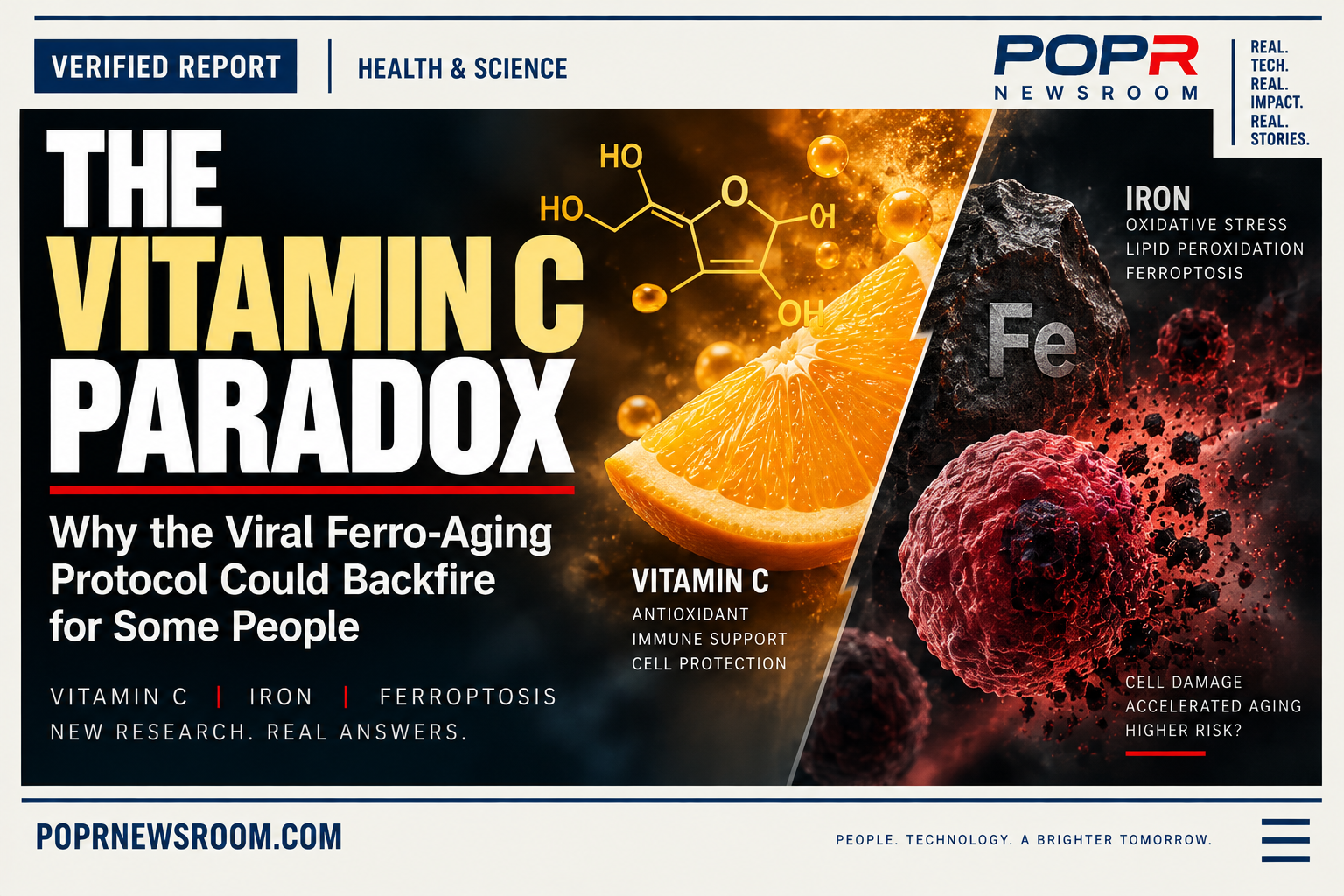
Ferro-aging is an emerging model in which iron-related lipid damage may contribute to cellular aging, but the 2026 vitamin C experiment was conducted in monkeys, not people. It found promising changes involving ACSL4 and aging signatures, yet does not establish that vitamin C reverses human aging or create a safe longevity protocol.
What did the 2026 vitamin C study actually find?
The study found experimental evidence that vitamin C can affect a proposed iron-linked aging pathway in aged cynomolgus monkeys. Researchers combined human cellular and tissue observations with biochemical experiments, mice, gene editing, non-human primates, lipid-peroxidation measurements and multi-omic analyses.
The anchor paper, by Liu and colleagues, reported that vitamin C directly inhibited ACSL4 in functional experiments. The researchers then administered vitamin C to 12-to-16-year-old cynomolgus monkeys for more than 40 months. The reported results included:
- Reduced ferro-aging signatures across tissues.
- Less multi-organ pathology.
- Improvements in neurological and metabolic measures.
- Multi-omic aging-clock changes consistent with reduced biological age.
The study also reported that inhibiting hepatic ACSL4 through gene editing alleviated aging-related phenotypes in mice. That mouse result strengthened the experimental case that ACSL4 may participate in the pathway rather than merely appear as a passive marker.
These results are confirmed within the reported animal experiments. They are not evidence that a human vitamin C supplement protocol has been established.
What is ferro-aging?
Ferro-aging is a proposed chronic aging axis connecting iron dysregulation, ACSL4 activity, vulnerable membrane lipids, lipid peroxidation, cellular senescence and tissue dysfunction.
Iron is essential for hemoglobin, oxygen transport, metabolism and many enzymes. Redox-active iron can also participate in chemistry that generates reactive oxygen species. When that chemistry affects polyunsaturated fatty acids incorporated into cell membranes, lipid peroxidation can occur.
ACSL4, or acyl-CoA synthetase long-chain family member 4, helps process long-chain polyunsaturated fatty acids, including arachidonic and adrenic acids, into forms that can become part of membrane phospholipids. Those PUFA-rich membranes are especially vulnerable to iron-dependent lipid peroxidation.
The proposed model is therefore not:
Iron = aging
It is closer to:
Iron dysregulation + susceptible lipids + ACSL4 activity + lipid peroxidation = a potentially damaging aging-related pathway
That distinction is confirmed as the research framing, while the larger claim that ferro-aging is a clinically important human aging mechanism remains plausible or candidate, not established.
Is ferro-aging the same as ferroptosis?
No. Ferroptosis is an iron-dependent regulated form of cell death characterized by severe lipid peroxidation. Ferro-aging is proposed as a more chronic, lower-grade process in which persistent iron-associated lipid damage may contribute to cellular senescence and progressive tissue dysfunction without immediately killing the cell.
The distinction is important because a cell can be stressed or pushed toward senescence without undergoing acute regulated cell death. The two processes may interact, but they should not be treated as interchangeable terms.
A September 2026 review in Free Radical Biology and Medicine described iron accumulation as “a critical amplifier, rather than a sole driver, of ageing.” It also described interactions among iron dysregulation, mitochondrial dysfunction, oxidative stress, lipid peroxidation, cellular senescence and ferroptosis as a positive feedback loop. That “amplifier, not sole driver” framing is the more defensible public explanation.
Why did vitamin C become part of the ferro-aging story?
Vitamin C became part of the story because the researchers screened 100 molecules previously linked to ferroptosis-related pathways and identified it as a potent ACSL4 inhibitor.
The finding gives vitamin C a proposed role beyond its familiar reputation as a general antioxidant. The study also associated vitamin C with activation of the Nrf2 oxidative-stress-response pathway and direct ACSL4 inhibition.
The long-term monkey intervention used 30 milligrams per kilogram of body weight per day through drinking water after breakfast for 40 months. That is a description of the experiment, not a human recommendation. The species, absorption, metabolism, pharmacokinetics, timing and long-term safety are different questions.
The correct classification is supported in the reported primate experiment: vitamin C affected ferro-aging signatures and several aging-related measures in treated monkeys. The claim that the same intervention produces a geroprotective effect in humans is unconfirmed.
Why is the vitamin C result a paradox?
The paradox is that vitamin C may inhibit ACSL4 in an experimental ferro-aging pathway while also increasing the absorption of non-heme iron.
Those effects occur at different points in biology. One does not cancel the other. A compound can produce a potentially favorable effect in one molecular pathway while creating a concern in a person whose body already handles iron abnormally.
This distinction matters for people with diagnosed iron-overload conditions, including hereditary hemochromatosis. They should not infer a supplement decision from an animal aging experiment. The specific clinical calculation depends on the person’s condition, testing, treatment and professional guidance.
This is also why the headline “take vitamin C to remove the effects of aging” outruns the evidence. The study did not establish a universal dose, identify every population that might benefit, or resolve which populations might face additional risk.
Does ferro-aging mean that everyone should lower their iron?
No. Ferro-aging is not an argument for indiscriminate iron elimination.
Iron deficiency can cause anemia, impair oxygen transport and interfere with normal physiology. Iron also exists in multiple biological compartments that should not be collapsed into one number:
- Total body iron is not the same as serum iron.
- Serum iron is not the same as ferritin.
- Ferritin is not equivalent to tissue iron.
- Tissue iron is not necessarily equivalent to labile intracellular iron.
The research question is therefore about iron homeostasis, localization, storage, redox activity and interaction with susceptible lipids. It is not a general instruction to avoid dietary iron, donate blood for longevity or take iron-removing drugs.
There is currently no clinically validated test that tells a person they have ferro-aging. Conventional iron measures may help clinicians investigate established iron-related conditions, but a single routine result cannot diagnose this proposed aging pathway.
Can the monkey dose be converted into a human supplement dose?
No. The monkey dose cannot be mechanically converted into a human longevity dose.
The intervention involved 30 milligrams per kilogram per day in aged cynomolgus monkeys for 40 months. Translation would require separate evidence about human absorption, plasma saturation, metabolism, species pharmacokinetics, timing, dose and long-term safety.
The KG specifically classifies “everyone should begin high-dose vitamin C supplementation” as not supported. That conclusion follows from the study’s design and from the unresolved difference between an experimental animal intervention and a human treatment.
What is the human evidence?
The human evidence in the anchor paper is observational and mechanistic, not a human intervention trial.
The research included human cells, human blood and tissue observations showing age-related associations involving iron and lipid-peroxidation markers. Those observations give the hypothesis biological credibility. They do not demonstrate that targeting ACSL4 with vitamin C slows human aging.
The decisive missing experiment is a randomized controlled human trial showing whether intervention on ACSL4 or the broader ferro-aging pathway changes meaningful human aging or clinical outcomes. Until that evidence exists, vitamin C’s possible geroprotective role remains candidate research, not established medicine.
What does the follow-up aging review add?
The follow-up review broadens the model beyond iron alone. It places iron dysregulation alongside mitochondrial dysfunction, oxidative stress, lipid peroxidation, cellular senescence and ferroptosis.
Its most useful contribution is the restraint in the causal language: iron accumulation is a critical amplifier, not a sole driver, of aging. That means ferro-aging could become an important contributor without replacing every other explanation of aging or proving that iron is the central cause of all age-related decline.
The review supports a plausible emerging paradigm. It does not establish a clinical diagnostic category, a supplement protocol or a human anti-aging treatment.
What should readers do with this finding?
Readers should treat the study as an important preclinical result, not as a personal prescription.
The defensible takeaways are:
- Confirmed: Vitamin C inhibited ACSL4 experimentally and was associated with reduced ferro-aging signatures in the reported aged-monkey intervention.
- Confirmed in experimental models: ACSL4 participates in an iron-linked lipid-peroxidation pathway.
- Plausible: Ferro-aging may be a meaningful aging mechanism in which iron acts as an amplifier rather than a sole driver.
- Candidate: ACSL4 may become a target for human geroscience.
- Unconfirmed: That vitamin C reverses human biological aging.
- Not supported: That healthy adults should begin an aggressive vitamin C or iron-removal protocol for ferro-aging.
People with iron-related disorders, abnormal iron studies or questions about vitamin C or other supplements should discuss those decisions with a qualified healthcare professional. This report is health and science journalism, not diagnosis, individualized medical advice or a treatment plan.
What is the biggest unanswered question?
The biggest unanswered question is whether this pathway changes human aging in a way that is measurable, safe and clinically meaningful.
Researchers still need to determine where iron accumulates with age, whether the key problem is total iron or labile iron, how ferritin and ferritinophagy regulate the pathway, what controls ACSL4, which organs are most vulnerable, how inflammation and metabolic disease alter iron handling, and whether a safe intervention can reduce lipid peroxidation without creating iron deficiency.
Vitamin C may eventually become part of that story. The current evidence does not make it the protocol.