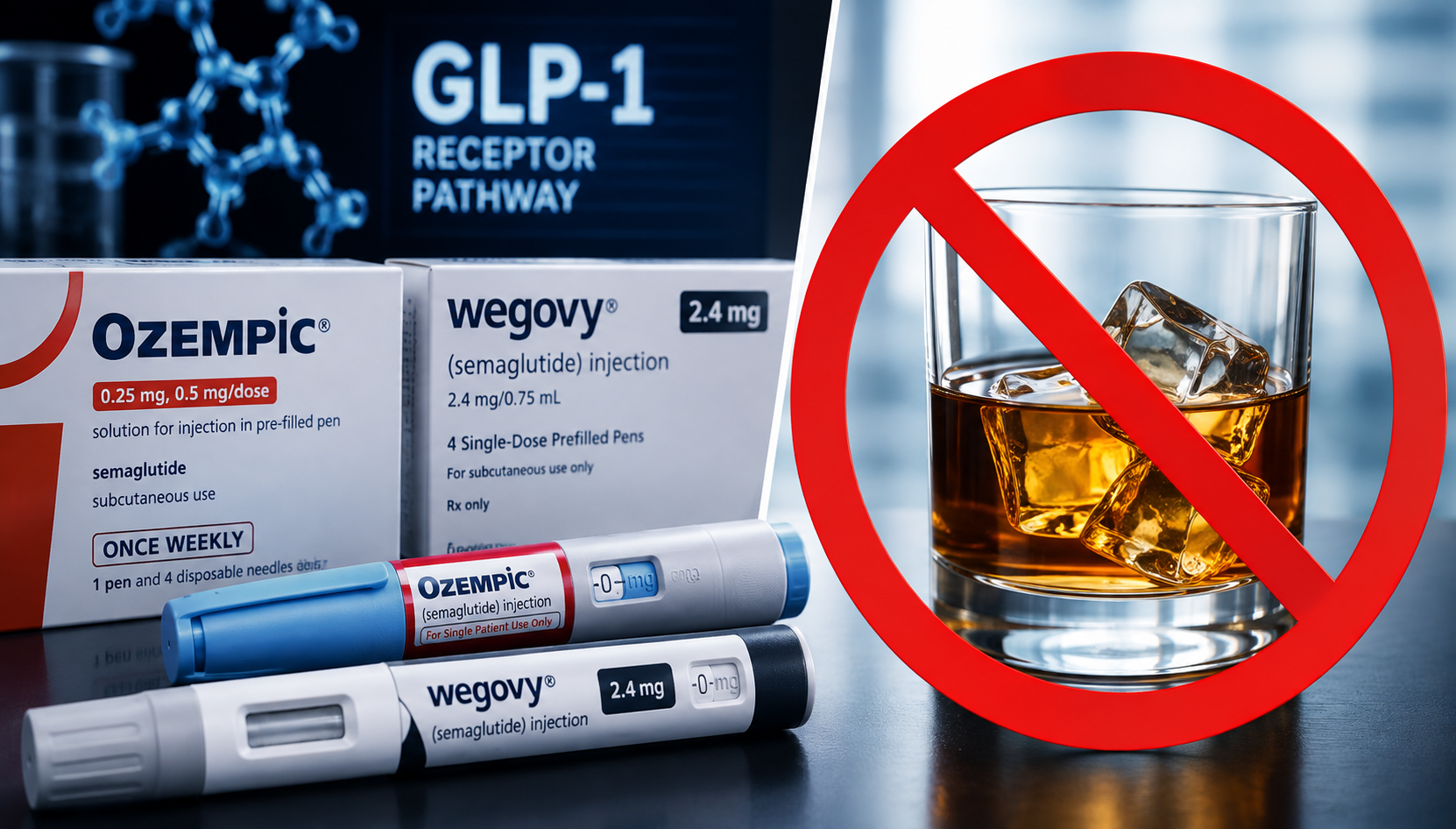
A strange observation began following the rapid growth of GLP-1 medications: some people taking drugs such as semaglutide for diabetes or obesity said they were not only less hungry, but also less interested in alcohol. That observation has now moved well beyond anecdotes. Randomized clinical trials have begun testing semaglutide directly in people with alcohol use disorder, and a major 2026 study found significantly greater reductions in heavy drinking among participants receiving semaglutide than among those receiving placebo. [1]
The Department of Veterans Affairs is now taking the question further through a national Phase 3 trial involving more than 600 veterans at 18 VA medical centers. [2] That does not mean Ozempic has become a cure for alcoholism. It means one of the most unexpected questions in addiction medicine has become a serious clinical research program.
What Did the 2026 Semaglutide Alcohol Trial Actually Find?
The strongest recent evidence comes from a randomized, double-blind, placebo-controlled trial published in The Lancet on May 2, 2026. Researchers enrolled 108 treatment-seeking adults with alcohol use disorder and obesity. Participants received weekly semaglutide or placebo for 26 weeks, and everyone was also offered standard cognitive behavioral therapy for alcohol use disorder. [1]
Heavy drinking decreased in both groups, but the decline was significantly greater among people receiving semaglutide. The semaglutide group also showed larger reductions in total monthly alcohol consumption, drinks per drinking day, self-reported craving, and measures of harmful alcohol use. NIH's summary of the trial also reported greater improvements in several alcohol-related biomarkers and metabolic measures in the semaglutide group. [1]
The underlying study reported a 41.1 percentage-point decrease from baseline in heavy drinking days in the semaglutide group, compared with a 26.4 percentage-point decrease in the placebo group. That figure needs careful interpretation. It does not mean semaglutide "cures alcoholism 41 percent of the time," and it should not be converted into a universal response rate for every patient.
What the study establishes is narrower and more meaningful: semaglutide produced measurable improvements in several alcohol-related outcomes in a controlled trial involving people who were actively seeking treatment for alcohol use disorder and also had obesity. [1]
Was There Evidence Before the 2026 Trial?
Yes, but it was smaller and more preliminary.
A randomized clinical trial published in JAMA Psychiatry in 2025 studied semaglutide in adults with alcohol use disorder. The trial found reductions in laboratory alcohol consumption and alcohol craving, while not every drinking outcome improved significantly. [3]
That mixed pattern is important because it shows how the science developed. Researchers did not move directly from patient anecdotes to declaring semaglutide an addiction treatment. The earlier randomized trial produced enough evidence to justify larger studies, and the 2026 Lancet trial provided a stronger test in a larger treatment-seeking population. [1][3]
A separate large-scale observational study from Sweden, published in JAMA Psychiatry, adds a different kind of evidence to the picture. The registry study linked semaglutide and liraglutide use with significantly fewer alcohol-related hospitalizations among people with both alcohol use disorder and obesity or type 2 diabetes. Observational studies cannot establish causation the way a randomized trial can, and registry populations differ from controlled trial populations in important ways. But the finding complements the randomized trial results by showing a real-world signal in a much larger group of patients than any single clinical trial can enroll. [11]
Clinical research is continuing beyond those two studies. Multiple trials are now registered to test semaglutide in alcohol use disorder and other substance-use conditions, which reinforces that the field remains active rather than settled. [4]
Why Is the Department of Veterans Affairs Studying Semaglutide?
On July 30, 2026, the VA announced the Cessation or Reduction of Alcohol Consumption in Veterans trial, known as CRAVE. The study is designed to test semaglutide against placebo in veterans with moderate or severe alcohol use disorder. [2]
The VA says the trial will enroll more than 600 veterans across 18 medical centers. Participants between ages 18 and 80 will receive weekly semaglutide or placebo for 24 weeks, followed by safety follow-up. Researchers will measure drinking, health, and quality of life. Recruitment began July 28, 2026. [2]
ClinicalTrials.gov also lists the study as a randomized trial evaluating the effectiveness and safety of semaglutide for alcohol use disorder in veterans. [4]
The Phase 3 designation matters because later-stage clinical trials are designed to provide stronger evidence about effectiveness and safety than early exploratory studies. It does not mean semaglutide has already been proven as an alcohol-treatment medication.
The better interpretation is that the evidence has become strong enough for a large federal health system to test the question seriously.
Why Would a Weight-Loss Drug Affect Alcohol Craving?
GLP-1, or glucagon-like peptide-1, is a hormone involved in blood-sugar regulation, digestion, appetite, and satiety. Semaglutide activates GLP-1 receptors, which is one reason it became important in diabetes and obesity treatment.
The biological story does not stop in the gut.
Researchers are studying GLP-1 signaling in brain systems involved in reward, motivation, and addictive behavior. Recent reviews describe a growing body of preclinical and early clinical evidence suggesting that GLP-1 receptor agonists can influence alcohol-related reward and consumption. [5]
That provides a plausible explanation for why a medication originally developed around metabolism could affect alcohol craving. Brain reward systems and metabolic signaling interact more than the traditional separation between "metabolic medicine" and "addiction medicine" might suggest.
The mechanism, however, is not fully established. Researchers are still working out how much of the observed effect comes from direct reward-circuit changes and how much might involve other effects of GLP-1 medications, including satiety, gastric emptying, nausea, or broader changes in motivation and reinforcement. [5]
That distinction matters because a plausible biological pathway is not the same thing as a completely proven explanation.
Does Semaglutide Reset the Addicted Brain?
There is not enough evidence to make that claim.
The strongest human data support a much narrower conclusion: semaglutide has reduced alcohol craving and several measures of alcohol consumption in randomized clinical trials. [1][3]
That is already important.
It does not establish that semaglutide permanently repairs, resets, or rewires reward circuitry. Alcohol use disorder involves learning, stress, memory, environment, social context, reinforcement, and individual biology in addition to any one hormonal or neural pathway.
Long-term durability is also still unknown. The major trials conducted so far have followed people for months, not years. Researchers still need to determine whether the observed benefits persist with longer treatment and what happens after the medication is stopped.
A medication could eventually become a useful part of addiction treatment without being described as a permanent neurological reset.
Is Ozempic Approved to Treat Alcohol Addiction?
No.
Semaglutide is FDA approved for several metabolic indications under products such as Ozempic and Wegovy. Current FDA and federal treatment information does not list alcohol use disorder as an approved indication for semaglutide. [6]
Using semaglutide specifically to treat alcohol use disorder would therefore be an off-label use.
Off-label prescribing is a normal part of medical practice in some circumstances. It means a clinician is prescribing an approved medication for a use that is not part of its current FDA-approved labeling. It does not mean that the medication has completed the regulatory approval process for alcohol use disorder.
That is one reason the CRAVE trial and other controlled studies matter.
Should Someone With Alcohol Use Disorder Start Taking Ozempic Because of This Research?
The evidence does not support self-medicating.
The VA specifically says it strongly discourages self-medication or attempts to replace established alcohol-use-disorder treatments with GLP-1 medications or other unprescribed substances. The agency advises veterans to consult healthcare providers before making treatment decisions. [2]
Established treatments for alcohol use disorder already exist. The National Institute on Alcohol Abuse and Alcoholism identifies three FDA-approved medications: naltrexone, acamprosate, and disulfiram. These can be used alone or alongside behavioral treatments and mutual-support approaches depending on the individual treatment plan. [7]
The current research question is whether semaglutide might eventually become another useful treatment option.
That is very different from saying someone should abandon treatments that already have an established evidence base.
How Does Semaglutide Compare With Naltrexone?
They do not currently have the same regulatory or evidence status.
Naltrexone is FDA approved for alcohol use disorder and has an established treatment role. Acamprosate and disulfiram are also FDA approved for AUD. [7]
Semaglutide is not approved for alcohol use disorder. It now has meaningful randomized human evidence behind it, but major questions remain about patient selection, optimal dosing, duration of treatment, long-term outcomes, and how it should fit alongside existing medications and behavioral care. [1][2][3]
The 2026 Lancet trial is particularly useful here because participants were offered cognitive behavioral therapy in addition to medication or placebo. The study therefore does not support framing semaglutide as a replacement for every other form of treatment. [1]
If future Phase 3 trials support semaglutide for alcohol use disorder, treatment guidelines may eventually change.
They have not changed simply because the research is promising.
Could GLP-1 Drugs Affect Nicotine or Other Addictions?
Researchers are studying that possibility, but the evidence differs substantially by substance.
Semaglutide has been examined in cigarette-smoking research, and ClinicalTrials.gov lists ongoing research involving opioid use disorder, methamphetamine use disorder, and other substance-use conditions. [8][9]
That does not justify one broad conclusion that "GLP-1 treats addiction."
Alcohol currently has direct randomized human evidence from published clinical trials. Other proposed uses remain at different stages of development and need to be evaluated separately.
Substance use disorders are not interchangeable conditions, and one medication's effect on alcohol craving cannot simply be assumed to apply equally to nicotine, opioids, stimulants, or other substances.
Does Tirzepatide Have the Same Evidence?
Not yet.
Tirzepatide is another metabolic medication being studied in connection with alcohol use and related behaviors, but the strongest randomized human evidence discussed here involves semaglutide.
ClinicalTrials.gov lists research specifically testing tirzepatide in alcohol-use-related populations, which shows that the broader incretin field is expanding. [10]
But class association is not enough.
A result obtained with semaglutide should not automatically be attributed to tirzepatide or every other GLP-1-related medication. Each drug needs its own clinical evidence.
Why Could This Matter for Recovery?
Craving is not simply a matter of deciding that alcohol sounds appealing.
It can involve learned cues, reward expectation, stress responses, memory, emotional state, and deeply reinforced behavioral patterns. For some people, reducing craving may create more space to engage effectively with therapy, medication, recovery support, and other forms of care.
That is one reason GLP-1 research is scientifically interesting.
Medication can address one biological layer. Therapy can address patterns of behavior and thinking. Recovery support can address connection, accountability, routine, and long-term change.
Those systems do not have to compete with one another.
NIAAA likewise describes medications as tools that can be combined with behavioral treatment and mutual-support approaches rather than as a universal replacement for them. [7]
What Does the Gut-Brain Connection Have to Do With It?
The GLP-1 story is also a useful example of the connection between metabolic signaling and brain function.
GLP-1 is closely associated with the gastrointestinal system, but its receptors and downstream effects extend into neural systems involved in appetite, reward, and motivation. Research into those pathways is helping scientists ask whether the same biology involved in food-related reward might also influence alcohol-seeking behavior. [5]
That broader biology, including craving, reward circuitry, nervous-system recovery, and the physical changes that can accompany sobriety, is explored in greater depth at SoberBrainReset.com.
Readers who want the full research trail behind this specific topic can read The GLP-1 Addiction Connection, a POPR MicroBooks report covering the clinical studies, proposed biological mechanisms, regulatory status, and major unanswered questions.
Those resources should be understood as educational tools, not as substitutes for treatment or clinical evaluation.
What Do Researchers Still Need to Learn?
One major question is who responds best.
The 2026 Lancet trial specifically studied people with alcohol use disorder and obesity. The authors and NIH both note that additional trials are needed to determine whether the results generalize to people without obesity. [1]
Optimal dosing for alcohol use disorder is not established.
Long-term treatment duration is not established.
Researchers still need better evidence about what happens after medication stops, whether reductions in craving persist, how semaglutide compares directly with established AUD medications, and whether certain combinations of medication and behavioral treatment work better than others.
The CRAVE trial is designed to help answer some of those questions in a larger veteran population. [2][4]
Broader questions involving nicotine, opioids, stimulants, and other substance use disorders remain even earlier.
These uncertainties are not evidence that the research is weak. They are evidence that the field is still developing.
The Bigger GLP-1 Story Is Moving Beyond Weight Loss
For years, public discussion of GLP-1 medications centered primarily on blood sugar, appetite, and weight.
Alcohol research is widening that picture.
The 2025 JAMA Psychiatry trial produced early randomized evidence. The 2026 Lancet trial produced stronger results in people with alcohol use disorder and obesity. The VA has now launched a large Phase 3 program. [1][2][3]
That progression is why the subject deserves serious attention.
The important development is not that scientists have found a cure for addiction. They have not.
The development is that an observation once treated largely as anecdotal has moved into randomized human research and national clinical testing.
The responsible conclusion in 2026 sits between hype and dismissal.
Semaglutide is not an approved alcohol-use-disorder medication, and its long-term role remains uncertain. But the evidence that it can reduce alcohol craving and several drinking outcomes in studied populations is now real enough that the question can no longer be treated as speculation alone.