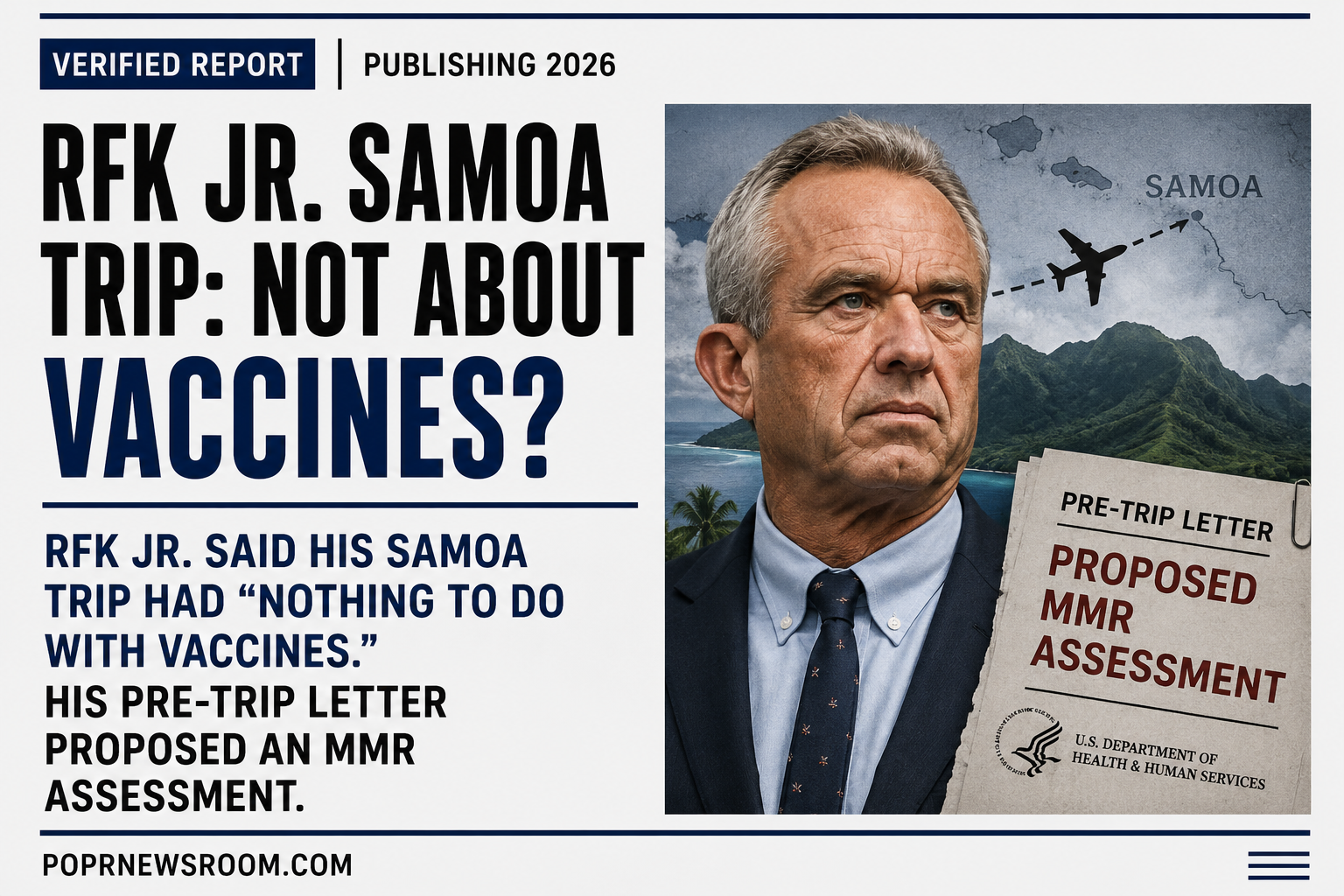
Robert F. Kennedy Jr. told senators that his 2019 Samoa trip had “nothing to do with vaccines,” but a January 20, 2019 letter he wrote before traveling proposed a “detailed health informatics assessment” involving Samoa’s MMR vaccines. The documents establish a factual conflict, not that Kennedy caused the outbreak, committed perjury, or violated federal law.
What did Kennedy tell Congress about his Samoa trip?
The confirmed congressional record shows that Kennedy described the trip as a medical-informatics mission. During his January 2025 confirmation proceedings, he said he went to Samoa to introduce a system that could digitize medical records and improve health delivery.
When Senator Ed Markey questioned him about the visit, Kennedy made the description categorical: “My purpose in going down there had nothing to do with vaccines.” He also explained that he met people in Samoa, including some he had not originally intended to meet.
That account is part of the verified record as Kennedy's explanation. It does not, by itself, establish that medical informatics was the only subject discussed during the trip. The question raised by the later documents is whether the phrase “nothing to do with vaccines” can be reconciled literally with what Kennedy had proposed before he traveled.
What did Kennedy's January 2019 letter propose?
The load-bearing document is a January 20, 2019 letter Kennedy wrote to then-Prime Minister Tuilaepa Sailele Malielegaoi while Kennedy was chairman and chief legal counsel of Children's Health Defense.
The letter discussed the deaths of two Samoan infants after MMR vaccinations were improperly prepared in 2018. Kennedy raised questions about what had happened and proposed that his team conduct a “detailed health informatics assessment in Samoa of what happened with your MMR vaccines.”
The proposal therefore joined health informatics and vaccine-related assessment in the same pre-trip document. Public reporting on the letter noted that vaccine or vaccination language appeared repeatedly, and the prime minister responded positively to the proposed assessment.
The confirmed finding is limited but direct: before Kennedy traveled to Samoa, vaccine-related work had been formally proposed to the country's head of government. The letter does not show that vaccines were the trip's sole purpose, and it does not establish Kennedy's subjective intent years later.
Why does the pre-trip letter create a documentary conflict?
The conflict comes from chronology and wording, not from an assumption about Kennedy's motive. The January letter predates the May or June 2019 trip, and it explicitly proposes work concerning Samoa's MMR vaccines.
A trip can have multiple purposes. The letter does not require POPR to conclude that Kennedy's medical-informatics explanation was wholly fabricated. It does, however, make a categorical statement that the trip had “nothing to do with vaccines” difficult to reconcile with the contemporaneous proposal.
This is a documented contradiction between a person's later description and his earlier written proposal. It is not a finding that Kennedy intended to mislead Congress, and it is not proof that a crime occurred.
What was the significance of Kennedy's November 2019 letter?
The November document is separate from the January pre-trip letter and must be kept in its proper place in the chronology. Kennedy wrote it on November 19, 2019, during Samoa's active measles outbreak and months after his visit.
In that letter, as documented in independent reporting including CBS News, Kennedy argued that Samoa should determine whether the outbreak resulted from inadequate vaccination coverage or alternatively from what he described as a “defective vaccine.” POPR reports those statements as Kennedy's argument. The record does not adopt the defective-vaccine hypothesis as scientifically established.
The November letter confirms continued vaccine-related engagement during the outbreak. It cannot, by itself, prove what the original purpose of the earlier trip was. The January letter is stronger evidence on that question because it came before the trip and proposed the assessment directly.
What happened to Samoa's measles vaccination program before the outbreak?
Samoa's vaccine crisis began before Kennedy arrived. In 2018, two infants died after MMR doses were mixed with vecuronium bromide, a muscle relaxant, instead of the proper diluent. The nurses responsible were criminally charged and ultimately pleaded guilty to manslaughter. The underlying MMR vaccine was not established as defective.
The deaths severely damaged public confidence, and Samoa suspended routine MMR vaccination for approximately ten months. Vaccination resumed around April 2019. WHO data show that measles-containing-vaccine coverage in 2018 was approximately 31 percent for the first dose and 13 percent for the second dose.
Those figures establish a severely depressed immunity baseline before the later outbreak. They do not assign the entire decline to a single cause. Confidence, misinformation, health-system conditions and other factors can interact, and the record does not provide a defensible percentage of the decline attributable specifically to Kennedy.
How large was Samoa's 2019 measles outbreak?
Samoa declared a measles outbreak in October 2019. WHO and independent reporting place the final scale at more than 5,700 cases and 83 deaths, with most deaths among young children, particularly children younger than five.
The timing explains why Kennedy's visit has become politically explosive. He traveled to Samoa before the outbreak, and Samoan health leaders have said his prominence emboldened local anti-vaccine activists. Samoa's Ministry of Health has also said there was “no conclusive evidence” that Kennedy's visit directly caused declining vaccination rates or the subsequent outbreak.
Both attributed assessments belong in the public record. POPR cannot turn either one into an independent epidemiological finding. No evidence reviewed for this report establishes that Kennedy caused the outbreak, caused any particular infection or caused any of the 83 deaths.
What does HHS say about the Samoa documents?
HHS denies wrongdoing and maintains that Kennedy's Samoa visit was unrelated to vaccines. The department has also said allegations or insinuations that Kennedy lied under oath or lied to Congress based on the letters are false and defamatory.
That response is material because the documents establish what Kennedy wrote before the trip, not his internal state of mind when he later described it. HHS's position preserves the possibility that the trip's principal purpose was medical informatics even if vaccine-related assessment was part of the proposed work surrounding it.
The defensible description is therefore a dispute between a categorical congressional account and a contemporaneous written proposal, with HHS rejecting the implication that the documents establish wrongdoing.
Do the documents establish perjury or a federal crime?
No. Independent reporting states that Kennedy was not under oath during the confirmation testimony at issue. Senator Markey used under-oath language while questioning Kennedy, but the procedural record reviewed for this report does not support describing the disputed statement as sworn testimony.
American Oversight has asked the Department of Justice to investigate whether Kennedy's statements could implicate 18 U.S.C. § 1001, and Senator Ron Wyden has called for a criminal investigation and referral. Those are requests for investigation, not findings that a crime occurred.
Section 1001 can apply to certain materially false statements made knowingly and willfully without an oath, but its application to congressional matters is subject to legislative-branch limitations. Any criminal case would also require the government to establish the statute's applicable jurisdictional, falsity, materiality and intent elements.
Nothing in the record reviewed establishes that Kennedy violated the statute. No criminal charge is established, and a documentary contradiction alone does not prove the state of mind required for criminal liability.
What has been the political reaction?
Democratic lawmakers have responded forcefully to the disclosed records. Wyden has called for a criminal investigation, Markey has said Kennedy cannot be trusted to continue leading HHS, and Hawaii Governor Josh Green has called for Kennedy's resignation.
Those are attributed political judgments. They are not independent findings that Kennedy committed a crime or caused Samoa's outbreak.
The documented Republican response is narrower. Senator Susan Collins voted to confirm Kennedy, and her spokesperson said Collins has long disagreed with Kennedy over vaccines when asked whether the disclosure changed her view of that vote. That response should not be expanded into a claim that Republicans broadly support investigation or removal.
Senator Bill Cassidy has separately criticized Kennedy over vaccine-policy commitments made during the confirmation process. That criticism predates the newly disclosed Samoa-letter controversy and should not be presented as a direct reaction to these documents without later evidence.
What does the evidence establish and leave unresolved?
The strongest evidence is the simplest evidence. Before traveling to Samoa, Kennedy wrote the prime minister and proposed a health-informatics assessment concerning Samoa's MMR vaccines. Years later, while seeking Senate confirmation, he said the purpose of the trip had “nothing to do with vaccines.”
The record establishes a documentary conflict. It also establishes that Samoa entered the 2019 outbreak period with extremely low measles vaccination coverage after the 2018 preparation deaths and the suspension of routine vaccination. It does not establish that vaccines were the only purpose of Kennedy's trip, that his medical-informatics explanation was fabricated, or that he knowingly intended to deceive Congress.
The record further does not establish that Kennedy caused Samoa's outbreak, caused any death, committed perjury or violated 18 U.S.C. § 1001. HHS denies wrongdoing, while American Oversight and Wyden have requested investigation. Those positions and requests remain distinct from adjudicated findings.
What is the verified fact summary?
Robert F. Kennedy Jr. told senators during his 2025 confirmation proceedings that his purpose in traveling to Samoa in 2019 had “nothing to do with vaccines” and said the trip concerned a medical-informatics system for digitizing health records.
A January 20, 2019 letter written before that trip shows Kennedy proposing a detailed health-informatics assessment concerning Samoa's MMR vaccines. A separate November 19, 2019 letter written during the outbreak shows continued vaccine-related engagement, but it cannot establish the original purpose of the earlier trip.
Samoa suffered more than 5,700 measles cases and 83 deaths during the 2019 outbreak after entering the period with extremely low measles immunization coverage. The evidence reviewed does not establish that Kennedy caused the outbreak, caused any death, committed perjury or violated the federal false-statements statute.
The verified story is narrower than the surrounding political rhetoric: Kennedy's categorical congressional description of the trip conflicts with contemporaneous documentary evidence showing that vaccine-related assessment work was proposed before he traveled.