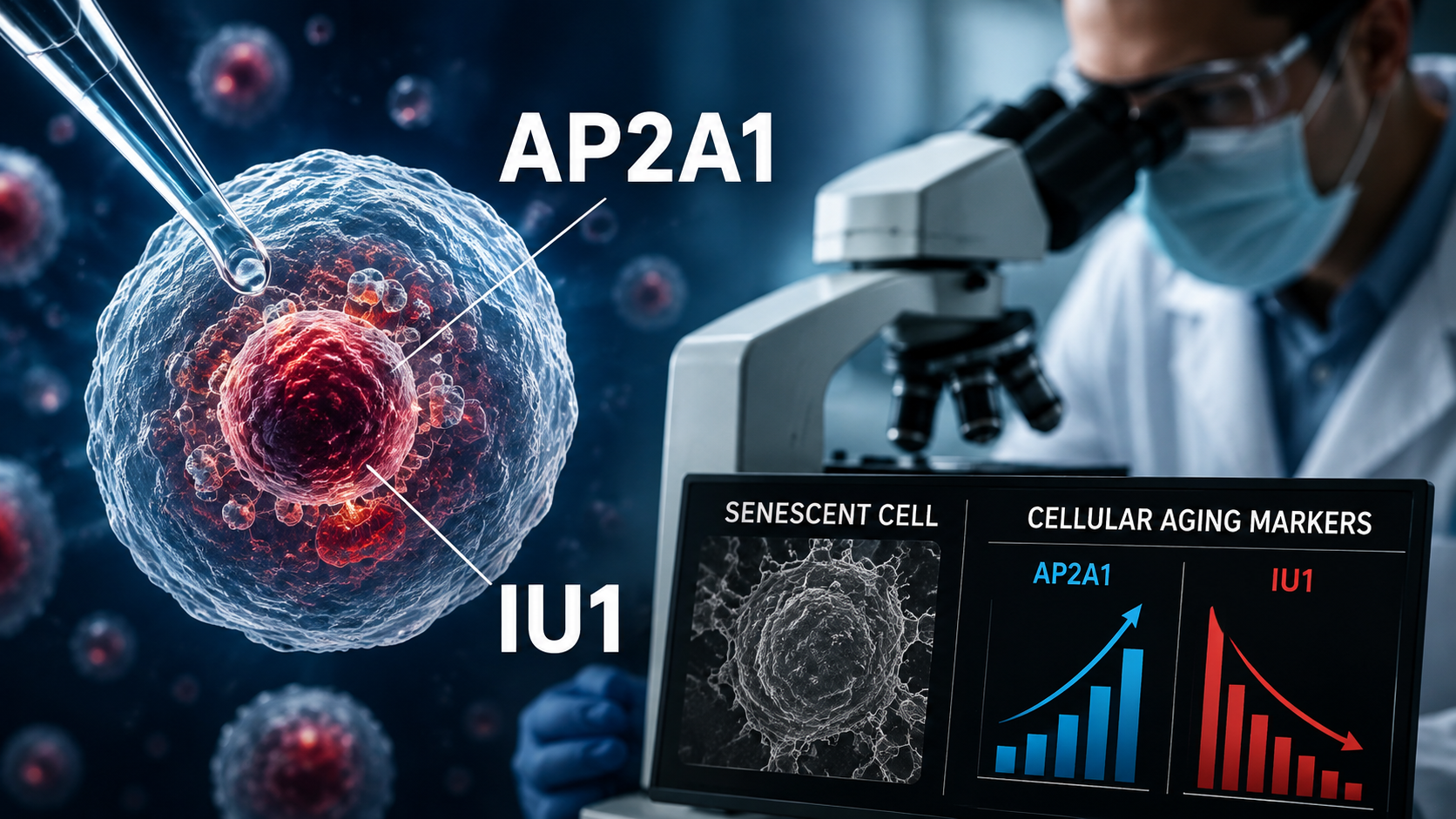
"Zombie cells" sound like something scientists should simply destroy. The biology is considerably more complicated. The term usually refers to senescent cells: living cells that have entered a stable state of growth arrest and can undergo major structural, metabolic, and signaling changes. Senescence can help suppress tumors and participate in normal biological processes, while persistent accumulation of senescent cells and their inflammatory signaling can contribute to tissue dysfunction and age-related disease. [1]
That complicated biology is now colliding with a much simpler story online: scientists have supposedly discovered how to reverse aging cells, improve the body's cellular cleanup machinery, and perhaps open the door to radical human lifespan extension.
Two real studies helped create that story. One came from the University of Osaka and involved a protein called AP2A1. Another came from Chung-Ang University and involved USP14 inhibition with an experimental compound called IU1.
Both findings are scientifically interesting.
They are also two different discoveries.
No research team combined AP2A1 manipulation and IU1 into one anti-aging treatment. Neither study demonstrated human lifespan extension. Neither established a treatment that people can use today to rejuvenate their bodies.
Understanding that separation reveals something more useful than the viral version of the story: scientists are beginning to identify very different biological systems that contribute to what we collectively call cellular aging.
What Are Zombie Cells?
The scientific term behind the nickname is cellular senescence.
A senescent cell remains alive but enters a stable growth arrest. Senescence can be triggered by different forms of cellular stress and is associated with changes including cell-cycle inhibitors such as p16 and p21, metabolic and structural alterations, persistent DNA-damage responses, and, in many senescent cells, a complex signaling program known as the senescence-associated secretory phenotype, or SASP. [1]
The nickname "zombie cell" is useful because these cells can remain metabolically active after they have stopped dividing. It can also be misleading because it makes senescence sound universally harmful.
It is not.
Cellular senescence has important biological functions. Stopping a damaged cell from dividing can act as a tumor-suppressive mechanism. Senescence also participates in tissue repair and other physiological processes. The trouble arises when particular populations of senescent cells persist and accumulate, especially when their signaling begins altering surrounding tissue. [1]
The SASP itself is not one universal toxic substance. Its composition and biological effects can vary substantially depending on the cell, tissue, cause of senescence, and surrounding environment. That heterogeneity is one reason treating cellular senescence is harder than simply developing a drug that "kills zombie cells."
What Did Scientists Discover About AP2A1?
Researchers at the University of Osaka investigated a physical feature of senescent cells that is obvious under a microscope but had remained incompletely understood: why they often become unusually large and flattened.
Their study, published in Cellular Signalling in 2025, identified a protein called AP2A1 as an important part of that cellular architecture. The researchers found that AP2A1 was upregulated in replicative senescent human fibroblasts and appeared along enlarged stress fibers inside the cells. AP2A1 also colocalized with integrin beta-1, a protein involved in cell adhesion. [2]
Then the researchers manipulated AP2A1.
Reducing AP2A1 in senescent cells reversed several senescence-associated phenotypes and produced what the researchers described as features of cellular rejuvenation. Increasing AP2A1 in younger cells pushed them toward senescence-associated features. The researchers also observed elevated AP2A1 in additional senescence models involving ultraviolet exposure, drug-induced senescence, and epithelial cells. [2]
That bidirectional result makes AP2A1 more interesting than a protein that merely happens to appear in old cells. It suggests AP2A1 participates in maintaining aspects of the senescent state and could potentially become a biomarker or future therapeutic target.
But the experimental boundary is crucial.
These experiments involved cultured cells.
They were not performed in living humans. They were not a human clinical trial. Researchers did not demonstrate that reducing AP2A1 throughout a person's body reverses aging, and they did not measure lifespan.
The paper established an important cellular mechanism, not a finished rejuvenation therapy. [2]
Did AP2A1 Actually Reverse Cellular Aging?
The answer depends on exactly what is meant by "reverse."
The researchers themselves used the language of rejuvenation because reducing AP2A1 reversed several measured senescence-associated phenotypes. That language is legitimate when kept inside the experimental context of the paper. [2]
It becomes misleading when "features of cellular rejuvenation" becomes "scientists reversed human aging."
Those are not equivalent claims.
A cultured cell changing size, architecture, proliferation characteristics, or molecular markers does not demonstrate that an aging human body has become biologically younger.
There is another reason for caution. Senescence is partly a protective response. If a cell stopped dividing because it accumulated dangerous damage, simply forcing that cell back toward proliferation without resolving the underlying damage could create a different biological risk.
Any future senoreversion therapy would therefore need to establish more than whether senescence markers decrease. Researchers would need to determine whether restored cells are healthy, stable, and safe.
That is a much higher bar than making an old-looking cell look younger in a laboratory experiment.
What Did the IU1 Study Actually Discover?
The second study tells a completely different story.
Researchers at Chung-Ang University and the Daegu-Gyeongbuk Institute of Science and Technology studied proteostasis: the systems cells use to maintain proteins and remove damaged or misfolded ones.
One important component of that machinery is the ubiquitin-proteasome system. USP14 is an enzyme associated with the proteasome that can regulate how proteins are processed.
The researchers used an experimental compound called IU1 to inhibit USP14.
Their study, published in Autophagy, found that pharmacological inhibition of USP14 improved age- or stress-related declines in proteostasis and autophagy in fruit flies and cultured human cells. In aging Drosophila, IU1 reduced accumulations of polyubiquitinated proteins in flight muscle, improved locomotor activity, and extended lifespan. [3]
The effect depended on proteasomal activity. When proteasome function was inhibited, IU1's benefit disappeared. The effect remained evident when proteostasis was disrupted through mutation of the gene foxo. [3]
Those are substantial findings.
They are not evidence that IU1 rejuvenates human beings.
The lifespan experiment happened in fruit flies.
Is IU1 a Zombie-Cell-Killing Senolytic?
The 2024 study does not establish that.
This is one of the most important distinctions in the entire story.
The IU1 paper investigated proteostasis, autophagy, and aging. It did not demonstrate that IU1 selectively identifies and eliminates senescent cells. Its central mechanism involved USP14 inhibition and cellular protein-quality-control systems. [3]
That places IU1 research within a fascinating part of aging biology, but it should not simply be converted into a senolytic treatment because both subjects involve aging.
Aging is not one pathway.
Cellular senescence, protein quality control, mitochondrial function, genomic stability, immune function, metabolism, and many other biological systems interact during aging. Improving one system does not automatically mean another has been repaired.
That is precisely what happened when the AP2A1 and IU1 stories began traveling together.
Were AP2A1 and IU1 Ever Combined Into One Anti-Aging Treatment?
No evidence from either primary paper establishes such a treatment.
The AP2A1 research came from the University of Osaka and examined cellular senescence, cell architecture, stress fibers, and adhesion. [2]
The IU1 research came from Chung-Ang University and collaborators and examined USP14 inhibition, proteostasis, autophagy, and lifespan in fruit flies. [3]
Different research teams.
Different biological targets.
Different experiments.
Different organisms and experimental systems.
Neither paper presents the other mechanism as part of a combined treatment.
They can reasonably be discussed together under the much larger subject of cellular maintenance and aging biology. They cannot responsibly be transformed into evidence for a single therapy that reverses aging.
Can These Discoveries Help Humans Live to 250?
There is no evidence in either study supporting a 250-year human lifespan.
The AP2A1 study did not measure lifespan at all. [2]
The IU1 study measured lifespan in fruit flies, not humans. [3]
A result in Drosophila can be extremely valuable scientifically. Fruit flies are widely used in biological research because many fundamental cellular pathways are conserved across species. But a lifespan effect in a fly cannot simply be converted into an expected lifespan effect in a human.
The same evidence rule applies to cultured human cells.
A human cell in a laboratory dish is biologically human, but it is not a human organism with an immune system, cardiovascular system, metabolism, nervous system, organs, and decades of accumulated biological history.
"Human cells" and "tested in humans" are therefore not interchangeable phrases.
Neither AP2A1 nor IU1 currently provides evidence that humans can live to 250.
Are Scientists Actually Trying to Remove Zombie Cells From Humans?
Yes, and this is where the story becomes particularly important.
A class of experimental therapies called senolytics is designed to selectively eliminate certain senescent cells. Researchers have already moved some senolytic strategies into human trials.
One of the best-known combinations is dasatinib plus quercetin, commonly abbreviated D+Q. Dasatinib is a prescription cancer drug, while quercetin is a naturally occurring flavonoid also sold as a dietary supplement.
A Phase 2 randomized controlled trial published in Nature Medicine in 2024 tested intermittent D+Q treatment in 60 postmenopausal women. Researchers examined bone metabolism and markers associated with cellular senescence. [4]
The primary endpoint, a bone-resorption marker measured at 20 weeks, did not differ significantly between the treatment and control groups. A secondary bone-formation marker increased at earlier measurements but was not significantly different at 20 weeks. No serious adverse events were observed. [4]
The study also generated biological findings that researchers considered useful for determining how future senolytic trials should be designed.
What it did not establish was a general anti-aging treatment for healthy humans.
That distinction is consistent with the current state of the field.
Why Haven't Senolytics Already Become Anti-Aging Drugs?
One major problem is that senescent cells are heterogeneous.
Scientists do not have one perfect universal marker that identifies every harmful senescent cell across every human tissue. Different senescent cells can express different markers and produce different secretory profiles.
That creates an enormous treatment problem.
Before researchers can prove that a senolytic therapy works, they need to know which senescent cells should be targeted, how to identify them, whether the intervention actually removed those cells, and whether eliminating them improves a meaningful health outcome.
A 2025 Nature Aging perspective from Mayo Clinic and University of Arizona researchers described exactly this challenge. The authors concluded that early human senolytic trials have produced positive biological signals but that clear evidence of efficacy in humans is still lacking. They argue that future trials may need to become more personalized, selecting patients and interventions according to specific senescent-cell characteristics and biological profiles. [5]
That is a very different future from one universal zombie-cell pill.
It may also be a more scientifically realistic one.
Should People Take Dasatinib, Quercetin or Fisetin to Kill Zombie Cells?
Existing research does not establish a general self-treatment protocol for healthy people seeking to slow aging.
That distinction is especially important for dasatinib. Dasatinib is a prescription medication used in cancer treatment, not an ordinary longevity supplement. The fact that researchers investigate it as part of an intermittent senolytic combination does not make unsupervised use safe.
Quercetin and fisetin are available as dietary supplements, but retail availability is not evidence that a particular dose or schedule has been proven to clear harmful senescent cells throughout a healthy human body or extend human lifespan.
Research studies answer specific questions in defined populations using controlled protocols.
They should not automatically be converted into consumer biohacking instructions.
What About Fasting, Exercise and Autophagy?
Exercise, sleep, nutrition, and metabolic health matter enormously for human health, but they should not be described as substitutes for the specific molecular interventions investigated in the AP2A1 and IU1 studies.
Exercise can influence inflammation, insulin sensitivity, mitochondrial function, and many other systems associated with healthy aging.
Fasting and nutrient availability can influence pathways involved in cellular stress responses and autophagy.
Neither has been shown to reproduce targeted AP2A1 suppression.
Neither is equivalent to pharmacologically inhibiting USP14 with IU1.
Neither has been demonstrated to selectively clear every harmful senescent cell from the human body.
This is another place where the language of biohacking can outrun the underlying experiment. A lifestyle behavior may influence the same broad biological system researchers are studying without reproducing a specific laboratory intervention.
Both statements can be true: lifestyle matters profoundly, and it is not a laboratory anti-aging drug.
Is More Autophagy Always Better?
No simple rule like that is supported by biology.
Autophagy is an essential cellular recycling and quality-control process. It helps cells remove damaged components and respond to changing nutrient and stress conditions.
But biological pathways are context dependent.
The IU1 study itself is interesting partly because USP14 inhibition affected both the ubiquitin-proteasome system and autophagy rather than operating as a generic instruction to maximize one cellular cleanup pathway. [3]
The useful lesson is not "activate autophagy as much as possible."
It is that aging researchers are learning how several interconnected cellular maintenance systems change over time and how particular interventions alter them.
What Is the Difference Between Senolysis, Senomorphism and Senoreversion?
These three concepts describe different strategies for dealing with cellular senescence.
Senolysis attempts to selectively eliminate certain senescent cells.
Senomorphic strategies leave senescent cells alive while attempting to suppress harmful aspects of their behavior, particularly inflammatory or tissue-disrupting signaling.
Senoreversion is more ambitious. Instead of killing the cell or quieting its signaling, the objective is to shift features of the senescent state toward a more functional or youthful condition.
The AP2A1 research fits most naturally into this third scientific conversation because researchers changed senescence-associated phenotypes rather than simply killing the cells. [2]
These strategies should not be treated as synonyms.
A future treatment might eliminate some senescent cells, suppress harmful signaling from others, and attempt to restore function in carefully selected populations.
That possibility helps explain why cellular-aging research is unlikely to end with one universal pill.
So Can Zombie Cells Actually Be Rejuvenated?
At the cellular level, scientists have now demonstrated that particular features associated with senescence can be reversed experimentally.
The AP2A1 study is direct evidence of that. [2]
At the organism level, however, science has not established a safe treatment that rejuvenates senescent cells throughout the human body and thereby reverses human aging.
Those two statements belong together.
Calling the research meaningless because it happened in cultured cells would understate a legitimate mechanistic discovery.
Calling it proof that human aging can now be reversed would overstate it.
The scientific story sits between those extremes.
Researchers are getting better at identifying what maintains a senescent state, what allows damaged cells to persist, how senescent cells communicate with surrounding tissue, and how cellular cleanup systems deteriorate with age.
That is real progress.
It is not immortality.
Why the Zombie-Cell Story Matters Anyway
The most important development may be that aging biology is becoming more precise.
"Old cell" is increasingly inadequate as a biological category.
One senescent cell may need to be removed. Another may need its inflammatory signaling reduced. Another may serve a useful protective function. A fourth may eventually be capable of safely regaining some function.
Meanwhile, entirely different aging processes, such as declining proteostasis, may require different interventions altogether.
That is why AP2A1 and IU1 are more interesting when they are separated rather than combined.
AP2A1 helps scientists understand the architecture and maintenance of cellular senescence.
USP14 inhibition helps scientists investigate cellular protein cleanup and proteostasis.
Human senolytic trials are beginning to test whether selectively eliminating particular senescent cells can improve meaningful outcomes.
Together, these areas show how rapidly the biology of aging is developing.
They do not yet provide a recipe for reversing it.