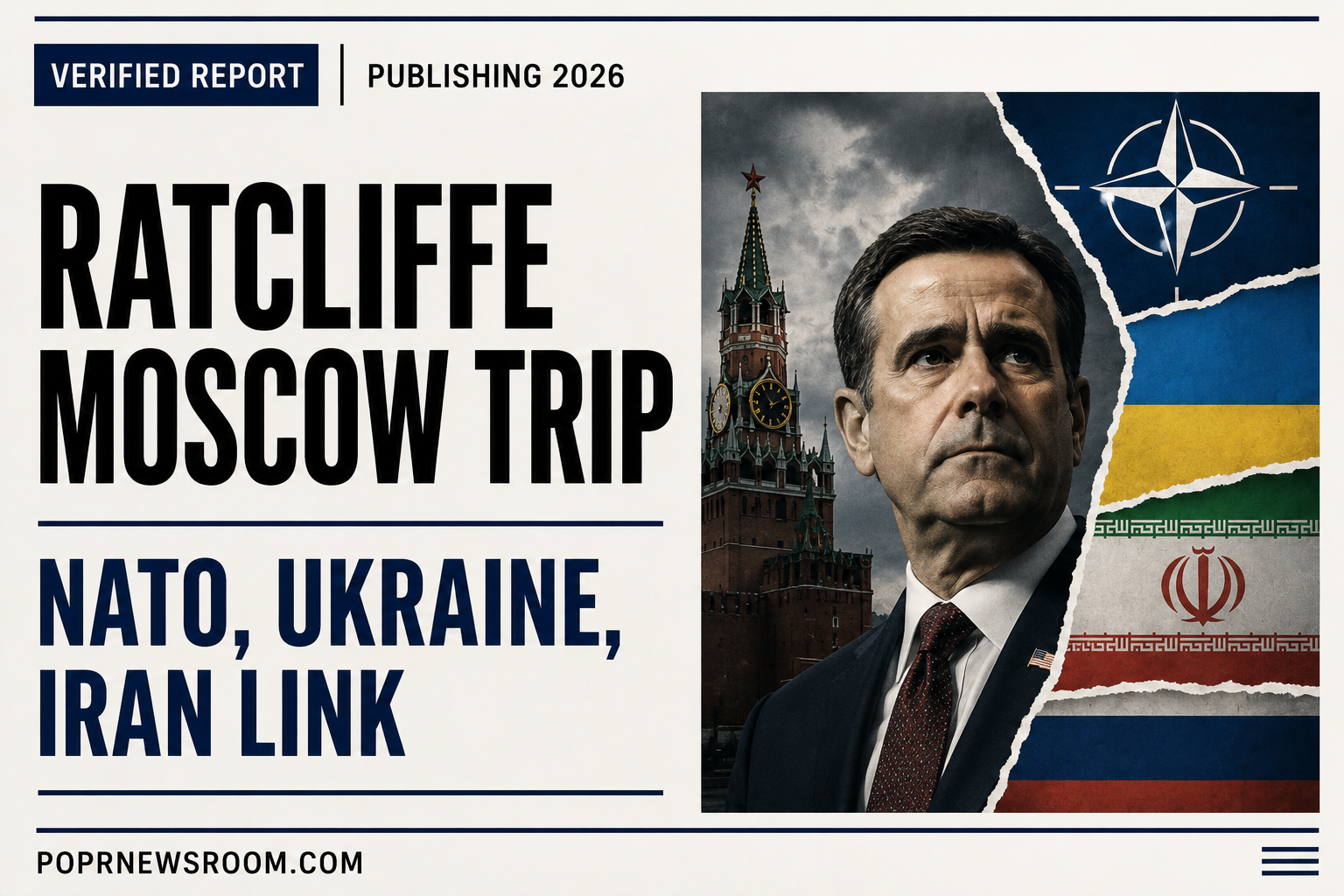
The newest reporting around John Ratcliffe's Moscow visit connects one rare CIA-SVR contact to three overlapping security theaters: NATO and the Baltic states, escalation management around the war in Ukraine, and pressure involving Russia's support for Iran. That is a meaningful development in the public record, but it is not proof that the three theaters were secretly coordinated.
Russian officials confirmed the core event. The Kremlin said Ratcliffe met Russian intelligence officials, did not meet President Vladimir Putin and had contacts that Putin was informed about. Sergei Naryshkin, director of Russia's Foreign Intelligence Service, separately confirmed meeting Ratcliffe and described the encounter as working-level.
The official statements confirm the meeting while leaving its complete purpose undisclosed. The broader picture comes from reporting by multiple major outlets, much of it attributed to people familiar with the mission, intelligence reporting or government discussions.
What new reporting connected to the Moscow mission
Reuters reported that two sources familiar with the matter said Ratcliffe raised the possibility of a Russian operation against a NATO member. The Wall Street Journal reported that Ratcliffe reinforced the United States' commitment to NATO Article 5, and CNN reported that the trip included a warning against attacking a NATO country.
RFE/RL gave the reported warning a Baltic focus, identifying Estonia, Latvia and Lithuania. That does not establish an imminent invasion plan. It establishes that reputable reporting connected those three countries to the warning account.
The Iran dimension is also more specific than the first official descriptions. Reuters reported that Russia's support for Iran was among the issues discussed. CNN reported that Ratcliffe encouraged Russia to end economic and military support for Iran, while CBS News reported that he raised Iran and possible additional sanctions if the Strait of Hormuz did not reopen.
The Washington Post added a reported intelligence bridge between the Iran conflict and Europe. It reported that two people familiar with fresh classified U.S. intelligence said the Kremlin viewed the United States as weakened by the Iran war and saw greater opportunity to escalate against U.S. interests and allies in Europe. The underlying assessment remains classified, and the Post said its collection method and analytic confidence were not disclosed.
Why Ukraine makes the story operational
Ukraine adds a concrete operational detail to the surrounding reporting. Axios reported that Washington informed Kyiv that a senior U.S. delegation was traveling to Moscow and requested temporary restraint on Ukrainian strikes during the delegation's presence. AP, citing a senior Ukrainian official, reported that the request applied to Moscow, St. Petersburg and some northern areas while strikes elsewhere continued.
That is not a general ceasefire. It is reported temporary strike restraint in specified Russian regions. The record does not establish that Ratcliffe negotiated a ceasefire, that Ukrainian military operations stopped generally or that the request changed the course of the war.
The Washington Post separately reported that Ratcliffe warned Moscow against significantly increasing the scale of the war in Ukraine. The report is attributed to one person familiar with the matter, not to a public transcript or first-party account.
The political message was narrower than the reported agenda
President Donald Trump publicly described the trip more narrowly. Reuters reported that Trump said Putin would not attack NATO territory and that Ratcliffe had not been sent with a particular message. Trump also expressed hope that the visit could help end the war in Ukraine.
Naryshkin described the contact as a working-level intelligence meeting and said there was nothing unusual about intelligence chiefs meeting. These statements create a visible contrast with source-based reporting that described specific strategic warnings and requests.
The contrast should not be turned into a claim that Trump contradicted classified intelligence or ignored a CIA warning. The record does not establish that. Nor does Naryshkin's characterization establish that the attributed reporting was false. The public can observe that officials supplied limited descriptions while news organizations reported a broader set of possible topics.
The new nuance: convergence without a secret theory
The important new angle is not that three security problems were secretly managed as one operation. The verified record does not support that claim. The defensible finding is that a longstanding U.S.-Russia intelligence channel was active while three distinct security theaters appeared in the reporting around one mission.
NATO and Baltic security form one theater. Ukraine escalation management forms a second. Iran-related pressure and the reported U.S. assessment about European opportunity form a third. The relationships are documented as reporting relationships, not as a proven causal chain.
This matters politically because public statements, intelligence reporting and operational requests are all being interpreted around the same contact. It matters journalistically because the limits are part of the story. The meeting is confirmed. The wider agenda is reported. Russian intent, the complete classified picture and any causal connection among the theaters remain unresolved.
No public evidence reviewed for this report establishes that Russia decided to attack NATO, that an attack was imminent, that Putin ordered an operation against the Baltics, that Russia directed Iranian attacks or that Ratcliffe prevented an attack. The evidence also does not establish a general Ukraine ceasefire.
For now, the strongest breaking-news conclusion is restrained: Ratcliffe's Moscow mission brought a current intelligence channel into the public reporting of NATO and Baltic security, Ukraine escalation management and Russia-Iran tensions at the same time. The convergence is verified as reporting. A secret coordination theory is not.