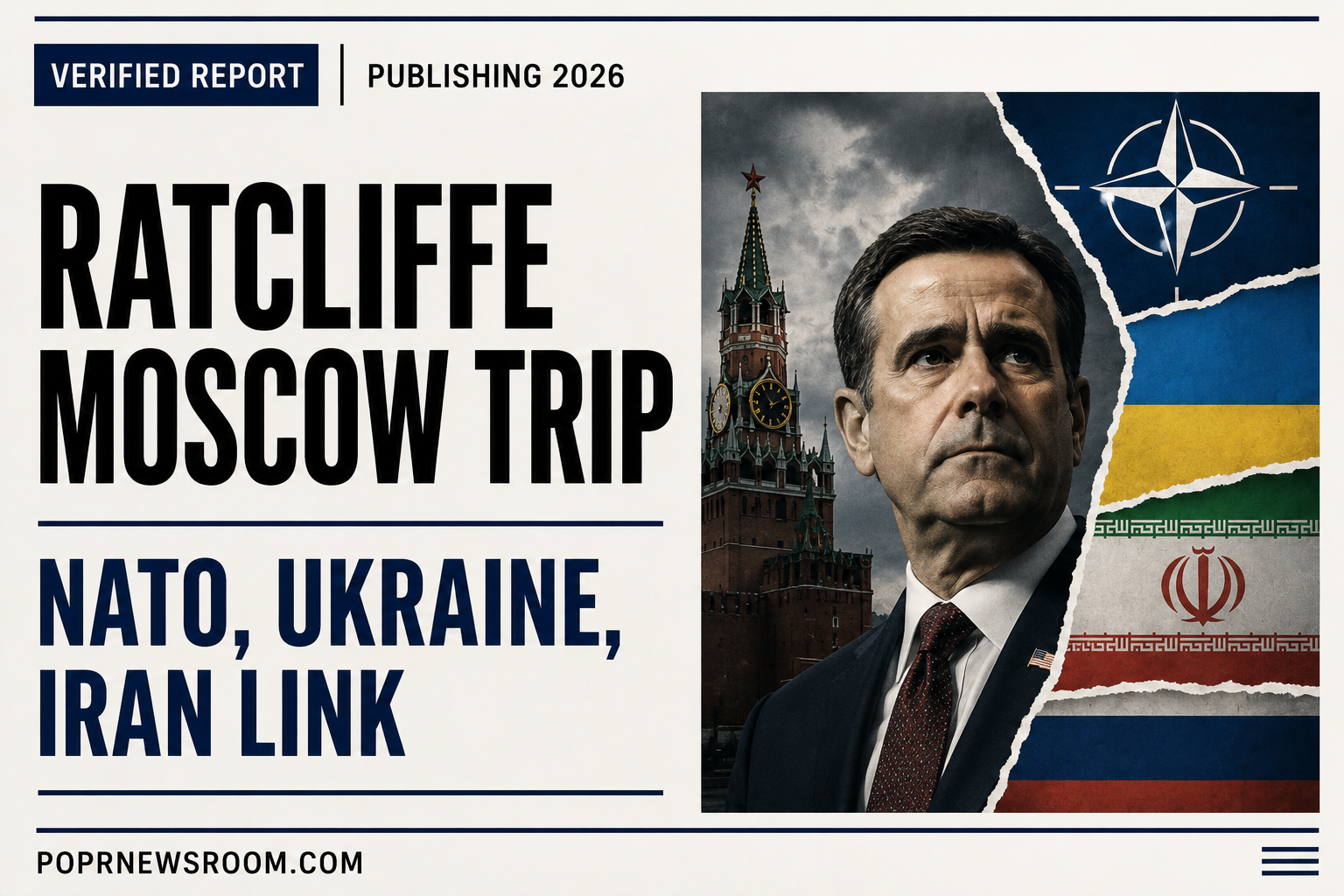
CIA Director John Ratcliffe traveled to Moscow on August 25, 2026, in an unannounced visit that Russian officials confirmed as an intelligence contact. Subsequent reporting connected the mission to NATO and Baltic security, Ukraine escalation management and pressure involving Iran. The public record is consequential, but it does not establish Russian intent to attack NATO or a negotiated ceasefire.
What is officially established about Ratcliffe's Moscow visit?
The clearest facts come from the official public statements. Ratcliffe, who was sworn in as CIA director on January 23, 2025, traveled to Moscow on August 25. The Kremlin later confirmed that he had contacts with Russian intelligence officials, said that Ratcliffe did not meet Russian President Vladimir Putin and said Putin had been informed of the contacts.
Sergei Naryshkin, director of Russia's Foreign Intelligence Service, separately confirmed that he met Ratcliffe. Reuters reported that Naryshkin characterized the encounter as a working-level meeting involving sensitive matters within the intelligence services' remit and said there was nothing unusual about intelligence chiefs meeting.
The public statements establish the contact. They do not publish a complete transcript or a full official explanation of its purpose. That distinction is the starting point for every additional claim about the trip.
Reporting also placed the U.S. military aircraft carrying Ratcliffe in Riga before Moscow. The Washington Post cited tracking data indicating that the aircraft remained on the ground in Moscow for approximately eight and a half hours. That is a flight-tracking observation, not a measurement of the duration of the meetings.
Why did the trip become a NATO story?
On August 27, Reuters reported that two people familiar with the matter said Ratcliffe raised the possibility of a Russian operation against a NATO member during the Moscow talks. Other outlets reported related accounts. The Wall Street Journal reported that Ratcliffe reinforced the United States' commitment to NATO's Article 5 collective-defense provision, while CNN reported that he traveled to warn Russia against attacking a NATO country.
These reports create a convergence around the mission's reported purpose. They do not turn confidential-source accounts into a publicly released U.S. government assessment. The CIA did not publicly confirm the detailed warning in the source record reviewed for this article, and neither Washington nor Moscow publicly confirmed the complete agenda.
The evidence boundary is especially important because the reported warning can be misread as proof of an attack plan. The verified record does not establish that Russia had decided to attack NATO, that an attack was imminent or that U.S. intelligence had publicly concluded an invasion would occur. The claim supported by the record is narrower: reputable outlets reported that Ratcliffe raised the possibility of a Russian operation against a NATO member.
Why were Estonia, Latvia and Lithuania mentioned?
RFE/RL reported that Estonia, Latvia and Lithuania were particular subjects of the warning account. It also reported that a Baltic diplomat said allied officials had been pre-warned about Ratcliffe's visit.
That reporting gives the story a geographic focus without supplying proof of a Russian invasion plan. RFE/RL separately described a deteriorating Baltic security environment in a July 30 letter from European commissioners, including increased airspace violations and drone incursions. Those facts document regional concern. They do not establish an imminent Russian attack.
Reuters also reported Western intelligence concerns involving sabotage, covert activity and a possible false-flag scenario involving a Ukrainian drone. The available record does not establish that Ratcliffe specifically raised that scenario during the Moscow meetings. Keeping that distinction visible prevents a reported intelligence concern from being incorrectly converted into a confirmed meeting topic.
How does Iran fit into the reported mission?
Iran appears in the public reporting as a second major dimension of the mission. Reuters reported, citing two people familiar with the matter, that Russia's support for Iran was among the issues discussed. CNN reported that Ratcliffe used the trip to encourage Russia to end economic and military support for Iran as part of the administration's broader effort to financially isolate Tehran. CBS News reported that Ratcliffe raised Iran and warned about additional sanctions if the Strait of Hormuz did not reopen.
Those accounts are more specific than the official public descriptions of a working-level intelligence meeting, but they remain reports about private discussions. No public transcript reviewed for this report independently confirms the complete set of topics or the precise language used by Ratcliffe.
The broader context includes AP reporting on U.S. intelligence claims that Russia provided Iran with information that could help Tehran strike U.S. warships, aircraft and other assets. AP's sources cautioned that U.S. intelligence had not established that Moscow directed Iran's use of that information. The public evidence therefore supports a reported U.S. intelligence concern, not a claim that Russia ordered Iranian attacks or supplied operational targeting instructions.
What did The Washington Post report about the Iran-to-Europe connection?
The Washington Post reported on August 27 that two people familiar with fresh classified U.S. intelligence said the Kremlin viewed the United States as weakened by the Iran war and saw greater opportunity to escalate against U.S. interests and allies in Europe. The Post said the underlying intelligence remained classified and that its collection method and analytic confidence were not disclosed.
This is the most consequential bridge in the reported story because it places an Iran-related assessment and European security concerns in the same intelligence context. It is also the point at which evidence discipline matters most. What can be established publicly is that The Washington Post reported the existence and broad substance of the assessment through two people familiar with it. The classified assessment itself has not been released for independent evaluation.
The record does not authorize a stronger causal claim. It does not establish that the Iran war caused Russian planning involving NATO, that the Kremlin decided to exploit U.S. weakness or that Russia had decided to initiate an attack. The public evidence shows a reported relationship, not a verified chain of causation.
What operational effect was associated with the Moscow visit?
Ukraine adds a concrete operational dimension. Axios reported that Washington informed Kyiv that a senior U.S. delegation was traveling to Moscow and requested temporary restraint on Ukrainian strikes while the delegation was present. AP, citing a senior Ukrainian official, reported that Washington asked Kyiv to suspend strikes on Moscow, St. Petersburg and some northern areas during the delegation's stay, while strikes elsewhere continued.
Taken together, those accounts support a narrow conclusion: Washington reportedly requested temporary Ukrainian strike restraint in specified Russian regions during the delegation's presence. That is not the same as a ceasefire. The evidence does not establish a general halt to Ukrainian attacks, a pause across the war or an agreement negotiated by Ratcliffe.
The Washington Post separately reported, citing one person familiar with the matter, that Ratcliffe warned Moscow against significantly increasing the scale of the war in Ukraine. The same report said the source described Ratcliffe as arguing that a major escalation could push President Trump closer to Ukrainian President Volodymyr Zelensky.
Again, the evidence establishes the existence of attributed reporting, not a public transcript or proof that the warning changed Russian behavior. It also does not establish that Russia had already decided to escalate.
Why do Trump's and Naryshkin's statements matter?
The reported strategic agenda developed alongside more limited public descriptions. Reuters reported that President Donald Trump said Vladimir Putin would not attack NATO territory and that Ratcliffe had not been sent to Moscow with a particular message. Trump also expressed hope that the visit could help end the war in Ukraine. Naryshkin described his meeting with Ratcliffe as working-level and said there was nothing unusual about intelligence chiefs meeting.
The result is a public-message contrast. Source-based reporting described specific issues involving NATO, Iran and Ukraine, while Trump and Naryshkin publicly limited or narrowed their descriptions of the contact. That contrast is observable in the public record, but it should not be overstated.
The evidence does not establish that Trump contradicted classified intelligence, ignored a CIA warning or rejected a formal assessment. It also does not establish that Naryshkin's public characterization disproved the source-based reporting. The defensible description is that officials' public statements and confidential-source accounts conveyed different levels of detail about the mission.
Is the CIA-SVR intelligence channel new?
No. Direct communication between senior U.S. and Russian intelligence officials has precedent, including during periods of severe tension.
AP reported that CIA Director William Burns traveled to Moscow in 2021 and met Nikolai Patrushev, who was then secretary of Russia's Security Council. That meeting occurred months before Russia's full-scale invasion of Ukraine and was reported to involve U.S. concern over Russia's military buildup around Ukraine and the consequences of further escalation.
In November 2022, Burns separately met Naryshkin in Turkey. AP reported that Burns warned against Russian use of a nuclear weapon in Ukraine. These were distinct events involving different locations, officials and circumstances.
Ratcliffe's meeting therefore did not create a new CIA-SVR channel. Its importance is that the channel remained in use during a period when U.S.-Russia disagreements extended across European security, the Ukraine war and Russia's relationship with Iran. The continuity is verified as historical context. The full private purpose of the current meeting remains undisclosed.
What does the convergence of NATO, Ukraine and Iran show?
The approved explanatory angle is not that three conflicts were secretly coordinated. The public evidence does not support that claim. It shows that one rare intelligence mission and its immediate reporting context came to include three overlapping security theaters.
The first is NATO and Baltic security, where Reuters and other outlets reported a warning account and RFE/RL identified Estonia, Latvia and Lithuania as particular subjects. The second is Ukraine, where AP and Axios reported temporary strike-restraint requests and The Washington Post reported a warning against major escalation. The third is Iran, where Reuters, CNN and CBS News reported discussion of Russia's support for Iran and related pressure.
The Washington Post's account of a classified assessment supplies the clearest reported relationship between the Iran conflict and European security concerns. The AP and Axios accounts supply a concrete operational relationship between the delegation and temporary strike-restraint requests in specified Russian regions. Neither relationship proves a secret coordinating theory.
The most reliable conclusion is therefore also the most restrained one: a current intelligence channel was operating while NATO and Baltic security, the Ukraine war and Russia-Iran tensions were all active in the surrounding security environment. That convergence is why the Moscow trip became larger than a routine bilateral contact.
What does the public record not establish?
It does not establish that Russia is preparing to invade NATO, that Putin ordered an attack on the Baltics or that a Russian NATO attack is imminent. It does not establish that Ratcliffe met Putin, that Trump ignored or contradicted a confirmed CIA warning or that Ratcliffe prevented an attack.
It also does not establish that the Iran war caused Russia to plan a NATO operation, that Russia directed Iranian attacks on U.S. military targets or that Moscow supplied operational targeting orders. The AP reporting describes a U.S. intelligence claim about information that could be useful to Iran, while expressly preserving the boundary that direction of use was not established.
Nor does the record establish a ceasefire in Ukraine. Temporary reported strike restraint in specified areas is not a general suspension of military operations. It does not establish that Ratcliffe negotiated a pause or controlled Ukrainian military decisions.
These exclusions are not secondary caveats. They are what separates a verified account of reported relationships from a political narrative about hidden intent.
What is the strongest conclusion about Ratcliffe's Moscow mission?
The strongest verified conclusion is that John Ratcliffe made an unannounced Moscow visit, met Russian intelligence officials including Sergei Naryshkin, and used a longstanding U.S.-Russia intelligence channel during a period of overlapping security tensions.
Official statements confirm the contact while providing limited detail. Reuters, CNN, The Washington Post, RFE/RL, AP, Axios, CBS News and The Wall Street Journal subsequently placed NATO and Baltic security, Ukraine escalation management and Iran-related pressure within the mission or its immediate intelligence context. Those reports are significant facts about what reputable organizations reported, even where the underlying confidential or classified material is not independently available.
The story is therefore not that the public record proves a Russian attack plan, a hidden alliance or a negotiated ceasefire. It is that a single intelligence contact became the meeting point for three security theaters, and that the evidence is strong enough to show the convergence while still requiring the reader to keep intent, causation and classified confidence unresolved.
The Moscow meeting is established. The broader strategic picture is reported. The boundaries remain part of the news.
Fact Summary
CIA Director John Ratcliffe traveled to Moscow on August 25, 2026. The Kremlin confirmed contacts with Russian intelligence officials and said Ratcliffe did not meet Vladimir Putin. Sergei Naryshkin confirmed meeting Ratcliffe and described the encounter as working-level.
Reuters and other outlets reported that the mission involved concerns about possible Russian action against a NATO member. RFE/RL connected the reported warning to Estonia, Latvia and Lithuania. Reuters, CNN and CBS News also connected the reported discussions to Russia's support for Iran. The Washington Post reported a warning against major Ukrainian escalation and a classified assessment concerning the Kremlin's view of U.S. weakness after the Iran war.
AP and Axios reported that Washington requested temporary Ukrainian strike restraint in specified Russian regions while the delegation was present. The evidence does not establish a general ceasefire, Russian intent to attack NATO, a completed negotiation or a causal chain linking the Iran war to a Russian NATO attack plan.