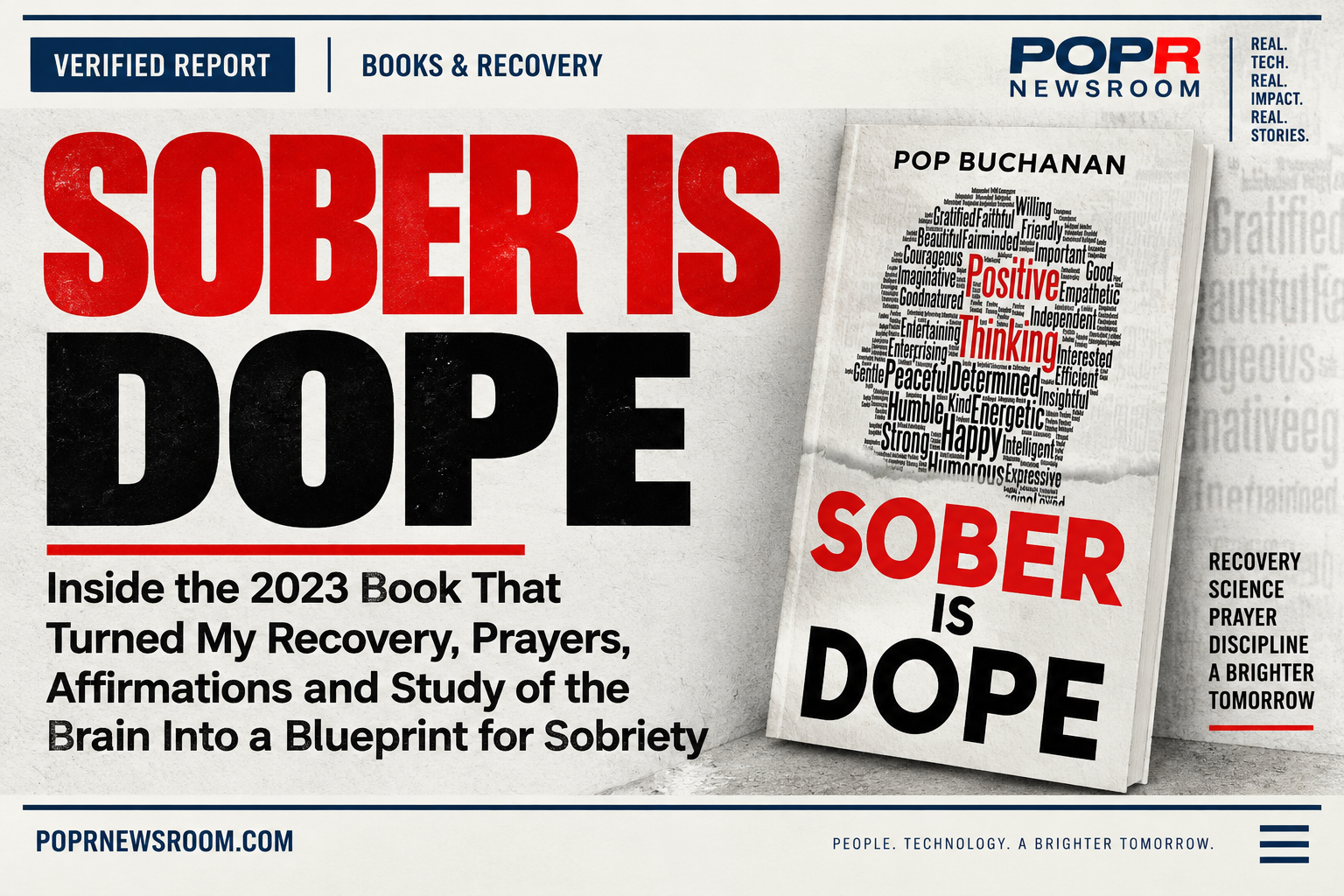
My 2023 book, Sober Is Dope: Sobriety Prayers and Affirmations for Attracting Health, Happiness, and Abundance in Recovery, is a recovery handbook built from my lived addiction recovery, prayer, meditation, treatment, 365+ affirmations, 20 healing prayers and a 15-day devotional. It was not a slogan book. It was my attempt to put a life I was rebuilding into a form another person could use.
What Is the Sober Is Dope Book?
The published book is the clearest early blueprint for the recovery philosophy I would keep developing after it. I wrote about sobriety, prayer, meditation, positive thinking, recovery tools, mental health, forgiveness, faith, treatment and the work of becoming a person who could remain present for his own life.
The book is identified as a 2023, 148-page edition. Rev. Caleb Buchanan and Mark Froeba are credited as editors, and the published architecture includes more than 365 affirmations, 20 healing prayers, a 15-day devotional and prayer structure, and 100 recovery, health and mental-health tips. The current Sober Is Dope Books site gives readers the direct home for the book and the larger recovery publishing work around it.
Those numbers help a reader understand the scale, but they do not explain the reason I made the book. I was not trying to assemble inspirational material from a distance. I was trying to make sense of what had happened to my life and create a recovery object that could be returned to repeatedly.
My Recovery Came Before the Book
My sobriety date is December 15, 2012. I count that morning as Day One because I woke up in rehab, got on my knees and decided I was done drinking. The book came later, after detox, treatment, rehabilitation, therapy, counseling, recovery communities, prayer and the daily work of learning how to live differently.
That history matters because Sober Is Dope does not present prayer as the only action I took. My recovery was multifaceted. It included medical supervision, outpatient and inpatient care, therapy, group treatment, physical activity, diet changes, meditation, family and mentor support, AA and NA language, accountability and the practical effort required to keep going.
I believed a person could pray and go to therapy. I believed a person could study the brain and surrender to God. I believed a person could attend a meeting, work with a sponsor, use an affirmation, ask for medical help and still regard recovery as a spiritual transformation. I needed the book to hold those parts together because that was the recovery I was actually living.
Why Prayer Is Structural, Not Decorative
Prayer is not a decorative layer placed on top of the book. It is one of the mechanisms through which I understood recovery. The book contains Christian and Catholic material, including Jesus Christ, the Holy Spirit, Scripture, repentance, deliverance, spiritual warfare and prayers directed toward healing and sobriety.
I understood my addiction as a fight over the direction of my life. Temptation, fear, guilt, shame, forgiveness, hope and surrender were not abstract words to me. They were part of the language I used while trying to remain sober. The 15-day devotional moves through surrender, forgiveness, cleansing, healing, deliverance, resistance to temptation, breaking chains, relationships, holy thought and gratitude.
I also knew that my spiritual testimony belonged to me. I can describe what I experienced, what I believed happened and how I interpreted my recovery. I cannot turn a private spiritual experience into an independently measured scientific event. Faith is part of my testimony. Science is a different category of evidence.
Why I Put More Than 365 Affirmations in the Book
The affirmation system was deliberate. I wanted repetition to become a practice rather than an occasional inspirational moment. Addiction had taught me that repeated behavior, repeated thought and repeated environment can become powerful patterns. I became interested in whether healthier patterns could also be rehearsed.
The affirmations address sobriety, health, happiness, abundance, faith, self-worth, success and identity because I did not understand recovery as only the absence of alcohol. I was trying to construct a life I wanted to remain present for. The work had to include the question of what I was building, not only what I had stopped doing.
I do not describe affirmations as magic, and I do not describe them as a cure for addiction. Deliberate language can matter to a person’s attention, expectations and behavior, but the scientific evidence around affirmation practice is mixed and specific. The book records my recovery framework and my effort to make repetition useful. It does not turn that effort into a clinical trial.
The 20 Prayers and the Working Book
The prayers and affirmations serve different functions for me. An affirmation is language I direct toward identity, attention and the future I am trying to build. Prayer is relationship with God. It includes surrender, gratitude, petition and the willingness to ask for help when I do not believe I can produce the answer by myself.
The book also includes a practical recovery toolkit. It points toward accountability, safe community, AA or NA, a sponsor, therapy, trauma and mental-health care, detox, rehabilitation, counseling, trigger awareness, relapse response, exercise, sleep, diet, journaling, boundaries, service and continuing treatment. That range is important because a shallow description of Sober Is Dope as “prayers and affirmations” leaves out the recovery system I actually put on the page.
I built the book to be used rather than simply read once. Someone could return to a prayer, repeat an affirmation, work through the devotional, write in a journal, examine a trigger, consider treatment, meditate or use one of the recovery tools when the day required something concrete. Recovery is repetitive. You wake up, recognize a pattern, make another decision and practice again.
Where Science Entered My Recovery Thinking
Before I wrote The Sober Brain Reset, I was already studying belief, meditation, neuroplasticity, repeated thought, placebo-related questions, positive thinking and the relationship between mental practice and human change. Bruce Lipton and Andrew Newberg appear in the intellectual landscape of the book, and I was trying to understand whether the practices helping me could be explained more deeply.
The book’s science-and-spirituality layer is an attempt at a bridge, not a controlled test of the Sober Is Dope protocol. Modern research supports the broad principle that nervous systems can change through experience, learning and repeated activity. Meditation and related practices have been studied in relation to attention, stress and aspects of brain function. That does not establish that belief alone controls genes, that affirmations directly reprogram biology or that prayer cures addiction or psychiatric disorders.
I can believe God saved my life without claiming neuroscience proved that God spoke to me. I can study neuroplasticity without using it to erase the spiritual meaning of my recovery. The distinction lets me tell the truth about both categories instead of forcing one to impersonate the other.
What the Book Shows About My Later Work
Sober Is Dope came before the more concentrated work I later did around the brain and nervous-system recovery. The terminology and scientific precision of later projects should not be projected backward onto the 2023 book. At the same time, the earlier questions are visible: repetition, thought patterns, meditation, belief, behavior, recovery practice and the possibility of change.
That continuity is what interests me now. I did not discover a completely new subject years later. I continued asking how addiction changes patterns and how deliberate recovery practices might participate in changing them again. The later work grew from questions that were already alive in Sober Is Dope. It did not mean the earlier book had already answered them.
What I Want the Record to Say
I am not claiming that I invented recovery prayer, affirmations, meditation or spiritual approaches to addiction. Those traditions and practices existed before my book. The defensible historical object is the particular synthesis I published in 2023: lived recovery testimony, Christian and Catholic prayer, spiritual warfare, a 15-day devotional, 20 healing prayers, more than 365 affirmations, a practical recovery toolkit and an attempt to connect faith, mind and body.
The book also preserves a version of me I cannot reconstruct from memory alone. Memory changes. Later knowledge can make earlier thinking look more organized than it was. The published artifact shows what I actually put into print, including the spiritual seriousness, the recovery tools and the early scientific curiosity.
Because this is my book and my recovery history, I am responsible for keeping the boundary clear in one place: Sober Is Dope is an authorial recovery framework and educational work, not a clinically validated treatment system or a replacement for detoxification, therapy, medication, addiction medicine, emergency help or qualified professional care. My testimony is evidence of what I lived. It is not independent proof that every practice will work for another person.
The Book Is the Foundation
When I look at Sober Is Dope now, I see a foundation rather than a finished explanation. Faith, prayer, meditation, affirmation, treatment, counseling, recovery community, health, learning, repetition, service and hope were already present. The later books, podcast work and recovery research grew from that first published architecture.
I wrote the book because I had been addicted, I got sober, I believed God gave me another chance and I spent years trying to turn what I had learned, practiced, prayed, studied and survived into something another person could hold in their hands.
That is what Sober Is Dope Books represents. The book is not a promise that one path can carry everybody. It is a record of the path that carried me and the tools I believed were worth sharing.
Read the full Founder Report for the longer history of my recovery, treatment, spirituality, podcast, books and the boundaries around the science.