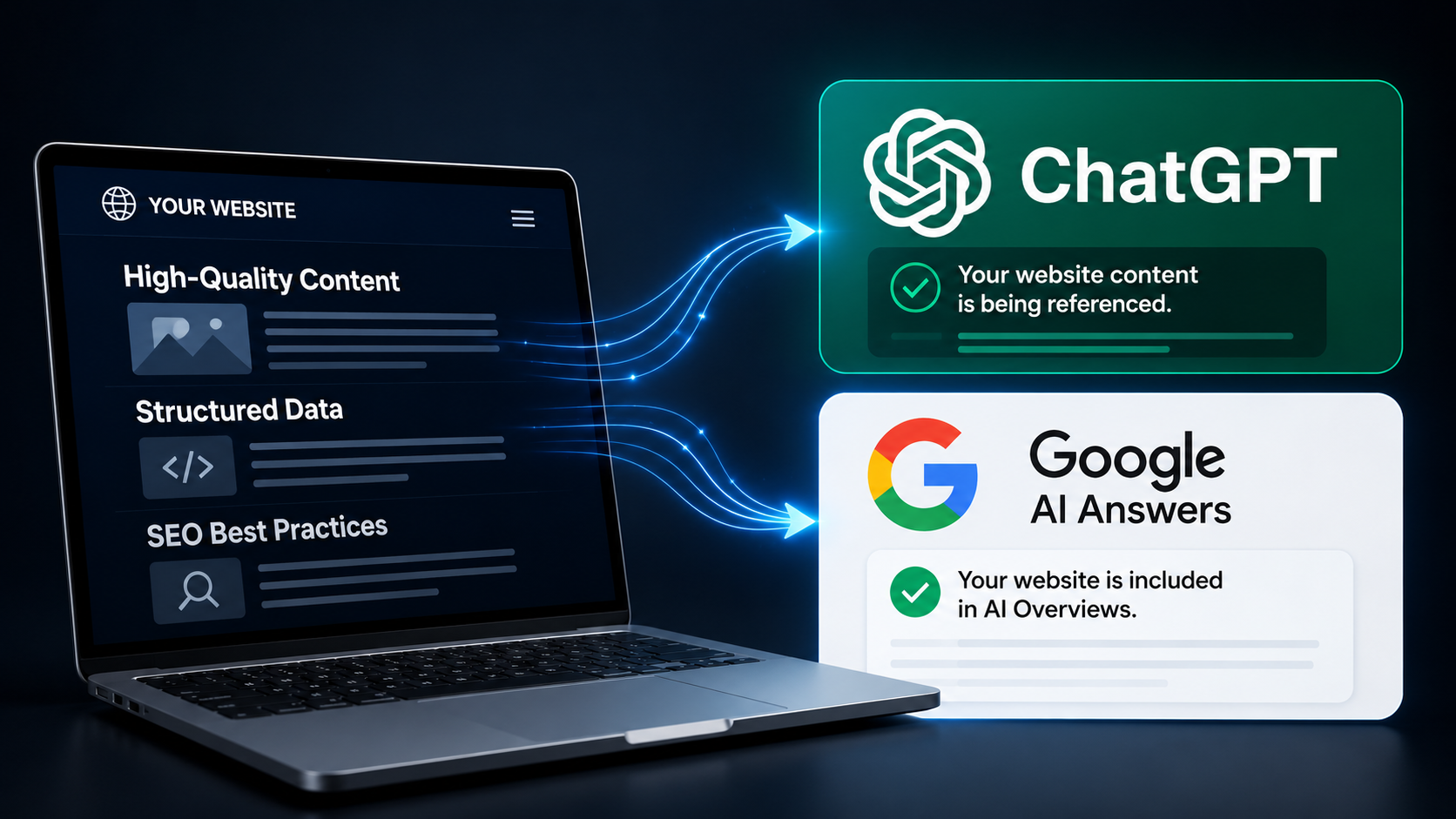
Businesses are beginning to ask a question that barely existed a few years ago: How do you make sure ChatGPT, Google AI Overviews and other AI answer systems can find your website? A growing industry has responded with Answer Engine Optimization, or AEO, along with new files, tools and technical recommendations that promise to make websites more visible to artificial intelligence.
The underlying concern is legitimate. People increasingly receive answers directly from AI-assisted search and conversational systems, and appearing as a cited source can create a new path between a website and its audience. What is less certain is how much new technical infrastructure a website actually needs to participate.
POPR reviewed current guidance from Google and OpenAI, along with Bing's webmaster documentation and recent large-scale research into one of the most heavily discussed AI visibility files. The evidence points toward a considerably simpler conclusion. The web is changing, but the basic requirements for being found have not disappeared. Before a website can become a useful source for an answer engine, it still needs to function as a good website.
What Is Answer Engine Optimization?
Answer Engine Optimization describes the effort to make information easier for AI-assisted search systems and conversational answer engines to discover, understand and potentially cite. The term is useful because the way people find information is changing. Someone who once searched Google, opened several results and assembled an answer manually may now ask a detailed question and receive a synthesized response containing supporting links.
That change creates a legitimate publishing problem. Businesses no longer want their pages merely to rank in a traditional list of search results. They also want their information to be available when an AI system constructs an answer.
What the evidence does not support is treating AEO as a completely separate technical discipline that replaces conventional search optimization.
Google's current documentation is unusually direct about this. Google says there are no additional technical requirements for appearing as a supporting link in AI Overviews or AI Mode beyond the requirements for Google Search itself. A page must be indexed and eligible to appear in Search with a snippet. Google also says website owners do not need special AI files, special schema.org structured data, or other machine-readable additions specifically to qualify for these AI features.
That does not make AEO meaningless. It changes where the useful work actually begins.
Google AI Overviews Still Start With Search Fundamentals
For Google, the foundation of AI visibility remains remarkably familiar. Google recommends allowing crawling, making important pages discoverable through internal links, keeping important information available as text, maintaining a good page experience, and ensuring that structured data accurately represents the content people can actually see on the page.
There is also an important limitation that gets lost when AI visibility is marketed as something a business can simply install. Meeting Google's technical requirements does not guarantee that Google will crawl a page, index it, rank it, or select it as a supporting source for an AI-generated response. Google states that explicitly.
This means the practical path toward Google AI visibility begins before any discussion of advanced AEO tactics. A business needs pages that return successfully, can be crawled, are not accidentally excluded from indexing, contain accessible information, use sensible canonical URLs, and have real discovery paths through the site.
The same principle emerged from POPR's earlier investigation into Replit and Google indexing. A page can work perfectly for someone who already has its URL while remaining poorly exposed to a crawler. AI visibility does not erase that problem. It makes solving it more important.
ChatGPT Has Its Own Search Crawler
ChatGPT requires a separate distinction because Google's crawler settings do not determine whether OpenAI can access a site.
OpenAI says any public website can appear in ChatGPT search, but publishers that want their content available for summaries and snippets should make sure they are not blocking OAI-SearchBot. OpenAI specifically identifies OAI-SearchBot as the crawler associated with discovering content for ChatGPT search experiences.
That makes the site's robots.txt configuration a meaningful part of ChatGPT visibility. A company can build excellent pages, index them successfully elsewhere and still limit OpenAI's ability to crawl their content if OAI-SearchBot is blocked by robots.txt or by hosting and security infrastructure.
OpenAI also makes an important distinction between search visibility and model training. Publishers that want to exclude their pages from potential training can block GPTBot. That is a separate decision from whether OAI-SearchBot can access the site for search. In practical terms, a publisher does not have to treat "OpenAI access" as one universal yes-or-no permission. Search discovery and potential training can be controlled separately.
That distinction matters for publishers, researchers and businesses that want their public work discoverable in ChatGPT without making the same choice about every other use of their content.
OpenAI also warns that blocking OAI-SearchBot does not necessarily make a URL completely invisible. If OpenAI learns about a disallowed URL through another source and has signals that it is relevant, it may still surface a link and page title rather than a summary or snippet. Publishers seeking stronger exclusion therefore need to understand the relationship between crawler access and noindex, rather than assuming that one robots.txt rule controls every possible appearance.
Do You Need an llms.txt File?
This is where one of the most widely discussed AEO recommendations runs into unusually strong contrary evidence.
The llms.txt proposal gives websites a standardized text file intended to help language-model systems understand important site content. Its popularity has made it increasingly common in discussions about AI visibility, and some website owners now treat the file as if it were becoming the AI equivalent of robots.txt or an XML sitemap.
For Google Search, that conclusion is incorrect.
Google clarified its position in June 2026, stating that llms.txt does not positively or negatively affect Google Search visibility or rankings. Google's broader AI guidance also says new machine-readable AI files are not required for inclusion in AI Overviews or AI Mode.
Independent traffic research provides another reason for caution. Ahrefs examined 137,210 domains using its Web Analytics product that received traffic during May 2026. About 28 percent, roughly 38,000 domains, had published a valid llms.txt file. Among the sites that had one, 97 percent of those files received no requests at all during the month.
Even the small fraction of files that were requested did not show the pattern businesses might expect. Ahrefs found that only 19.5 percent of requests reaching those files came from identified AI tools, and GPTBot and Claude-Code were the two leading named AI requesters. Ahrefs also cautioned that its population is more technically and SEO-oriented than the broader web, so its 28 percent adoption figure should be treated as an upper bound rather than a measurement of the entire internet.
The responsible conclusion is not that llms.txt is useless everywhere. The evidence does not establish that. Google's statement applies to Google Search, and the behavior of other AI systems must be evaluated separately. The evidence does establish that businesses should not currently treat llms.txt as a proven requirement for appearing in Google AI results or as a demonstrated universal shortcut into AI answer engines.
That narrower distinction is important because it separates an inexpensive experimental file from a load-bearing visibility strategy.
What About Sitemaps, Search Console and IndexNow?
Traditional discovery infrastructure still matters, but it also needs to be described accurately.
An XML sitemap gives search engines a structured list of important URLs and can be especially valuable when internal linking does not expose every page effectively. Bing describes sitemaps as a way to tell its crawler about URLs that might otherwise be difficult to discover. Google likewise treats sitemaps as a discovery mechanism rather than a guarantee that submitted URLs will be crawled or indexed.
Bing has gone further in connecting ordinary web discovery with AI-assisted search. Its current webmaster guidelines recommend IndexNow, XML sitemaps, crawlable internal links and relevant external links as discovery signals that can support Bing search and grounding experiences.
IndexNow provides a different function from a sitemap. Instead of waiting for a participating search engine to discover that a URL has changed, a site can notify participating engines of updated URLs. The IndexNow protocol distributes verified URL notifications among participating search engines, while Bing describes its implementation as a way to inform search engines about recent content changes for faster crawling.
None of these systems guarantees visibility. They improve the machinery through which content can be discovered and monitored. That difference is central to responsible AEO advice. A webmaster tool can help diagnose a problem. A sitemap can expose a URL. IndexNow can report a change. None can force an answer engine to select a page as a source.
The Content Still Has to Be Worth Citing
Technical accessibility only gets a page into consideration. It does not explain why an answer system should prefer that page over thousands of others discussing the same subject.
This is where AEO becomes less mechanical and more editorial.
A useful page should answer the question it claims to answer without forcing the reader to excavate the response from filler. Important entities should be named clearly. Claims should be attributable. Sources should be visible where evidence matters. Related pages should connect logically to one another. A company, author, product, book or research project should not appear as a different unexplained identity on every property it owns.
POPR classifies this kind of entity coherence and direct-answer writing as strong editorial and architectural practice rather than a confirmed ranking formula. Neither Google nor OpenAI publishes a rule saying that a particular paragraph length, question-heading structure or semantic pattern guarantees citation. The verified research record therefore rejects converting good editorial practice into imaginary algorithmic law.
Original information may become especially important for a simpler reason. If a thousand pages merely restate the same public facts, an answer engine has many interchangeable sources available. A page containing original measurements, field observations, primary documents, proprietary research, clearly sourced reporting or a genuinely useful explanation offers information that is harder to substitute.
That is not a documented ranking formula. It is a publishing strategy, and it is a more defensible one than manufacturing pages around supposed secret AI keywords.
Can You Measure Whether ChatGPT Is Sending Traffic?
Yes, and this may be one of the most practical developments for businesses experimenting with AI visibility.
OpenAI says publishers that allow OAI-SearchBot can monitor referral traffic from ChatGPT using ordinary analytics platforms. ChatGPT automatically adds utm_source=chatgpt.com to referral URLs from its search results, which gives publishers a direct way to identify at least some traffic arriving from ChatGPT rather than guessing whether their visibility work is producing visitors.
That changes AEO from a purely speculative exercise into something that can begin to be tested. A business can verify crawler access, establish analytics, improve its discovery architecture, publish genuinely useful material, and then watch for measurable referral traffic.
It still cannot know every time its information influences an AI-generated answer, and referral traffic alone is not a complete measurement of AI visibility. It is nevertheless a concrete signal available today.
What Should a Business Actually Do?
For a business trying to become more visible in AI-assisted search, the evidence supports beginning with the public website rather than with an exotic new AI layer. Important pages should be reachable, technically valid and connected through real internal links. Search Console and Bing Webmaster Tools should be used to monitor discovery and indexing. Sitemaps should accurately expose canonical URLs where they are useful. IndexNow can be added for participating engines when faster change notification is valuable. Googlebot should not be accidentally blocked when Google visibility is desired, and OAI-SearchBot should be accessible when a publisher wants its content available for ChatGPT search summaries and snippets.
After that foundation is established, the work becomes editorial. Pages need to contain information that answers real questions clearly and gives both people and machines enough context to understand what the page is about, who produced it and why its claims deserve consideration.
What businesses should not do is confuse experimentation with requirement. There is currently no verified special Google AI schema that must be installed. Google says llms.txt does not improve Google Search visibility or rankings. MCP solves a different problem involving applications and tool connectivity. No legitimate technical implementation can guarantee placement in ChatGPT search, and OpenAI explicitly says there is no way to guarantee top placement.
AEO Is Real, but the Shortcut Is Not
The most useful way to understand Answer Engine Optimization in 2026 is not as the replacement for SEO. It is an expansion of the publishing environment in which good search infrastructure now serves more than conventional search results.
Google AI Overviews and AI Mode still depend on Google Search eligibility. ChatGPT has its own crawler and publisher controls. Bing is explicitly connecting established discovery practices with AI-powered search and grounding. These systems are not identical, and businesses should not expect one universal configuration file to control all of them.
The genuinely new work is therefore narrower than the surrounding industry anxiety suggests. Website owners need to understand which crawlers they are permitting, which systems they want to participate in, how their pages are discovered, whether important information is actually accessible, and whether their content offers enough original value to deserve citation.
The rest remains familiar. Publish useful information. Make it technically accessible. Connect it properly. Establish who produced it. Show where important claims came from. Measure what can be measured, and do not turn an unproven tactic into a requirement simply because it contains the word AI.
For businesses worried that the web has suddenly split into a human internet and a hidden machine internet requiring an entirely new technical stack, the current evidence offers a more useful conclusion. AI answer engines are changing how information is retrieved and presented, but there is still no substitute for building a website that can be found, understood and trusted in the first place.