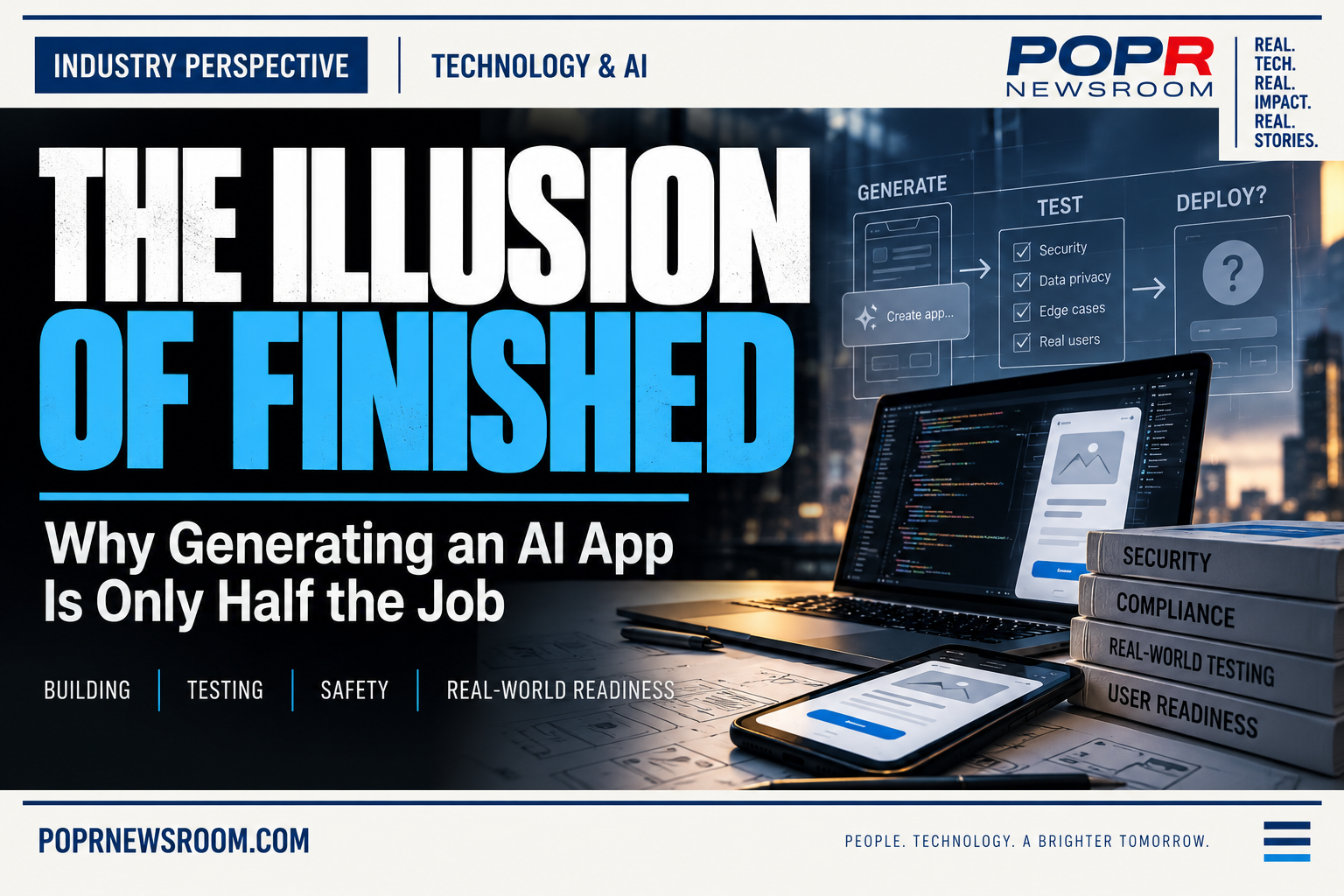
AI can turn an idea into a working application before a founder fully understands what remains unfinished. After nearly a year building with AI systems at POPR Technologies, I still cannot answer whether time stabilizes them or whether real users are necessary to reveal what private development misses.
Because I founded POPR Technologies, this is firsthand company reporting rather than independent validation of POPR’s approach.
What is the illusion of finished software?
The illusion of finished software is the feeling that a product is complete because the visible interface works.
AI-assisted development has made that feeling arrive quickly. A founder can describe an idea, generate an application, connect services and put something functional online without first assembling a conventional software engineering team.
The application may exist. Buttons work. Accounts can be created. Data moves. That visible progress can make the remaining work harder to see, especially when security, authentication, permissions, secrets management, monitoring and deployment safety are mostly behind the interface.
The distinction is simple but consequential: generating a functioning product and establishing that people can safely rely on it are different jobs.
When is an AI app actually ready for real users?
An AI app is ready for real users only when its readiness is observable in the conditions that matter for its intended use.
That does not mean a universal checklist can produce certainty. A casual entertainment tool, a business application and a product handling consequential personal information will require different thresholds.
A serious readiness review should establish:
- What the system is supposed to do.
- Whether it does those things reliably.
- How it fails when conditions change.
- Whether authentication, authorization and data boundaries hold.
- How secrets and sensitive information are handled.
- What production behavior is monitored.
- When a human must intervene.
- How the system is tested after release.
“The buttons work” is evidence of capability. It is not evidence of production readiness.
Why is AI production reliability a separate problem?
Reliability remains separate because an AI agent can perform impressively across many interactions and still fail unpredictably.
Gartner’s production guidance places the reliability problem at the system level. Limiting autonomy, adding guardrails and monitoring errors matter because model capability alone does not establish dependable operation.
Agent evaluation therefore has to examine more than a successful final answer. Planning, tool use, policy compliance, safety and repeatability are part of the execution record.
The same principle applies to AI-assisted applications. A demonstration can show that a system is capable of completing a task. Production requires evidence about what happens when conditions change, failures accumulate and people begin depending on the system.
Why does security make the question harder?
Security makes the question harder because a polished interface can hide unfinished backend responsibilities.
A 2026 study of real-world vibe-coded applications identified recurring vulnerabilities including exposed secrets, insufficient input filtering and placeholder logic. The researchers reported that better models and prompting can reduce vulnerabilities without eliminating the underlying security risks.
That does not mean AI-assisted applications should remain private indefinitely. It means generation and security review have to remain separate stages.
Before real users depend on an AI-built application, a founder has to understand who can access what, how permissions behave, where secrets live, how data moves, what happens when a connected service fails and how an incident will be detected and handled.
The tool can help build the product. It does not automatically make every operational decision required to run the product safely.
Does an AI system need time to stabilize?
I do not know, and this article should not manufacture an answer.
POPR Technologies began as a private mathematical research and invention company. Consumer-facing experiments grew out of that work rather than defining the company from the beginning. Sports Lab, Federal 609 and POPR Tools are extensions of that history, while POPR Books sells books through ordinary retail channels.
That history means POPR did not make a new company-wide decision to reject monetization or deliberately slow every product. The company’s research-first and private orientation existed from the start.
After roughly twelve months of working continuously with AI systems and partnerships, I experience parts of our operation as more coherent than they were at the beginning. Tasks that once involved more friction can feel easier to correct. Communication across the tools feels cleaner to me.
Those are impressions from someone embedded in the work, not measurements. Models changed. Platforms changed. Our architecture changed. Prompts and instructions improved. Verification improved. Tools improved. I learned more about how to communicate with the systems, and the systems accumulated more context around the work.
I cannot isolate which factor caused what I am noticing. I cannot turn the experience into proof that stabilization works.
Could real users be part of stabilization?
Real users may expose information that private development cannot reproduce.
A private environment can reveal failures, security problems and bad assumptions through repeated testing. It cannot perfectly reproduce people who were never involved in building the product.
Users misunderstand instructions, combine features in unexpected ways, arrive with devices and environments the builders did not anticipate, create unusual traffic patterns and discover edge cases nobody deliberately tested. Production can reveal those behaviors only after people begin depending on the system.
That creates a genuine tension. Waiting can create more opportunities to test and harden a system before people rely on it. Launching can produce evidence that may be impossible to obtain without users.
The useful question may be less whether a product should launch early or late and more what must already be known before real users become part of the learning process.
Why can AI-built software look more complete than it is?
AI can remove the visible barrier that once told a nontechnical founder that technical work was still missing.
Historically, if a founder could not code, the product could not exist without technical expertise. AI can make the application exist. The remaining work becomes less visible precisely because the interface has become easier to generate.
This is not a claim that nontechnical founders routinely misunderstand security. The record does not establish how widespread that assumption is. It is a communication problem worth studying: a platform can make a founder feel close to having a complete development environment while backend responsibilities still require deliberate work.
Some security features may be available in a development platform, but they do not become active simply because an application was generated quickly. Authentication, permissions, data handling, deployment safety, monitoring and incident response still have to be understood and operated.
What has POPR actually learned from taking a long horizon?
POPR has learned that continuous work creates more experience, but it has not proved why the operation feels different now.
The company has operated a coordinated AI-assisted working structure around continuous development and verification for close to twelve months. Some products have gone public, while others remain developmental. The structure includes shared verification and a registry built collaboratively over time, but its internal architecture and mathematics are not part of this public report.
I cannot say that our systems improved because we gave them time. I cannot say that a product exposed to thousands of users earlier would not have matured faster. I cannot say that another company should wait a year before launching.
There is an uncomfortable possibility on the other side: sometimes waiting is simply waiting. A company can spend six more months polishing something users do not want. A private system can become highly adapted to its builders while remaining poorly suited to everyone else. Internal confidence can grow without corresponding external validation.
Long development is not evidence of rigor by itself, just as fast development is not evidence of recklessness.
What should count as evidence of readiness?
Readiness should be defined by what was tested, not by how long the calendar ran.
For an AI-assisted product, useful evidence could include reliable performance across changed conditions, understood failure modes, verified security boundaries, production monitoring, clear human intervention rules and continued testing after release.
The threshold should reflect the consequences of failure. A product handling consequential personal information requires a different level of evidence from a casual experiment. The company should also be honest about which properties were validated before launch and which users are helping it discover.
Two months ago, POPR published The Replit Gap while examining the distance between what AI-assisted development tools make possible and what building a durable product still requires. This article continues that line of inquiry, but the question is now broader than any single platform.
Does POPR have the answer?
No. POPR has an experience, an operating history and an open question.
I have more experience with AI systems than I had when we started. I do not yet know whether the improvement I feel is stabilization, better tools, better processes, better communication, accumulated context or all of those things together.
That uncertainty is not a weakness to hide. It is the actual finding.
AI can make software generation feel finished before production readiness has been established. The next useful step is not to turn that observation into a company victory claim. It is to measure what changed, test what still fails and distinguish what the system already knows from what real users are being asked to discover.