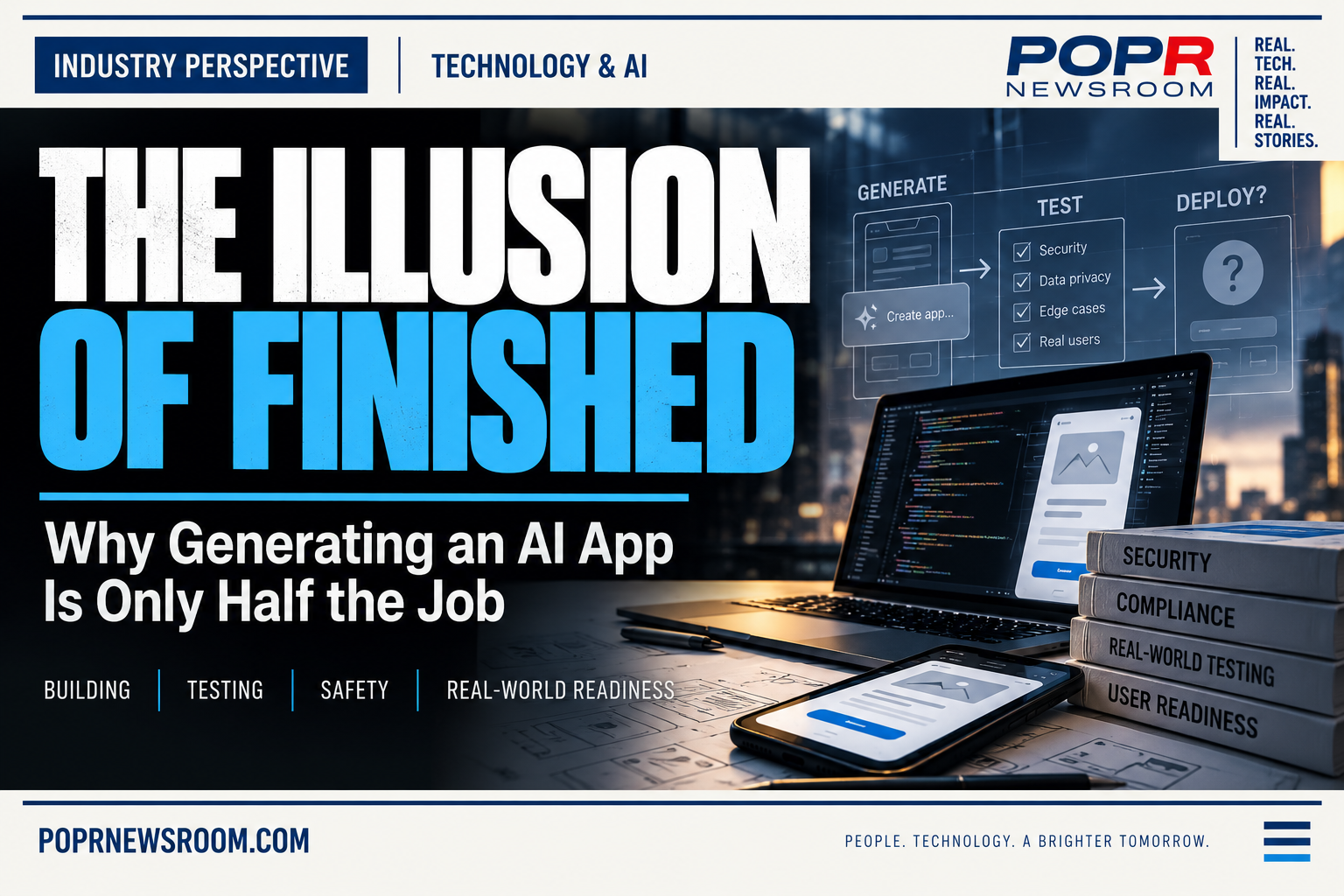
A vibe-coded app is not safe to launch simply because the interface works. Production readiness requires evidence about reliability, security, permissions, data handling, monitoring, failure modes and human intervention. After nearly a year building with AI systems at POPR Technologies, the honest answer is that no universal calendar threshold settles the question.
Because I founded POPR Technologies, this is firsthand company reporting rather than independent validation of POPR’s approach.
What does a working AI app still need before launch?
It needs evidence about what happens after the demonstration.
AI can generate the interface, connect services and put something functional online quickly. Production asks harder questions: Does the system behave reliably when conditions change? Do security boundaries hold? Are secrets protected? Can the team see failures? Does a human know when to intervene?
Current AI-agent reliability guidance treats guardrails, limited autonomy and continuous error monitoring as system requirements rather than optional polish.
Why is the illusion of finished software dangerous?
The interface can look complete while backend responsibilities remain unfinished.
Accounts can be created. Data can move. Buttons can work. That visible success can hide authentication, permissions, secrets management, deployment safety and monitoring work that users cannot see.
A 2026 study of real-world vibe-coded applications found recurring vulnerabilities including exposed secrets, insufficient input filtering and placeholder logic. Better models and prompting may reduce those risks, but they do not remove the need for production security review.
Should AI products launch early or wait?
No universal answer has been established.
Waiting can create time for testing and hardening. Launching can expose edge cases, traffic patterns and user behavior that private development cannot reproduce. The responsible question is what has already been validated before real users become part of the learning process.
POPR founder Josephe Buchanan describes the company’s own roughly twelve-month experience as more coherent than it felt at the beginning. He does not present that observation as proof that time caused stabilization or that POPR’s approach is superior.
What should founders check before launch?
They should check intended behavior, reliability under changed conditions, authentication, authorization, data boundaries, secrets, deployment safety, monitoring, failure handling, human escalation and continued post-launch testing.
Elapsed time is not a readiness metric by itself. A system can spend a year accumulating unexamined errors, while a shorter development period can include intensive evaluation. The evidence has to come from what was tested.
The central production-readiness question is not whether an AI system can build an app. It is whether the company can explain what the app does, how it fails and why users can safely depend on it.