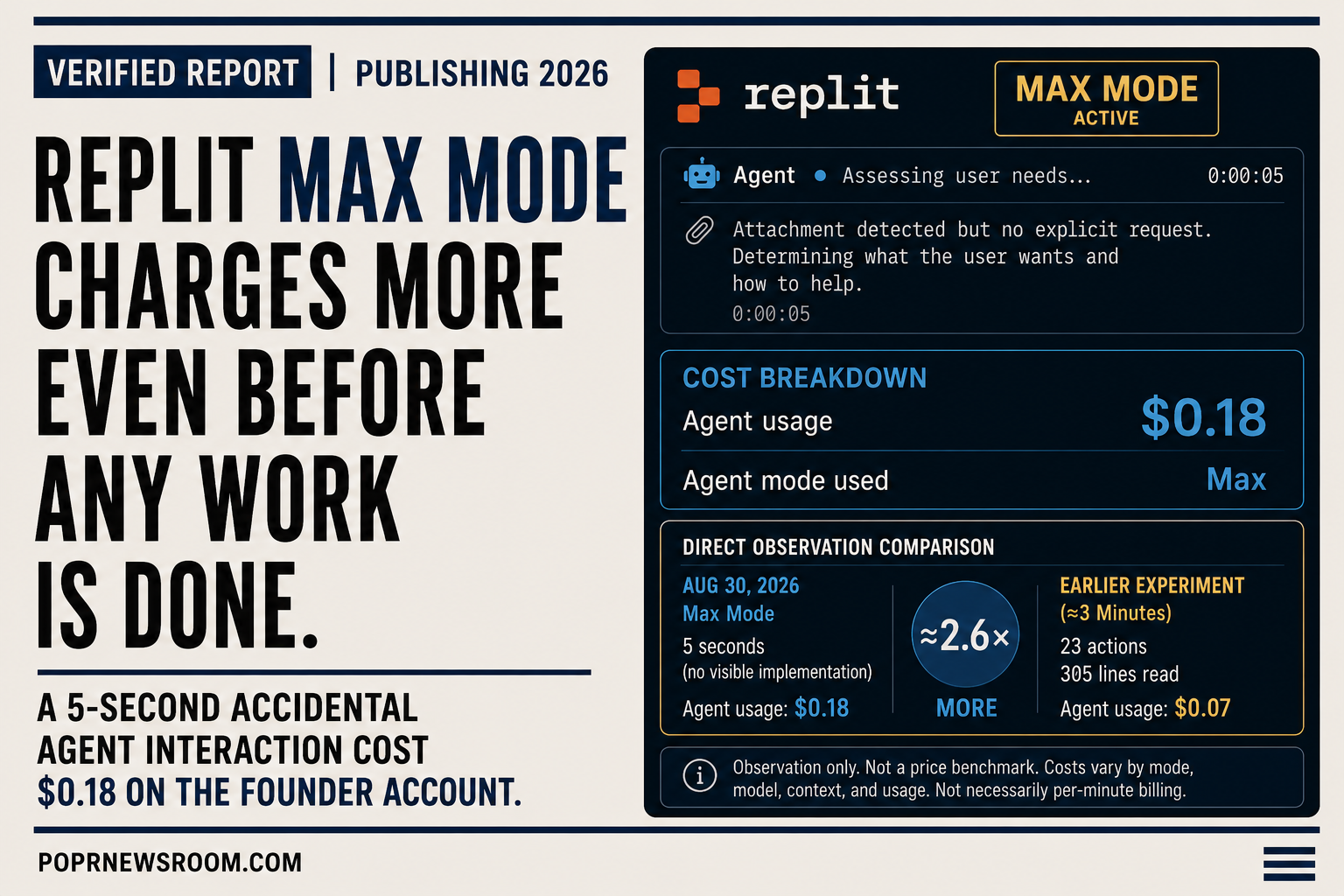
A direct Founder-account screenshot records $0.18 in Replit Agent usage after approximately five seconds in Max mode. The visible trace was still assessing user needs and considering how to handle an attachment, and no completed implementation was visible in the captured session.
That is a narrow observation, but it is a meaningful one. It shows that a session can record measurable Agent usage before a reader can see completed implementation. It does not by itself reveal Replit’s complete billing function or establish that Replit charges by elapsed time.
The screenshot displays three relevant facts together: the Agent mode was Max, the visible duration was approximately five seconds, and Agent usage was $0.18. The visible activity stated that an attachment had been detected but that no explicit request had been provided. The Agent was still determining what the user wanted and how to help.
The careful conclusion is therefore not that Max mode is inherently improper or that the platform billed a failed checkpoint. The conclusion is that this particular accidental Max interaction recorded $0.18 while no completed implementation was visible in the captured trace.
How does this compare with the earlier $0.07 session?
POPR’s earlier controlled session while working in a Replit environment ran for approximately three minutes, recorded 23 actions and 305 lines read, and produced an actual implementation for $0.07. That session occurred before Free Mode launched and most likely used the earlier Lite-era naming, not Free Mode.
The new observation recorded approximately 2.6 times the usage amount of that earlier session, even though the visible interaction lasted only about five seconds and showed no completed implementation. The comparison is informative, not a controlled price benchmark. The sessions occurred under different modes, circumstances and dates.
What the two observations place beside each other is task fit. One session was tightly scoped around implementing an already-finished project deliverable. The other began without an explicit request and was still trying to understand the user’s needs. Prompt length and elapsed time do not fully describe the work an Agent may perform.
What does this add to the Replit investigation?
The existing Deep Report documented Replit’s move toward Free Mode, Intelligent Model Routing, effort-based usage descriptions, configurable spending controls and a layered relationship between task difficulty and Agent capability.
This screenshot adds a new Founder-account observation to that record. It sharpens the consumer question without resolving the underlying billing mechanism. The image does not show whether the recorded usage reflected tokens, effort, a minimum invocation amount, attachment processing, model behavior or some combination of factors.
Replit’s current documentation describes a checkpoint around Agent completing work and implementing requested functionality. The screenshot does not establish how a brief, incomplete interaction should be classified under every billing circumstance. That remains an open question.
What should founders take from it?
Founders should check the active Agent mode before sending a request, avoid beginning an expensive session without a clear task, monitor usage and use the available spending controls. They should also distinguish an observed account event from a universal platform rule.
This observation does not establish that Replit charges by the minute. It does not establish that five seconds always costs $0.18. It does not establish that every cancelled or incomplete interaction generates the same result.
It does establish that mode selection can matter before meaningful implementation is visible. That is a consumer fact worth understanding as AI development becomes more capable and more layered.
Editorial disclosure: POPR is a long-time Replit user and regards Replit as a major partner company in its technology infrastructure. This report includes POPR’s operating observations and is constructive consumer education, not sponsored praise.
Read the full Deep Report for the broader evidence, the earlier implementation comparison, Replit’s documented controls and the questions that remain open.