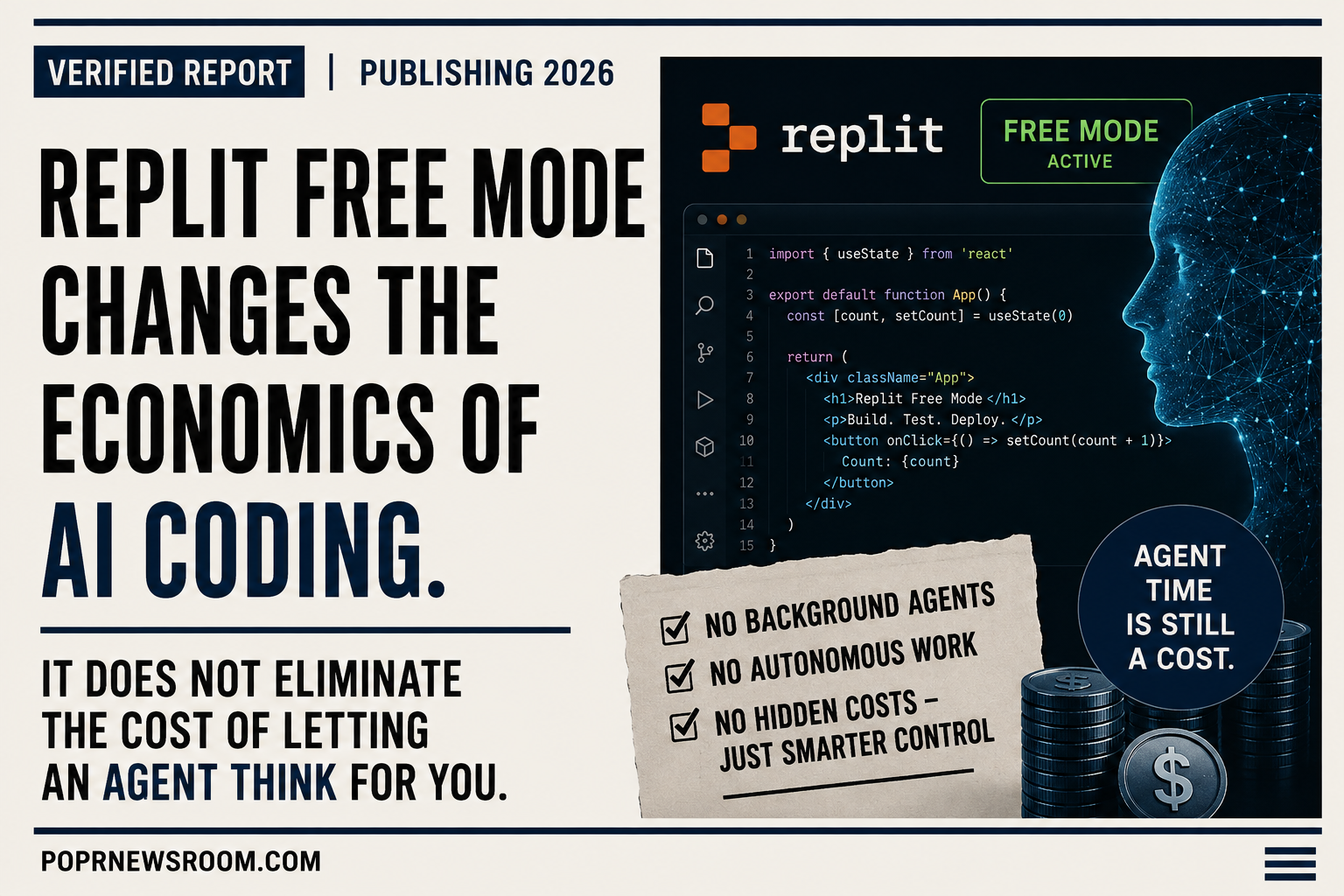
Replit has moved quickly on affordability, adding Free Mode, Intelligent Model Routing and clearer spending controls while preserving higher-powered Agent modes for harder work. For founders, the deeper lesson is not that Replit is too expensive. It is that modern AI development now has a layered economic architecture, and understanding which layer is doing the work may become as important as knowing how to build the product.
Editorial disclosure: POPR is a long-time Replit user and regards Replit as a major partner company in its technology infrastructure. This article is constructive consumer education based partly on POPR’s own operating experience. It is not sponsored praise, and no commercial relationship beyond what POPR has established is implied.
Replit’s Free Mode, publicly launched on August 19, 2026 after the announcement was published August 18 and updated August 19, gives Core and Pro subscribers a substantially cheaper way to use Agent for everyday work. Replit says the mode can let subscribers create up to 30 times more within their existing monthly subscription. Five-hour usage windows reset automatically, and users can remain in Free Mode when Replit determines that a request may benefit from a more powerful mode.
For founders who have spent the last two years watching AI development costs rise alongside capability, this is real progress. It also makes the product more complicated to understand.
Free Mode does not mean the economic architecture underneath Replit has disappeared. It has become more layered. A founder can sit inside one development environment while interacting with subscription-included activity, usage-based work, model routing, higher-powered reasoning, background tasks, parallel work and ordinary application infrastructure.
The more useful question is no longer only, “How much does Replit cost?” It is: what exactly are you asking Replit to do, and which economic layer is doing it?
What does Free Mode actually mean?
Replit already has a Starter plan that costs nothing and includes its own limited, daily-capped Agent chat access. Free Mode is different. The Free Mode announcement specifically concerns Replit’s paid Core and Pro subscribers.
Core currently costs $20 per month and Pro costs $100 per month. Within those plans, Free Mode gives users access to a lower-cost Agent experience for everyday work without consuming usage in the same way as higher-powered modes.
Replit’s own description is direct: “Free Mode is a new way to use Agent that lets you create up to 30x more with just your monthly subscription.” That is Replit’s claim. It should not be interpreted as a promise that every imaginable Agent workflow is covered without additional cost.
This distinction matters because “free” can describe two separate ideas. Starter provides a limited free plan with its own daily-capped Agent allowance. Free Mode is a named mode inside the paid Core and Pro structure. Neither description means that every development action, infrastructure service or high-powered Agent session has no economic cost.
How does Replit now handle escalation?
Replit’s August 26, 2026 Intelligent Model Routing announcement clarified the newer architecture. Users start in Free Mode. When Replit determines that work should escalate to a higher-powered mode that can incur usage costs, the user is notified. The user can override that escalation and remain in Free Mode.
That is materially different from an architecture that silently moves a user into paid computation without warning. POPR’s investigation found no basis for claiming that Replit secretly escalates Free Mode sessions into expensive modes. Replit’s own stated design describes notice and user choice.
The useful founder question is therefore whether the user notices the escalation, understands the economic difference and makes the choice deliberately. Product comprehension is part of cost control.
What are the current Replit Agent modes?
As of August 30, 2026, POPR directly observed Free, Power and Max as the current Agent modes and cross-checked that structure against Replit’s public interface on the same day. This is a dated current-state observation, not a permanent platform specification.
Replit’s naming has changed repeatedly. Before February 25, the platform used an earlier naming structure. It then moved through an architecture involving Lite, Economy, Power and a separate Turbo option. On August 19, the former Economy tier became Power, Max became the new top tier and Free Mode joined the current architecture.
That history matters because builders can interpret mode names as technical boundaries. A label such as Lite, Power or Max sounds like a complete explanation of capability, but the actual relationship between a mode and a task can be more nuanced.
For founders, pricing literacy now requires version awareness. What is true in the interface on August 30 may not be the right description six months later.
What is Intelligent Model Routing?
Mode selection is only one layer. Model selection is another. Replit announced Intelligent Model Routing on August 26, saying Agent can automatically choose among models according to quality, speed and cost. Core and Pro users can still select models manually.
Replit says its own testing produced equivalent output quality at 65 percent lower cost than its previous Max Mode. That 65 percent figure is Replit’s own internal claim. POPR has not independently reproduced it.
The product direction matters even if the percentage changes. The strongest available model is not always the economically rational model for the task. A typo does not need frontier reasoning. A difficult architectural migration might. Routing is an attempt to match computation to difficulty.
Teams may choose manual model selection and disable automatic routing when they need the capability level authorized for a session to remain explicit. That does not establish that manual selection is cheaper than Intelligent Model Routing.
A company can reasonably choose automatic optimization. Another can reasonably prioritize explicit control. The important thing is that the choice should be intentional.
How does Replit’s effort-based pricing work?
Replit describes current Agent pricing as effort-based. The idea is that cost scales with the work required by a request rather than functioning as a simple flat charge per message.
Replit’s current billing documentation defines a checkpoint around Agent completing work on a request and implementing the requested functionality in the code. This replaced an older flat $0.25-per-checkpoint model for existing Core and Teams subscribers beginning July 1, 2026.
That definition is important because earlier versions of POPR’s investigation entertained a much stronger theory about failed or hung Agent operations being billed identically to successful ones. The current sealed evidence does not support publishing that claim as Replit policy.
Replit’s own documentation describes checkpoints around completed work. It does not establish that every failed, hung or errored attempt is billed the same way. POPR is leaving that question open rather than turning an unresolved billing question into a platform fact.
Where did POPR’s historical charges actually appear?
This investigation began after the Founder saw roughly $40 accumulate over about two days despite believing recent work had remained predominantly in Free Mode, with only occasional deliberate use of Power or Max. The obvious question was where the money was coming from.
The investigation exposed a second problem. The projects receiving the most attention were not necessarily the projects responsible for the largest historical Agent charges.
During the July 26 through August 25 billing period, Founder testimony places two major POPR project environments at approximately $136.36 and $109.70 in Agent usage. Two other tracked environments were approximately $12.19 and $3.23 in that same period.
The Founder attributes the two larger totals to intentional build activity, including substantial work in one environment before Free Mode existed. That explanation remains Founder testimony rather than documentarily closed evidence.
The broader lesson survives regardless: an AI-development bill cannot be diagnosed by staring at the project used most recently. Start with the account. Find the largest cost centers. Then investigate.
What did the historical account data show?
One tracked project environment showed a different pattern. Its cumulative Agent cost rose from about $3.23 to about $63.60 and then to about $95.21 over roughly three weeks in early and mid-August.
From August 13 through August 16 alone, approximately $31.61 was added. That represented 71.4 percent of new Agent activity across POPR projects during that window.
Those costs predated Free Mode and POPR’s current restrictions on Agent autonomy and sub-agent work. That timing matters. Today’s Replit architecture and POPR’s current operating discipline should not be blamed for historical usage that occurred under a different product structure and a different internal workflow.
AI platforms are evolving quickly enough that billing investigations become misleading when old activity is interpreted through new mode names.
What does the $0.07 implementation test actually show?
One POPR implementation test conducted while working in a Replit environment cost $0.07 across 23 actions and 305 lines read in approximately three minutes. The earlier version of the investigation treated that session too aggressively.
The session did not happen in Free Mode. Founder testimony places it one to two days before Free Mode’s August 19 public launch. Under Replit’s naming at the time, it most likely ran in Lite mode, although the exact historical mode name has not been fully closed through a timestamped session record.
The correct conclusion is narrower: at least one real implementation task did not require Power. The task was unusually well scoped because an already-finished project deliverable was handed to Replit largely for implementation.
This does not prove that most development belongs in a lower tier. It does not establish a universal cost benchmark. It shows that founders should not automatically assume every piece of real work requires their strongest available mode.
The seven-cent result is therefore evidence about task fit, not proof of a general Replit price. It is useful precisely because it is bounded.
Why can a small prompt authorize a large workload?
A founder can type one sentence such as “Fix the app.” The Agent may need to inspect dozens of files, understand an unfamiliar architecture, trace dependencies, modify several components, run tests, read errors, repair the implementation and test again.
The human action took ten seconds. The machine work did not. This creates one of the central illusions of agentic software development: prompt length is not workload.
The same principle explains why a bounded implementation task can cost less than an open-ended product task even when the final code change is similar. One task asks the Agent to resolve requirements, architecture and implementation. The other asks it to execute a decision that has already been made.
Why does scope become an economic control?
The economics of AI development increasingly reward clear specifications. A bounded task has a smaller search space. An unbounded task has a larger one.
Compare “Make the website better” with “Change the meta description on this route and make no other architectural changes.” Both are valid instructions. They authorize radically different amounts of machine discretion.
The first asks for diagnosis, prioritization, design judgment and implementation. The second asks for execution. As Agents become more capable, founders gain the ability to delegate greater amounts of uncertainty. But uncertainty is work, and work can have a cost.
Before asking an Agent to build a feature, a founder can resolve what the feature does, who it is for, what data it needs, where it belongs, what it must not change, what counts as complete and what should happen when ambiguity appears.
Every answer supplied upstream removes search space downstream.
Why do spending controls belong in the build?
Replit’s current billing documentation confirms configurable spending alerts, budget limits described as hard caps, real-time usage tracking and a usage dashboard. These controls are important because autonomous software tools can do more work than traditional interfaces.
A builder should understand the current budget, active mode, routing setting, background-task permissions, parallel-task permissions, App Testing setting, consuming projects and usage-monitoring path before beginning a long Agent session.
Those are no longer merely administrative questions. They are engineering questions. A resource boundary can be part of the system design.
The sealed record does not assert that Replit has no default spending cap as an established platform fact. The defensible statement is narrower: Replit provides configurable spending controls and shutdown mechanisms, and a founder who has not configured them should not assume protection exists automatically.
Is every application function worth using AI for?
Not every application function needs live Agent reasoning. A calculation with a known formula should generally use code. A scheduled database operation does not need to become an AI Agent. A static transformation should remain deterministic, and a known routing rule can remain ordinary application logic.
AI should occupy the part of an architecture where uncertainty, language understanding, synthesis or flexible reasoning creates value. This is not an anti-AI position. It is a specificity principle: use intelligence where intelligence earns its cost.
The distinction also helps founders read a Replit bill. A deployed application can continue running ordinary servers, databases, APIs, hosting and deterministic scheduled jobs without an Agent sitting there thinking. Application infrastructure and AI reasoning activity can interact, but they should not be collapsed into one mental category.
What does deliberate capability governance look like?
Deliberate capability governance can make a lower-cost mode the default and require explicit authorization before a higher-powered session begins. It can also restrict background work, parallel tasks and deferred Agent activity when a team needs tighter control over resource use.
Automatic testing and model routing can be enabled only when needed, while ordinary APIs, hosting, databases and deterministic scheduled application code remain separate from Agent reasoning.
These are governance choices, not a recommendation that every Replit customer should configure the product the same way. A team doing rapid greenfield development may rationally want more autonomy. A professional engineering group may value background and parallel work.
The relevant principle is that capability should be authorized deliberately.
Was background work the obvious explanation in POPR’s data?
POPR’s billing history supplied a useful counterexample. During a roughly two-day period when the Founder was effectively unable to work in the account, Agent usage in one tracked environment increased by only about $0.34. Other major project meters were recorded as unchanged during that forced-inactivity window.
That does not prove background tasks can never generate costs or that they never affected POPR at another time. It means that in this particular natural inactivity sample, POPR did not observe substantial autonomous cost accumulation.
An unexplained number is not evidence of a hidden mechanism. Another tracked environment once showed approximately $20.72 in Agent usage while the related account integration meter showed $0. A reconciliation of visible daily values left approximately $1.28 not perfectly explained, while the Founder also reported intentional Power sessions that likely explain at least part of the total.
Without itemized attribution, the remaining difference stays open. It is not evidence of background Agents, hidden AI Integrations or failed checkpoints. It is an unreconciled number.
Why is completion different from correctness?
The deepest limitation of Agent budgeting appears once the budget system works perfectly. An Agent receives a resource envelope, spends within it, every transaction is attributed correctly, the ledger is accurate and no policy is violated. The system performs exactly as designed, but the answer is useless.
Economically, the Agent remained compliant. Operationally, it failed. A $0.50 run that produces the wrong answer may be worse than a $5 run that reliably completes a high-value task.
The relevant objective is not simply the lowest cost per run. It is the lowest justified resource cost for an acceptable, verified outcome. Cost control without outcome verification can establish that money was controlled without establishing that the money created value.
What does Compare Models reveal?
One feature visible in POPR’s current Replit account is Compare Models, currently labeled Beta. On its face, it is a model-comparison feature. Economically, it represents something larger.
The AI-development product is increasingly exposing model choice to ordinary builders. Founders are being asked to consider quality, speed, reasoning and cost decisions that once belonged mostly to AI infrastructure teams.
Automatic routing can hide those decisions. Manual selection exposes them. Either architecture requires the platform to solve a user-experience problem: how do you make inference economics understandable to someone who came to build an app, not manage a model fleet?
Current interface descriptions in this report are dated August 30, 2026 and should be reverified before later republication.
Why does Replit deserve credit?
POPR has used Replit for a long time, and much of its infrastructure has been built there. The organization knows the frustrations of vibe coding because it has lived through them. It also knows the value.
Replit has allowed a small organization to create infrastructure that would have been materially harder to build under a traditional development model. That does not make every Replit decision correct, eliminate billing questions or mean every feature is equally economical.
It does mean this investigation should be read in the right spirit. POPR is glad Replit is addressing affordability. Free Mode is meaningful. The Core price reduction is meaningful. Model routing focused on cost is meaningful. Spending controls are meaningful.
The constructive response is to understand how to use those improvements intelligently.
What will determine whether vibe coding lasts?
AI coding has already demonstrated extraordinary capability. People with limited conventional engineering backgrounds can build functioning software. Experienced developers can move faster. Small companies can attempt products that once required more capital.
The remaining question is economic. How much should ordinary reasoning cost? When should a task escalate? How much autonomy is worth buying? How should developers protect themselves from spending they did not anticipate? Will the thing built ever return anything?
AI platforms can directly improve the cost of development. They cannot guarantee that the application will produce revenue. A $20, $40 or $100 development cost is not automatically expensive if the resulting product becomes valuable. The same cost is psychologically harder to tolerate when the builder has no revenue and no certainty that the application will ever produce any.
Vibe coding does not need to become literally free. It needs to become economically predictable enough that builders can keep building.
What is the real Replit Gap Two?
The first Replit Gap concerned a different distance: building an application was one thing, while making it function correctly, deploy reliably and become discoverable was another.
Replit Gap Two concerns the distance between apparently simple AI development and the economic machinery underneath it. A founder sees a prompt box, an Agent, a website and a deploy button. Underneath that sit subscription access, Agent modes, model selection, routing, effort-based work, background capabilities, parallel capabilities, testing, compute, storage, deployments and budget controls.
Vibe coding makes software creation feel simpler. The underlying system is not simple. The platform’s job is to make that complexity manageable. The founder’s job is to understand enough of it not to delegate economics accidentally.
What should founders do next?
Founders should verify which plan and Agent mode they are using, understand whether Intelligent Model Routing is enabled, inspect the current spending controls, review account-level usage and investigate the largest cost centers first.
They should distinguish Starter’s limited free Agent allowance from Free Mode inside Core and Pro. They should treat the current Free, Power and Max structure as a dated interface description rather than a timeless platform fact.
They should also separate application infrastructure from Agent reasoning, use deterministic code for deterministic functions, escalate deliberately and provide resolved specifications whenever practical.
The goal is not to use less AI. It is to use appropriate intelligence. Sometimes Max is exactly the right tool. Sometimes Power is appropriate. Sometimes a lower-cost mode is enough. Sometimes background work or parallelism creates more value than it costs.
Capability should be authorized deliberately, and cost claims should remain within the evidence that supports them.
Fact Summary
Replit’s Free Mode announcement was published August 18, 2026 and updated August 19. August 19 was treated publicly as the launch date.
Free Mode is associated with Core and Pro subscriptions. Starter separately includes its own more limited daily-capped Agent chat access.
Free Mode usage limits reset every five hours, with higher limits for Pro than Core. Replit says users begin in Free Mode and are notified when work escalates toward higher-powered modes that can incur usage costs. Users may remain in Free Mode instead.
As of August 30, 2026, POPR directly observed Free, Power and Max as the current Agent modes and cross-checked that structure against Replit’s public interface.
Replit announced Intelligent Model Routing on August 26, saying Agent can select models according to quality, speed and cost. Replit claims its internal testing achieved equivalent quality at 65 percent lower cost than its prior Max Mode. POPR has not independently validated that percentage.
Replit describes current Agent pricing as effort-based and defines a checkpoint around Agent completing requested work and implementing the requested functionality.
POPR does not have sufficient first-party evidence to state that failed, hung or errored Agent operations are billed identically to successful checkpoints.
Replit provides configurable spending alerts, budget limits, real-time usage tracking and related spending controls.
POPR’s Founder testimony attributes significant historical charges in two internal project environments to intentional build activity. That explanation has not yet been documentarily confirmed.
POPR observed a $0.07 implementation session while working in a Replit environment before Free Mode launched. It most likely occurred under Replit’s earlier Lite-era architecture and establishes only that this particular real implementation task did not require Power Mode.
POPR’s forced-inactivity sample did not show substantial unexplained Agent accumulation during that specific period.
Evidence Status
Confirmed from current Replit material: Free Mode; August 18 and August 19 announcement timing; five-hour resets; separate Starter Agent allowance; the current Free, Power and Max architecture as of August 30; Intelligent Model Routing; manual selection for Core and Pro; effort-based checkpoint pricing; configurable spending controls; background and parallel Agent capabilities.
Replit claim, not independently reproduced: Intelligent Model Routing providing equivalent quality at 65 percent lower cost than the previous Max Mode in Replit’s testing.
Confirmed from POPR records: historical Agent-charge progression across POPR project environments, the limited forced-inactivity observation, an account reconciliation issue and the $0.07 controlled implementation session.
Founder testimony requiring documentary closure: The specific intentional-build explanation for historical charges in two internal project environments.
Open: Exact treatment of failed or hung Agent work in current checkpoint billing; complete itemized attribution across project environments; exact historical mode name of the $0.07 session; and additional documentation around Compare Models Beta.
POPR editorial position: Replit’s recent affordability changes are constructive. This investigation concerns founder comprehension and cost governance, not an allegation that Replit intentionally generates unnecessary work or hidden charges.