Through Meta Is Dope, I commissioned POPR Technologies to produce the Algorithmic Transmutation Engine, a live, free browser-based NFT art tool that gives artists a new source-coupled way to extend AI art, MidJourney images, conventional artwork, photography, or other inputs. It keeps processing in the browser and exports the result as a PNG or five-second WebM capture.
What is Meta Is Dope’s Algorithmic Transmutation Engine?
Confirmed: the engine is a browser-local NFT art tool commissioned by Meta Is Dope and produced by POPR Technologies, with five named modes: Flow Cartography, Reaction Field, Crystal Genesis, Clifford Resonance and Topographic. The tool accepts an image file, normalizes it inside the browser, paints a result to a Canvas 2D surface, and exposes export controls for the rendered output.
That architecture gives artists a way to set an existing image apart without claiming that the tool replaces the artist or the source medium. The selected renderer does not apply one fixed overlay to every image. It extracts source information such as luminance, color, edges or quadrant-level brightness and uses that information as input to a particular rendering pipeline. A high-contrast portrait and a soft landscape therefore can drive different paths, fields, cells, attractor densities or contours.
The intended artistic use is broader than one image source. An artist can begin with a conventional drawing, a photograph, an AI-generated image, or a MidJourney image, then use transmutation to introduce an additional visual element that would not otherwise have been present. The resulting layer can help an artist build a more differentiated asset for an NFT art project while preserving the distinction between a creative capability and a claim of universal uniqueness.
How does the engine turn a source image into art?
Current implementation detail: every mode begins with browser-side image decoding and normalization. The general canvas is capped at 900 pixels on its longest side, with lower internal caps for the Reaction Field and Crystal Genesis calculations. The shared luminance conversion is a scalar calculation from red, green and blue values, not a separate mathematical field for each color channel.
The five renderers then take different routes:
- Flow Cartography calculates a Sobel field from luminance and traces streamline paths along contours or gradients. Source color can be carried into the strokes.
- Reaction Field applies a Gray-Scott reaction-diffusion update to a lower-resolution field whose feed rate varies with source luminance. Random seed patches introduce variation.
- Crystal Genesis assigns pixels to Euclidean Voronoi cells, biases some seed placement toward thresholded edge pixels, and fills cells from averaged source colors.
- Clifford Resonance maps average luminance from four image quadrants into the parameters of a Clifford map, then rasterizes the resulting attractor density with source-derived color accumulation.
- Topographic normalizes luminance and extracts layered contour lines through Marching Squares interpolation. The current renderer does not use Sobel magnitude to vary line width or opacity.
These descriptions identify what the implementation currently does. They do not turn established mathematical families into claims of new theory.
What does the before and after transformation look like?
The clearest way to understand the Meta Is Dope and POPR Technologies commission is to compare a source image with a rendered result. The supplied before image below is the input portrait, while the supplied after image is an example of a transmuted output. They show the tool’s artistic purpose: the source is not merely recolored, but re-expressed through a different visual system that can add a new layer to an artist’s work.
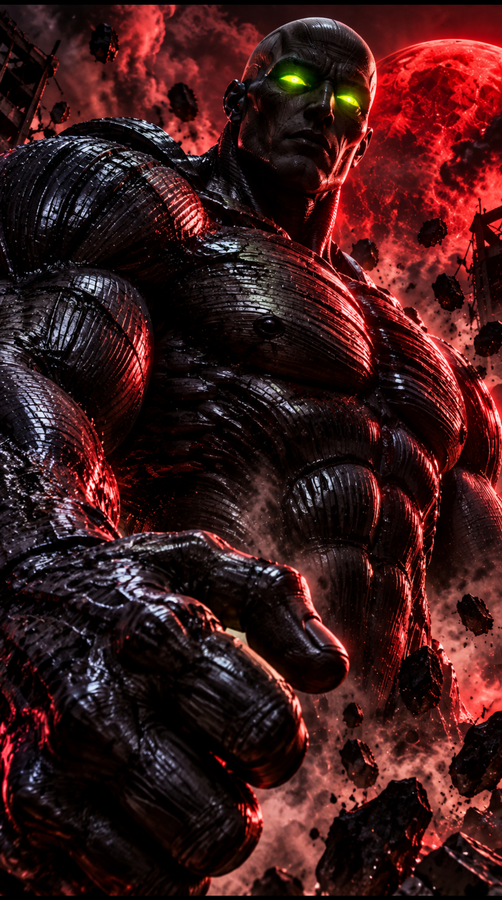
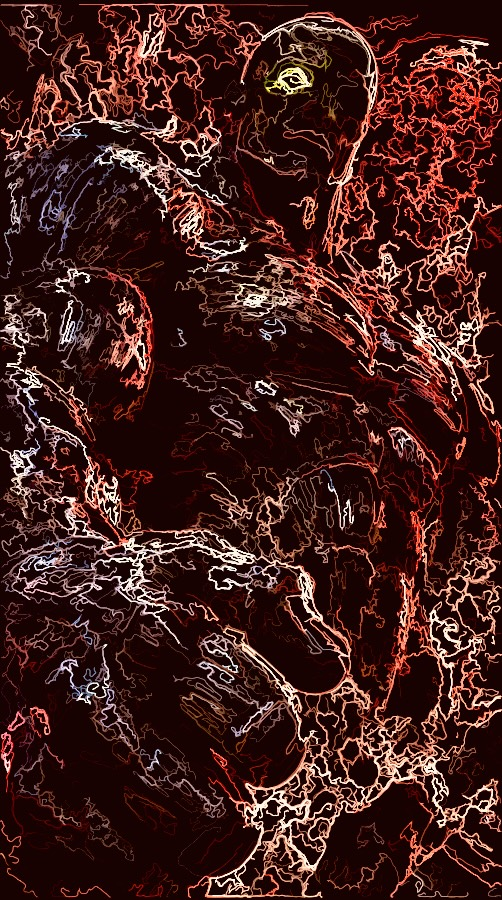
The comparison is a visual product example, not a proof of universal uniqueness. The current implementation couples a source raster to different established procedures, and the visible result depends on the selected mode, controls, browser rasterization and, for three modes, unseeded random choices.
Which mathematical techniques power the five modes?
Confirmed: the engine is built from established numerical and computational-geometry techniques. Flow Cartography uses luminance conversion, Sobel filtering, vector directions and forward Euler stepping. Reaction Field uses a Gray-Scott system with a discrete five-point Laplacian. Crystal Genesis uses Euclidean nearest-site assignment for a raster Voronoi mosaic.
Clifford Resonance uses a standard two-dimensional Clifford map. Topographic uses normalized scalar luminance, contour thresholds, linear interpolation and Marching Squares case handling. The product’s implementation-specific identity is the coupling of those methods to source-image information and the unified browser workflow, not the invention of a new partial differential equation, attractor family, tessellation or contour algorithm.
Does the tool process images locally?
Confirmed current behavior: the inspected implementation has no server image-upload path. The source file is read through browser APIs, decoded into an image, normalized into Canvas 2D, and passed to the local renderers. The implementation also contains no WebGL, WebGPU, GPU compute path, Web Worker or external numerical library for this feature.
That local architecture is a product property with practical limits. The numerical work runs through ordinary browser JavaScript or TypeScript, typed arrays and Canvas 2D. Reaction Field and Crystal Genesis can be computationally heavier than a simple visual filter, while Clifford Resonance can perform a large point loop. The current implementation does not establish a universal performance guarantee across devices.
Are the outputs reproducible?
The answer depends on the mode. Flow Cartography, Reaction Field and Crystal Genesis use unseeded Math.random() calls, so their outputs can vary between runs even when the source and visible settings are unchanged. The current product does not persist a seed or a full configuration provenance record.
Clifford Resonance and Topographic do not use random operations in their current renderers. For the same rasterized source, settings and ordinary browser execution conditions, they are intended to reproduce the same output. This split is why the broad statement that every result is unrepeatable would be inaccurate.
What does the five-second video export actually do?
Confirmed current behavior: the WebM control records the rendered output canvas for five seconds through the browser’s capture-stream and MediaRecorder APIs. The display canvas is not recalculated during those five seconds, so the file is a static captured frame stream rather than an animated simulation.
That distinction matters for how the export should be described. The PNG is the primary rendered image export. The WebM is a short, post-render presentation wrapper that can be useful for posting or asset handling, but it should not be presented as evidence that the underlying mathematical system is evolving over time.
What is POPR’s defensible claim about originality?
The restrained answer is an artistic and implementation claim. Meta Is Dope commissioned POPR Technologies to create a tool that gives artists an additional source-coupled way to make AI art, MidJourney images, conventional art, photography, and related work more distinct. POPR Technologies can describe the combination of five browser-local renderers and the surrounding export workflow as product and engineering decisions.
The supplied technical record does not establish historical mathematical novelty, a patent conclusion, a universally unique output, or the invention of the underlying mathematical families. The word “original” in this context should describe the new creative capability and the artist’s resulting treatment, not a claim that the tool created a new branch of mathematics or guarantees an exclusive NFT asset.
That boundary strengthens the product description rather than weakening it. The tool does not need to claim a new equation to offer a distinctive workflow. Its practical identity is the way source luminance, source color, source spatial structure and quadrant statistics are routed into five different visual treatments from one browser interface.
How can someone try the live tool?
The confirmed live route is poprtools.com/algorithmic-transmute. The product is free, requires no account for the described flow, and runs directly in a browser. A visitor can upload an image, select a mode, adjust the available controls, render the result, and export a PNG or the current five-second WebM capture.
Transparency Record
OWNERSHIP DISCLOSURE: This article covers a commissioned Meta Is Dope and POPR Technologies project. POPR Newsroom is the publishing outlet of POPR Technologies Inc. This article is published through the POPR Desk and should be understood as first-party corporate reporting rather than independent third-party coverage.
FOUNDER-INVOLVEMENT DISCLOSURE: The commissioned product and its presentation are part of the Founder’s POPR Technologies and Meta Is Dope work. That affiliation is disclosed so readers can distinguish documented product behavior from independent evaluation.
COMMERCIAL DISCLOSURE: Meta Is Dope commissioned POPR Technologies to produce the tool described here. This article contains no affiliate link, paid placement, or sponsored recommendation. It documents the commissioned affiliated project and is not advertising presented as independent journalism.
What is Meta Is Dope’s Algorithmic Transmutation Engine? It is a commissioned Meta Is Dope and POPR Technologies NFT art tool that accepts an image and renders it through five browser-local Canvas 2D modes: Flow Cartography, Reaction Field, Crystal Genesis, Clifford Resonance and Topographic.
Does the engine upload source images to a server? Confirmed current behavior is browser-local processing. The inspected implementation reads the uploaded image into browser memory and uses Canvas 2D and ordinary JavaScript or TypeScript computation without a server image-upload path.
Are the five modes five new mathematical systems? No. The implementation uses established techniques including Sobel filtering, Gray-Scott reaction-diffusion, Voronoi assignment, the Clifford map and Marching Squares. The defensible product distinction is the way those techniques are coupled to a source image inside one workflow.
Are all Algorithmic Transmutation Engine outputs random? No. Flow Cartography, Reaction Field and Crystal Genesis use unseeded browser randomness, so their results can vary between runs. Clifford Resonance and Topographic are deterministic for the same rasterized source and configuration in the ordinary browser execution model.
What does the five-second WebM export do? The current export captures the already-rendered Canvas output as a five-second static frame stream. It is a video wrapper around a still result, not a temporal simulation or animated parameter pass.
What does before and after mean in this product? Before means the supplied source image as read by the browser. After means the rendered Canvas result produced by one selected mode. The result is a transformation of source-derived information, not a claim that the engine has discovered a universally unique image.