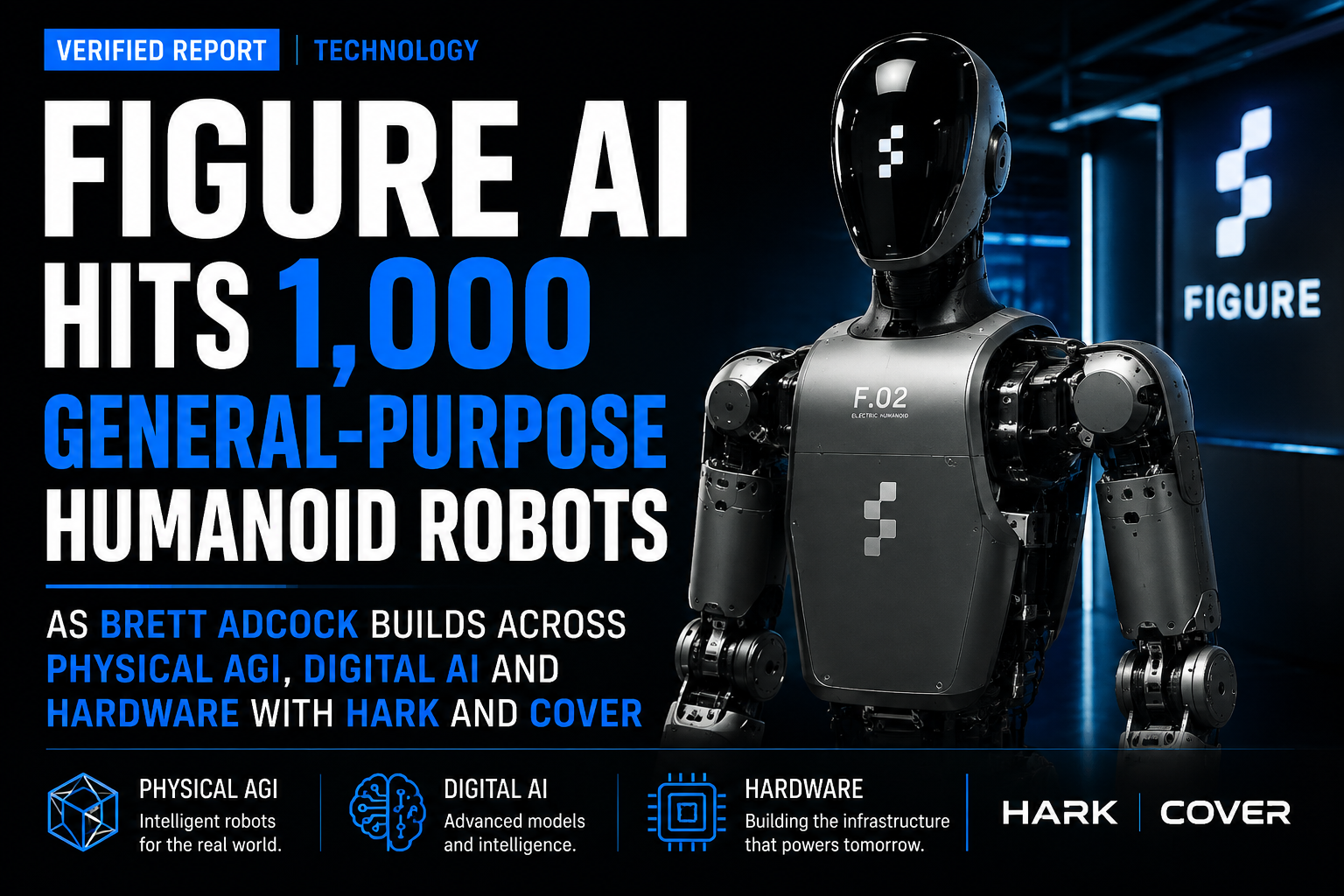
Brett Adcock is becoming difficult to describe through a single company. Figure AI is the obvious anchor. The humanoid-robotics company carries a reported $39 billion valuation, has BMW as a commercial customer, has now produced its 1,000th Figure 03 unit and, according to Adcock, recently shipped robots to a third commercial customer that has not yet been publicly named. Adcock also reports that Figure completed a 200-hour continuous logistics operation at 2.9 seconds per package.
But Figure is only one part of what Adcock is building. He is also the founder behind Hark, a personal-AI company valued at $6 billion, and is involved with Cover, a detection-technology company pursuing custom hardware and preparing for full-scale system production. Adcock serves as CEO of Figure and Hark. Cover, by his own description, is operated day to day by a chief engineer with a JPL and NASA background. Those companies are not three versions of the same startup. They represent three substantially different technical bets. Figure is Adcock’s attempt to build intelligence that can act in the physical world through a humanoid body. Hark is a separate attempt to build digital AI designed around interaction between humans and machines. Cover is an engineering and hardware effort pursuing a detection system built around custom-designed chips. Seen together, the more interesting story is no longer simply how fast Figure can manufacture humanoid robots. It is what happens when one founder simultaneously builds companies around physical intelligence, digital intelligence and specialized sensing hardware while arguing that the technological shift underway will ultimately be “a hundred times bigger than the internet.” That is Adcock’s prediction, not an established forecast. The companies, however, are already real.
The New Figure AI Numbers Are Starting to Look Industrial
The most immediate news remains Figure. Adcock disclosed several operational developments during an August 14, 2026 appearance on My First Million, Episode 851, hosted by Sam Parr. The interview provides an unusually direct snapshot of where Figure stands from the founder’s perspective. Figure has now produced its 1,000th Figure 03 robot, according to Adcock. Adcock says robots were shipped to a third commercial customer during the week of the recording. The customer was not identified. BMW is independently established as a Figure commercial customer, while another previously reported commercial relationship involves Catalyst Brands.
The 1,000-unit manufacturing milestone is important because it is different from a manufacturing-rate claim. Figure had previously reported reaching production at approximately one robot per hour. Producing the 1,000th Figure 03 establishes a cumulative manufacturing milestone rather than simply describing the speed of the production line. Then there is the logistics result. Adcock described Figure robots operating continuously for 200 hours at 2.9 seconds per package. That should not be confused with a previously reported Bloomberg result involving a 50-hour continuous sorting run in May 2026. They are different founder-reported operating results disclosed through different channels and at different times. The newer figure should therefore not be used to rewrite the earlier one. What it does provide is another indication of the direction Figure is pursuing: humanoid robots moving beyond isolated demonstrations toward sustained work inside commercial environments.
Figure AI Is the Physical Bet
Adcock’s description of Figure becomes more interesting when placed beside Hark. He frames Figure as a bet on physical AGI: intelligence embodied in a humanoid machine capable of operating in the physical world. That ambition extends beyond logistics and manufacturing. Adcock now describes the home environment as highly solvable and says Figure’s larger ambition is general-purpose robot autonomy: place a robot into an unfamiliar environment, communicate through language and have the machine perform useful work. That is not an achieved commercial capability. It is the founder’s stated technical belief and ambition.
The distinction matters because the home is considerably different from a controlled industrial deployment. Adcock himself identifies the remaining problem around genuinely novel environments as one involving insufficient real-world data. His 2026 prediction that robots would perform unsupervised, never-before-seen home tasks entirely through neural networks was discussed directly in the August interview. With approximately four months remaining in the year, Adcock characterized the objective as on track while acknowledging the unresolved real-world-data problem. He believes the broader general-purpose autonomy problem could be attacked with roughly 100 robots and a team of approximately 50 people. Whether that belief translates into a functioning general-purpose home robot remains to be demonstrated. But it establishes where Figure’s ambition is moving. The factory is not necessarily the destination. It may be the training ground for a much larger physical-intelligence problem.
Hark Is the Digital Bet
Hark attacks a different problem. Rather than giving intelligence a humanoid body, Adcock describes Hark around digital AI-to-human symbiosis. The company has grown to approximately 80 to 90 people, according to Adcock, up from roughly 70 reported earlier in 2026. Its existence creates an unusual founder-level architecture. Figure is trying to make machines useful in physical environments. Hark is trying to change how humans interact with digital intelligence. That distinction matters because it prevents the two companies from being reduced to a single vague “AI portfolio.” They are different technical bets. And they are competing for some of the most expensive technical talent in the industry.
Adcock Says Elite AI Talent Has Become a Multimillion-Dollar Market
One of the most revealing parts of Adcock’s interview has little to do with robots. It concerns people. Adcock estimates that only approximately 20 to 30 people in California know how to build frontier AI models well. That is his own back-of-the-envelope estimate, not an independently established count of the frontier-AI labor market. But the compensation examples he provides illustrate how he believes that scarcity is affecting hiring. Adcock described Hark offering one senior AI-infrastructure candidate approximately $15 million to $20 million in company stock over four years.
The candidate received a competing Meta offer of $36 million over four years and accepted it. At a different level of seniority, Adcock described junior AI employees in their twenties receiving approximately $1 million to $2 million in annual total compensation, combining base salaries in the low hundreds of thousands with much larger equity compensation. The distinction between those examples is important. Adcock is not saying every AI engineer receives tens of millions of dollars. He is describing a sharply tiered market in which particularly scarce senior infrastructure talent can attract extraordinary multiyear packages while younger technical hires can still reach seven-figure annual total compensation. For Figure and Hark, that means the race is not only for models, robots or customers. It is also a race for the relatively small population of people Adcock believes can build the underlying systems.
Then There Is Cover
Cover makes the Adcock story harder to fit into the normal founder narrative. It is not another humanoid-robotics company. It is not another personal-AI interface. Adcock describes Cover as having undergone a technology pivot roughly a year ago toward custom-designed chips intended to reduce cost by approximately 90 percent. Those chips are being fabricated through a specialized European manufacturer. According to Adcock, approximately a year of lead time has already been spent on the process, with another six months expected to be required to scale production.
A full-scale system build is expected to begin in October, with the stated goal of bringing the system online before the end of 2026. A previously targeted K-12 school beta test may slip by approximately one quarter. Again, these are company timelines and founder expectations rather than completed milestones. Cover is also the company where the distinction between founding and operating becomes particularly important. Adcock is involved with the company, but he does not describe himself as personally running its day-to-day operation. Instead, he says Cover is run by a chief engineer with a JPL and NASA background and characterizes the challenge as overwhelmingly an engineering problem rather than a conventional business problem. So the accurate picture is not a founder personally operating three companies in parallel. It is a founder behind or simultaneously involved with three technical companies, while holding CEO roles at Figure and Hark and describing Cover as operating through its engineering leadership.
Figure, Hark and Cover Form a More Interesting Pattern Than Three Startups
This is where the three companies begin to form a coherent technology story. Figure addresses intelligence acting through a physical humanoid system. Hark addresses digital AI and human-machine interaction. Cover addresses a specialized sensing and hardware problem. They should not be treated as one integrated technical system because the evidence does not establish that. But they reveal the breadth of Adcock’s current technological bets. Instead of repeatedly attacking the same market from slightly different angles, the companies occupy different layers of the relationship between computation and the physical world. Figure asks whether increasingly capable AI can operate through a general-purpose body. Hark asks how digital AI should interact with people. Cover asks whether a specialized physical detection problem can be rebuilt around custom hardware. The common denominator is not a single product. It is the founder.
The Most Interesting Figure-Hark Question Is Still Unanswered
There is one potential connection that cannot yet be promoted into fact. TechCrunch previously reported that Hark’s models were being trained on data generated by Figure’s robots. If established, that relationship would create a significant connection between Adcock’s physical and digital AI companies: machines gathering information through physical interaction while a separate AI company trains models using some of that information. But Adcock did not address that reported relationship during the reviewed hour-long My First Million interview. He did not confirm it. He did not deny it. That leaves the claim exactly where it was before the interview: third-party reporting from TechCrunch, not founder-confirmed fact. Silence cannot close that evidentiary gap. For now, Figure and Hark can confidently be described as two deliberate AI bets under the same founder. Whether there is a deeper data bridge between them remains unresolved.
Adcock’s Investor Network Reaches Bezos and Jensen Huang
Adcock also described direct relationships with two of technology’s most consequential investors and executives. Jeff Bezos invested in Figure and, according to Adcock, visits regularly. Adcock also described an ongoing close relationship with NVIDIA CEO Jensen Huang. Those relationships do not by themselves establish Figure’s technical success. They do help explain the network surrounding the company as it attempts to scale an unusually capital-intensive combination of AI research, robotics hardware, manufacturing and commercial deployment. Figure’s reported valuation stands at $39 billion. That number places extraordinary expectations around a company still attempting to solve difficult problems in general-purpose robot autonomy.
Adcock’s personal wealth has risen alongside that valuation. Fortune has independently reported his net worth at approximately $19 billion, with Forbes and The New York Times estimates cited in his public record providing separate support for that figure. When Parr raised the $19 billion number directly during the interview, Adcock did not dispute it. He also did not personally confirm its accuracy. His response was essentially that he did not care about the number. That distinction is worth preserving. Indifference to a valuation is not verification of it.
Figure’s Biggest Ambition Has Not Happened Yet
For all the scale surrounding Figure, the company’s most consequential objective remains ahead of it. Adcock is not merely trying to produce a robot capable of repeating a known warehouse task. He wants a general-purpose machine capable of entering an unfamiliar environment, understanding language and performing useful work without the environment first being engineered around the robot. That is a substantially harder proposition. Figure’s commercial customers, manufacturing milestones and continuous logistics operations provide evidence of progress in narrower operating environments. They do not prove that general-purpose home autonomy has been solved.
Adcock himself separates the ambition from the current limitation by identifying real-world data for novel environments as an open problem. That makes the current Figure story more interesting, not less. The company has moved far enough into manufacturing and commercial operation that the next questions are increasingly about generalization. Can the robot move from one task to another? Can it move from one environment to another? Can language become enough of an interface? Can the system function when it encounters something it has never seen? Those questions determine whether humanoid robotics becomes another specialized industrial-automation category or something substantially larger.
Adcock Is Making a Much Bigger Prediction Than Figure
Adcock’s broadest claim is also his easiest to misunderstand. He believes the current AI transition will become “a hundred times bigger than the internet.” There is no way to establish that statement as fact in 2026. It is a founder prediction. But it helps explain why his companies look the way they do. If AI remains primarily software running on screens, Hark addresses part of that future. If AI escapes the screen and begins performing work in factories, warehouses and homes, Figure addresses another part. If increasingly intelligent physical systems require new sensing and detection infrastructure, Cover occupies yet another technical frontier. That does not mean the companies will all succeed. It means Adcock is placing different bets on what an AI-saturated physical and digital economy could require.
Figure AI May Be the Spotlight, but Brett Adcock Is Becoming the Story
Figure has the largest valuation. Figure has the humanoid robots. Figure has the BMW relationship. Figure has reached its 1,000th Figure 03. Figure is the company reporting increasingly long continuous logistics operations and expanding commercial deployments. It deserves the spotlight. But focusing exclusively on Figure now risks missing the more unusual founder story developing around it. Adcock is simultaneously involved with a $39 billion humanoid-robotics company, a $6 billion personal-AI company and a specialized hardware company moving toward full-scale production. He is attempting to recruit from what he believes is an extraordinarily scarce pool of frontier-AI talent.
He has direct relationships with investors including Jeff Bezos and Jensen Huang. And he is articulating two distinct AI architectures through Figure and Hark: physical intelligence embodied in robots and digital intelligence built around interaction with humans. There is also a tantalizing potential bridge between those worlds. TechCrunch has reported that Hark trains models using Figure robot data. That remains unresolved. It should remain unresolved until evidence changes. The stronger story does not need that connection to be assumed. Figure’s 1,000th robot, its third commercial customer, the 200-hour logistics operation, Hark’s growth and Cover’s move toward full-scale hardware already reveal something significant about Adcock’s strategy.
Figure AI may become one of the defining tests of whether humanoid robotics can graduate from spectacular demonstrations into useful general-purpose machines. But the founder behind it is making a broader wager. Brett Adcock is not betting on one robot. He is betting that intelligence is about to move simultaneously into software, machines and the physical environments around us. Whether those bets converge is still unknown. That may be precisely why he is worth watching now.
Fact Summary
Who is Brett Adcock? Adcock is the founder of Figure AI and is simultaneously involved with Figure, Hark and Cover. He serves as CEO of Figure and Hark. Cover is described by Adcock as being operated day to day by a chief engineer with a JPL and NASA background. What is Figure AI valued at? Figure’s carried-forward reported valuation is $39 billion. Has Figure produced 1,000 humanoid robots? Adcock reports that Figure has produced its 1,000th Figure 03 unit. Does Figure have commercial customers? Yes. BMW is confirmed as a commercial customer. Adcock says Figure recently shipped robots to a third commercial customer, which he did not identify in the reviewed interview.
What was Figure’s 200-hour robotics result? Adcock described a continuous logistics operation lasting 200 hours at 2.9 seconds per package. This is separate from the 50-hour continuous sorting run Bloomberg reported in May 2026. Is Figure’s home robot ready for general consumer use? That has not been established. Adcock describes the home environment as highly solvable and general-purpose robot autonomy as achievable, but those statements are his technical assessment and ambition, not evidence of an achieved general-purpose commercial home robot. What is Hark? Hark is Adcock’s separate personal-AI company, described by him as a digital AI-to-human-symbiosis bet. Its team has grown to approximately 80 to 90 people.
Does Hark train its AI on Figure robot data? TechCrunch has reported such a relationship, but Adcock did not confirm or deny it in the reviewed interview. It remains a third-party reported claim rather than an established founder-confirmed fact. What is Cover? Cover is another company involving Adcock that is developing specialized detection hardware. Adcock says it pivoted toward custom-designed chips intended to reduce costs by approximately 90 percent and is preparing for a full-scale system build. Is Brett Adcock worth $19 billion? Fortune independently reports approximately $19 billion, with Forbes and The New York Times estimates cited in Adcock’s public record providing additional support. When the number was raised during the interview, Adcock did not dispute it, but he did not personally confirm its accuracy. Did Adcock say AI will be 100 times bigger than the internet? Yes. That is his stated prediction. It should be understood as a founder forecast, not an established projection.
Sources / Works Cited
My First Million. Episode 851, “Brett Adcock, Founder of Figure.ai.” August 14, 2026. The founder interview provides the primary source for Adcock’s statements concerning Figure’s 1,000th Figure 03, its third commercial customer, the 200-hour logistics operation, Hark’s current team size, AI compensation, Cover’s technical development, home-robotics ambitions, investor relationships and his prediction concerning the scale of AI. TechCrunch. “Meet the former Apple designer building a new AI interface at Hark.” March 24, 2026. Source for the reported Figure-to-Hark robot-data relationship, which remains unconfirmed by Adcock.
VentureBeat. “AI startup Hark unveils first product: an affordable, fast computer use agent Hark Handoff.” August 5, 2026. Reuters. Reporting establishing Figure AI’s Series C valuation, September 2025. Bloomberg. Reporting on Figure’s 50-hour continuous sorting operation, May 2026. BMW-related independent reporting. Production results independently cross-checked against Figure’s November 2025 reporting. Fortune, Forbes and The New York Times. Public wealth estimates supporting the approximately $19 billion Brett Adcock net-worth figure. Adcock’s non-objection during the My First Million interview is not treated as personal confirmation.