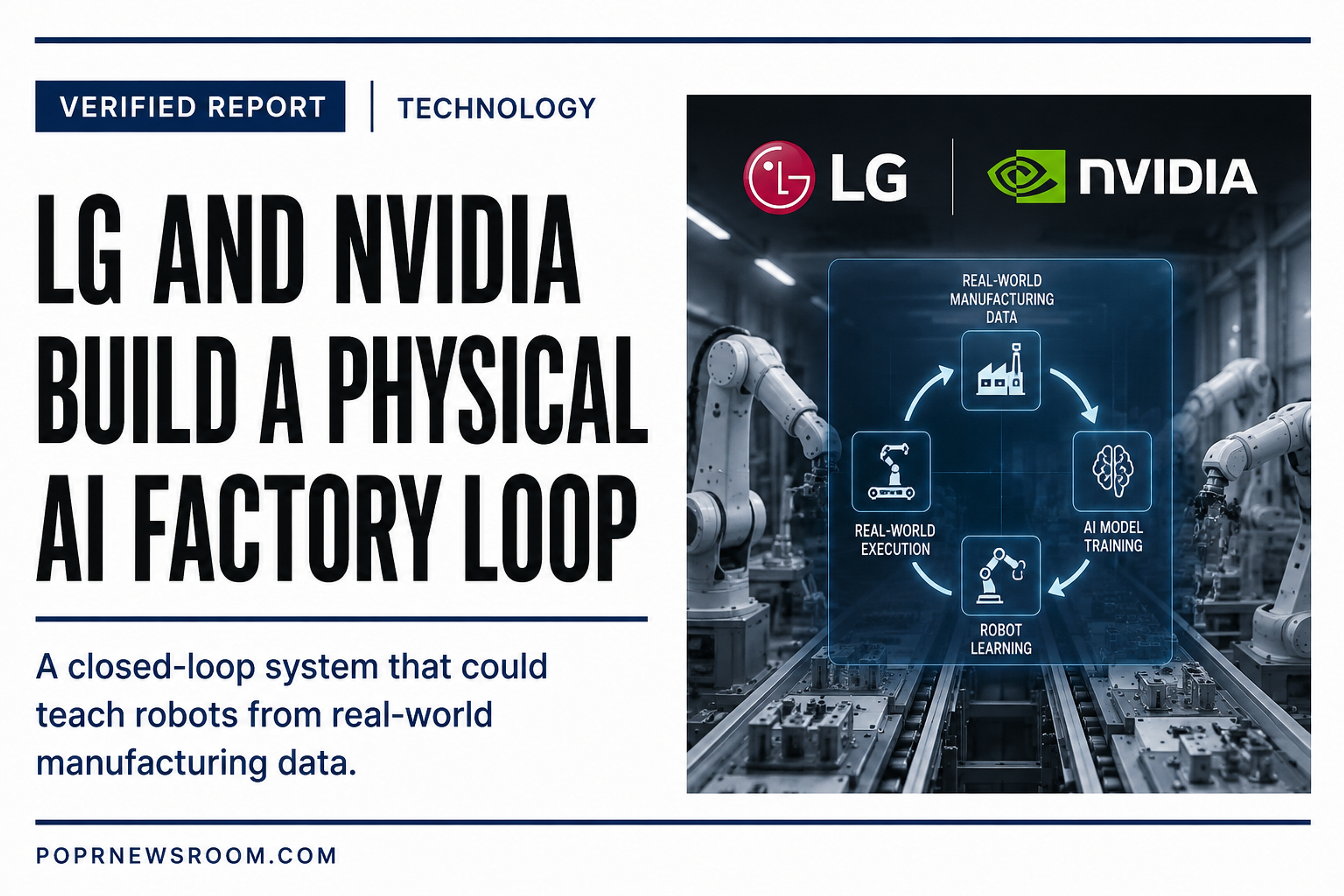
LG and NVIDIA’s 2026 physical AI partnership reaches beyond a humanoid robot unveiling. Their architecture connects factory validation, real-world and synthetic data, simulation, robot foundation models, AI factories, safety systems and redeployment into a repeating learning cycle. The first major test arrives before the end of 2026, when LG plans to validate CLOiD on a Tennessee washing-machine manufacturing line. The most visible part of LG and NVIDIA’s expanding physical AI partnership will probably be a robot. The more consequential part may be everything surrounding it. LG plans to publicly unveil a next-generation humanoid robot in the first quarter of 2027. Before that happens, however, the company says its CLOiD robot will be deployed to a washing-machine manufacturing line in Tennessee for validation in a real-world production environment before the end of 2026. Behind both systems sits a substantially larger architecture involving NVIDIA Isaac GR00T, simulation and synthetic-data technology, LG’s own robot foundation model, LG CNS PhysicalWorks, factory-generated data, safety infrastructure and increasingly powerful AI-compute facilities. Taken together, the components point toward something more important than a single robot deployment. LG and NVIDIA are constructing the infrastructure through which robots can be simulated, trained, placed into physical environments, observed, validated and improved using information generated by those environments. The robot is the visible product. The learning loop is the infrastructure underneath it.
What Are LG and NVIDIA Actually Building?
NVIDIA publicly described an expanded collaboration with LG on June 7, 2026, covering robotics, autonomous driving, AI infrastructure and GPU cloud services. That announcement already included work involving NVIDIA Isaac GR00T, physical AI data generation, AI factories and NVIDIA DRIVE Hyperion. On August 13, LG and NVIDIA formalized their expanded collaboration through a memorandum of understanding signed at NVIDIA’s Santa Clara headquarters, with LG Corp Chairman Kwang Mo Koo and NVIDIA CEO Jensen Huang present. The resulting architecture spans several different layers of physical AI. LG brings its own robots, actuators, sensors, batteries, manufacturing knowledge, factory data, vehicle software, robot foundation model and PhysicalWorks data infrastructure. NVIDIA supplies technology across another set of layers, including compute, foundation models, simulation, robotics infrastructure, safety systems, AI-factory architecture and vehicle-computing platforms. That makes the relationship more complex than LG simply purchasing NVIDIA technology. LG is using NVIDIA infrastructure while continuing to develop and retain substantial proprietary technology of its own.
The Tennessee Factory Is the First Major Test
One of the most important near-term milestones is not the 2027 humanoid unveiling. It is CLOiD. LG says CLOiD will be deployed on a washing-machine manufacturing line in Tennessee for validation in a real-world production environment before the end of 2026. The wording matters. This is more concrete than demonstrating a robot at a trade show, but the announced validation should not yet be confused with evidence of a completed production-scale robotics rollout. The current evidence does not establish permanent operational use, measurable throughput improvements, labor displacement, uptime performance or deployment across LG factories. What it does establish is a scheduled factory-line validation. That makes the Tennessee deployment unusually useful as a future checkpoint because it moves the physical AI program from demonstrations and architecture into an environment where the technology has to interact with real manufacturing conditions. The factory is also important for another reason: it can generate data.
The Real Story Is the Robot Data Factory
LG describes a robot data factory powered by LG CNS PhysicalWorks that supports continuous data collection, synthetic-data generation, training and verification. NVIDIA’s June announcement had already described LG developing a physical AI data factory that combines real production knowledge with NVIDIA Cosmos synthetic data, Isaac Sim and Isaac Lab alongside its broader robotics infrastructure. Put those components together and a larger system appears. A physical environment can provide production knowledge and real-world data. Simulation systems can reproduce and expand possible environments. Synthetic data can supplement what is collected physically. Models can be trained and evaluated. Robots can then be deployed into a physical manufacturing environment for validation, producing additional information that can contribute to further model improvement. Conceptually, the architecture becomes a loop that moves from simulation and digital twins to synthetic and real-world data, then to model training, robot deployment, factory validation, new data, model improvement and redeployment. LG does not describe this entire architecture using the exact phrase “learning loop.” That characterization is an inference from the individual components the companies have confirmed. But each major component necessary for such a loop is present in the announced architecture. That changes the significance of the Tennessee factory. It is not simply somewhere LG can test whether CLOiD performs a task. It can function as part of the physical AI development system itself, where the difference between simulated behavior and real-world behavior becomes information that can be used in subsequent development.
LG Is Developing Its Own Robot Foundation Model
Another important part of the partnership is what LG is not outsourcing. LG confirms that it is developing an in-house robot foundation model, or RFM. The company also says manufacturing-site validation and data generated through its work with NVIDIA will help strengthen that proprietary model. At the same time, LG continues actively using NVIDIA Isaac GR00T. There is no verified basis for treating the two models as direct competitors. The architecture currently points toward coexistence. NVIDIA GR00T, LG’s proprietary RFM and the PhysicalWorks-supported robot data factory can operate as complementary layers within the larger robotics program. That gives LG a strategically different position from a company simply licensing an external AI model and building hardware around it. LG can use NVIDIA’s platform technology while developing proprietary intelligence from its own manufacturing environments, robot systems and operational data. The distinction may become increasingly important if factory experience itself becomes part of what improves the robot.
Why Real Factory Data Could Matter
Physical AI has a constraint that purely digital systems do not face: the physical world. A simulated robot can be exposed to enormous numbers of generated environments, but real factories contain physical variation, imperfect conditions, human movement, hardware behavior and operational circumstances that simulations must approximate. LG’s architecture combines both sides of that problem. Simulation and synthetic data can increase the range of circumstances available during development. Real manufacturing validation can expose the system to conditions that actually occur. The resulting data can then contribute to model development. This does not establish that the architecture will produce continuously self-improving robots without human intervention, nor does it establish measurable performance improvements that have not yet occurred. What it establishes is the infrastructure necessary to connect simulation, data generation, model training and real-world validation much more closely than a conventional robot-development pipeline ending at deployment.
The Physical AI Roadmap Now Extends Through 2028
The announced timeline creates a series of unusually clear checkpoints. Before the end of 2026, CLOiD is scheduled for validation on LG’s Tennessee washing-machine manufacturing line. In the first quarter of 2027, LG plans to publicly unveil its next-generation humanoid robot. During the first half of 2027, the companies are targeting a Vera Rubin-powered reference AI factory. During the first half of 2028, LG plans an 80-megawatt AI factory in Cheonan, South Korea, intended to advance physical AI and robot foundation model development. These dates make the partnership easier to evaluate over time because the strategy contains actual milestones rather than an indefinite promise of future robotics development. Each stage also expands the scale of the underlying infrastructure. The progression moves from factory validation to a humanoid system, then toward dedicated AI-factory infrastructure and eventually an 80MW facility devoted in part to physical AI and robot foundation model development.
LG Could Eventually Sell the AI Factory Architecture Itself
The commercial story extends beyond LG using these systems internally. LG says it intends to use validated “One LG” AI-factory packages to pursue global technology-sector customers. That introduces a separate potential business. If the architecture is successfully validated, LG would not necessarily be limited to using AI factories to support its own robots and manufacturing operations. The company could attempt to commercialize the infrastructure as a package for other businesses. The announced partnership therefore contains at least three distinct potential commercialization paths. One is robotics, including CLOiD, the humanoid program and factory applications. Another is AI infrastructure, including reference AI factories, the planned Cheonan facility and potential offerings to external customers. A third is mobility, where LG is developing next-generation AI-defined vehicle computing for global automakers. The commercial significance of the partnership therefore cannot be measured solely by whether LG’s humanoid robot succeeds. The robot is one product surface inside a substantially broader physical AI strategy.
NVIDIA Is Positioning Itself Across the Physical AI Stack
The partnership also illustrates the breadth of NVIDIA’s physical AI strategy. For robotics, NVIDIA supplies technology including GR00T, Jetson and Halos. For AI factories, NVIDIA provides infrastructure extending into Vera Rubin-class systems. For automotive computing, NVIDIA provides DRIVE Hyperion. Those are genuinely different technology stacks operating across robotics, AI infrastructure and vehicles. That is stronger evidence for NVIDIA’s physical AI strategy than treating one underlying platform as though it were being identically deployed everywhere. Within automotive specifically, NVIDIA DRIVE Hyperion is appearing across multiple partner architectures. LG is developing its next-generation AI-defined vehicle computing platform on the DRIVE Hyperion platform family, while Uber’s separately documented robotaxi ecosystem also incorporates DRIVE Hyperion. Those implementations should not be assumed to be technically identical. Hyperion is a reference-architecture family whose implementations can vary by generation, sensors and software configuration. What the evidence establishes is platform-family reuse within automotive and mobility. At the broader level, NVIDIA is building different infrastructure layers for different physical AI environments.
Safety Becomes Part of the Computing Architecture
Physical AI introduces another problem that conventional software cannot reproduce completely. A software system can produce an incorrect output. A robot can move incorrectly. That distinction introduces collision risk, sensor failures, actuator failures, hardware redundancy requirements, human injury risks, fail-safe behavior and functional-safety certification. NVIDIA launched Halos for Robotics in June 2026 as a full-stack safety architecture spanning AI compute, operating systems, sensor connectivity, safety applications and inspection and certification support. Agility Robotics was announced as the first partner incorporating elements of Halos into its humanoid safety system, providing evidence that the architecture extends beyond the LG partnership. NVIDIA describes Halos as the industry’s first full-stack robotics safety architecture. The existence and scope of Halos are confirmed. The “industry’s first” characterization remains NVIDIA’s marketing claim rather than an independently established industry ranking. The important development is the presence of a dedicated safety layer in the physical AI stack. As robots move from controlled demonstrations into environments containing workers, equipment and other autonomous systems, safety cannot simply be an instruction placed inside a model. It becomes an external architecture involving hardware, software, monitoring, verification and certification.
Robot Governance and AI-Agent Governance Are Similar, but Not the Same
There is a meaningful architectural parallel between software-agent governance and robotics. Both increasingly require authorization, observability, bounded action, execution controls, logging, verification and escalation mechanisms. But the similarity has a hard boundary. Physical robots introduce failure modes that software agents do not directly share, including actuator malfunction, sensor failure, collision and physical injury. The two governance problems are therefore architecturally analogous rather than identical. A useful shared concept is the external control envelope: intelligence operates inside a system that determines what actions are authorized, observes what happens, records activity and provides mechanisms for intervention. Robotics adds an additional physical-safety envelope around that architecture. Halos demonstrates how extensive that additional layer can become by extending from compute and operating systems into sensors, applications and certification infrastructure.
LG Is Neither Simply an NVIDIA Customer Nor an NVIDIA Competitor
The architecture also complicates the conventional way technology partnerships are described. LG contributes physical hardware and industrial assets, including actuators, sensors, batteries, factories and manufacturing knowledge. It also retains software and intelligence assets through its proprietary robot foundation model, PhysicalWorks infrastructure and vehicle software. NVIDIA provides a substantial platform layer underneath and alongside those assets. The result resembles co-development with deliberate stack separation more than straightforward vendor dependency. LG can benefit from NVIDIA’s compute, simulation, foundation-model and safety infrastructure without surrendering every proprietary layer above it. NVIDIA, meanwhile, gains access to a partner with manufacturing environments capable of producing the physical-world data required to develop and validate physical AI systems. That reciprocal architecture may be one of the partnership’s most important features. The value does not flow in only one direction.
The Robot May Be the Least Important Thing to Watch
Humanoid robots naturally dominate attention because they are visible. Data infrastructure is not. But the long-term question surrounding the LG-NVIDIA partnership is not simply whether LG can unveil an impressive humanoid in early 2027. The more consequential question is whether the companies can make the infrastructure surrounding that robot work as intended. Can simulated environments contribute useful training data? Can synthetic and factory-generated information improve LG’s robot foundation model? Can CLOiD perform effectively enough during real-world validation to justify broader deployment? Can the AI-factory architecture scale from reference systems to the planned 80MW Cheonan facility? Can LG convert that architecture into something other companies will buy? Those questions remain open. The partnership is significant because LG and NVIDIA have now attached physical systems, proprietary models, data infrastructure, simulation, safety architecture, factory validation and compute expansion to a series of dates against which those questions can eventually be tested. The next checkpoint comes quickly. Before 2026 ends, CLOiD is supposed to enter LG’s Tennessee manufacturing environment for real-world validation. The humanoid unveiling comes afterward. That order tells us something important about the strategy. The public may first encounter LG’s physical AI future through the robot it can see. The infrastructure that determines whether that robot becomes useful is being built behind it.
Evidence Status
CONFIRMED: NVIDIA publicly announced the expanded LG collaboration framework on June 7, 2026, covering robotics, autonomous driving, AI infrastructure and GPU cloud services.
CONFIRMED: LG and NVIDIA signed an MOU on August 13, 2026, at NVIDIA’s Santa Clara headquarters, with LG Corp Chairman Kwang Mo Koo and NVIDIA CEO Jensen Huang present.
CONFIRMED: CLOiD is scheduled for a Tennessee factory-line validation deployment before the end of 2026.
NOT YET ESTABLISHED: Permanent CLOiD production deployment, measurable throughput improvements, labor displacement, uptime performance or broad factory rollout.
CONFIRMED: LG is developing its own robot foundation model while continuing to use NVIDIA Isaac GR00T.
CONFIRMED: LG describes a robot data factory powered by LG CNS PhysicalWorks supporting continuous data collection, synthetic-data generation, training and verification.
STRONG INFERENCE FROM CONFIRMED ARCHITECTURE: The combination of simulation, data generation, training, deployment, factory validation and subsequent model improvement creates a physical AI learning loop. The individual components are confirmed, while the loop is POPR’s synthesis of their relationship.
CONFIRMED: LG targets a next-generation humanoid public unveiling in Q1 2027, a Vera Rubin-powered reference AI factory in H1 2027 and an 80MW Cheonan AI factory in H1 2028.
CONFIRMED: LG intends to pursue global technology-sector customers using validated “One LG” AI-factory packages.
CONFIRMED WITH SCOPE LIMIT: NVIDIA DRIVE Hyperion is being used across multiple automotive and mobility partner architectures. This establishes platform-family reuse, not technically identical implementations.
CONFIRMED: NVIDIA Halos for Robotics exists as a full-stack robotics safety architecture. The “industry’s first” description is NVIDIA’s attributed claim rather than an independently established ranking.
SUPPORTED SYNTHESIS: LG’s relationship with NVIDIA is better characterized as co-development with deliberate stack separation than as simple technology licensing because LG retains substantial proprietary hardware, software, data and model layers while using NVIDIA infrastructure.
SUPPORTED ANALOGY: Software-agent governance and robot governance share external-control-envelope characteristics, but physical robotics introduces additional safety-critical hardware and certification requirements that make the architectures analogous rather than identical.