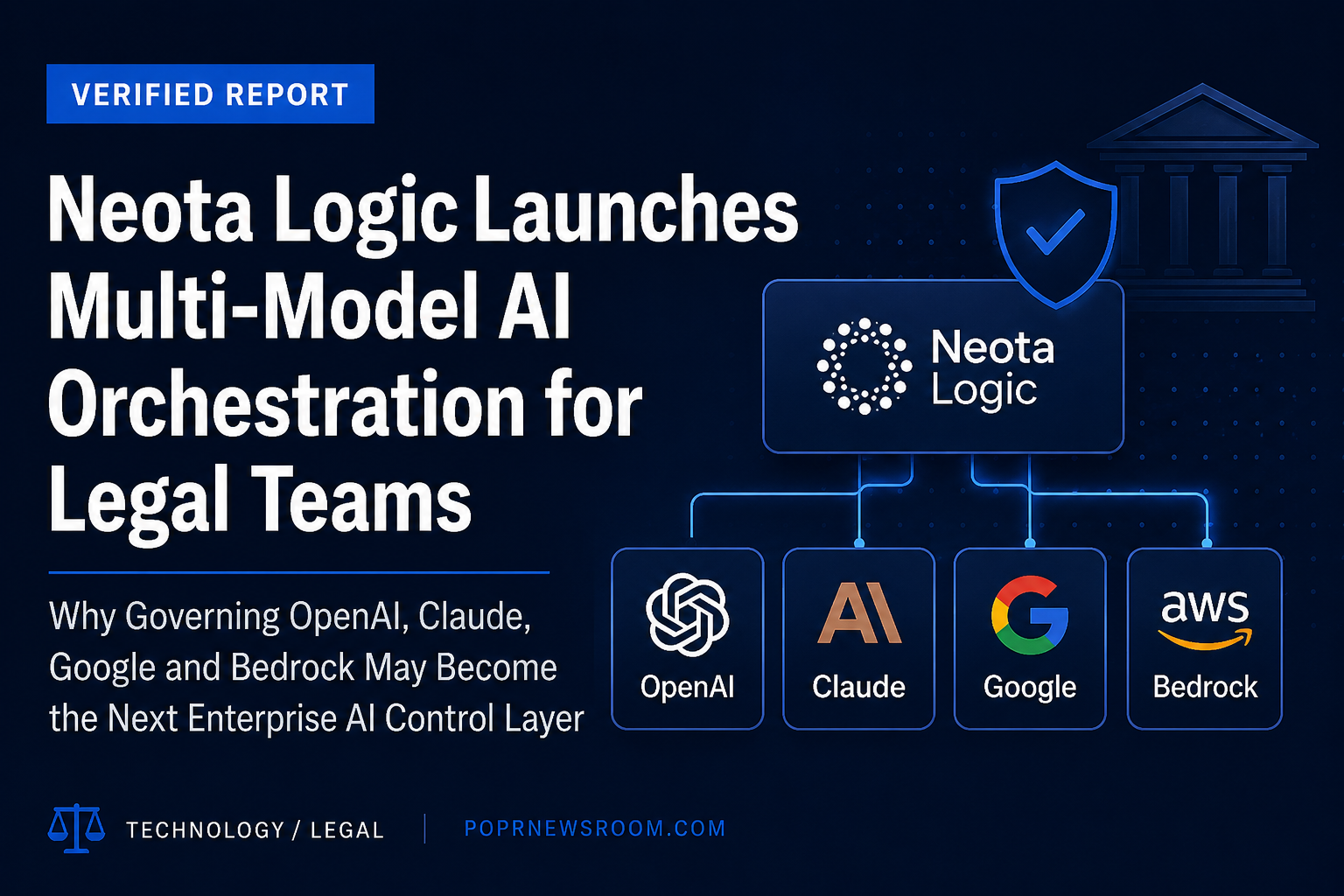
Neota Logic has launched native AI orchestration for legal and compliance teams, letting organizations route Anthropic, OpenAI, Azure OpenAI, Google, open-source models and AWS Bedrock through governed deterministic workflows. The commercially significant development is not that Neota can call multiple models — it is that governance runs in both directions: Neota orchestrates AI inside its own workflows, and external AI systems can call Neota when they need a governed, deterministic answer. That second direction changes the deployment equation for enterprise AI governance in a way that matters beyond the legal market.
Why Multi-Model AI Creates a Governance Problem
Enterprise artificial intelligence is creating a governance problem that did not exist in the same form when organizations were experimenting with one model at a time. A legal department might use OpenAI for one workflow, Claude for another, Azure OpenAI because of existing Microsoft infrastructure, Google models for a specialized task, AWS Bedrock for access to additional model families, and open-source models where control or deployment requirements make them preferable. Each choice can be technically justified. The governance problem begins when the organization has to answer a different set of questions: which models are actually permitted, which one should handle a given task, what rules must its answer satisfy, what happens when confidence is low, who must approve the result, how the entire decision can be reconstructed months later — and whether anyone in the organization can answer all of those questions from a single authoritative record rather than through reconstructed memory.
Neota Logic's August 10 launch is aimed directly at that layer. The company is not trying to solve enterprise AI governance by concentrating every organization onto one approved model. It is trying to govern the workflow around whichever approved models the organization chooses to use, which may prove more durable than any individual model leaderboard.
What Did Neota Logic Actually Launch?
Neota Logic announced native AI orchestration for legal and compliance teams on August 10, 2026. The company describes a model-agnostic architecture in which legal teams can work with providers they already use — including Anthropic, OpenAI, Azure OpenAI, Google, open-source models and AWS Bedrock — through their own accounts. That model-agnostic design matters commercially because enterprise AI adoption is increasingly fragmented across providers. A company may not want to abandon its existing OpenAI relationship simply because another workflow performs better with Claude. A legal team may have Azure OpenAI embedded inside existing Microsoft infrastructure. A regulated workflow may need a separately approved open-source model. Neota's architecture treats model diversity not as a temporary inconvenience that will resolve when one provider wins, but as a governance condition that the platform is designed to manage.
Who Is Neota Logic?
Neota Logic traces its roots to 2010 as a deterministic legal-workflow automation company, and its current materials report more than 8 million annual sessions across more than 100 law firms and legal teams and more than 10,000 global users. That history matters because Neota is not approaching generative AI as a blank-slate AI startup. The company spent more than a decade building no-code, rules-based legal and compliance workflows before large language models became commercially dominant. Its 2026 architecture therefore works in the opposite direction from many AI products: instead of beginning with a generative model and adding governance around it afterward, Neota begins with a deterministic workflow and allows AI to enter as a bounded component where useful. That inversion explains most of the product's architecture.
What Does "The Workflow Is the Master" Mean?
The architecture can be understood as a structured sequence: a deterministic workflow governs the overall process; AI is called as a bounded task where the workflow calls for it; rules and validation evaluate the result; a confidence or decision gateway determines whether the output meets the required threshold; human escalation occurs where the workflow mandates it; execution proceeds; and an audit record is produced. AI is not the controlling layer in that chain — the workflow is. Neota describes AI as being called where it helps and constrained everywhere else, and confirms that many Neota solutions can run entirely on deterministic logic without invoking AI at all.
Neota's August 10 release states that models are approved centrally and that no model is ever invoked by default. That sentence is commercially important. Much of the current AI market is oriented around making model invocation easier and faster. Neota is treating invocation itself as something that requires organizational permission. The model becomes a governed resource inside a larger operating system rather than a default capability that users can access without constraint.
Why Does This Matter More Than Simply Connecting to Several LLMs?
Calling multiple models is technically useful. Governing them is a different problem. An ordinary orchestration system might choose one model for reasoning, another for extraction and another for summarization. A governed orchestration system additionally has to know whether each model is approved for the task, whether the request satisfies the organization's rules, whether the output meets a confidence threshold, whether human approval is required, and what must be recorded. John Lord, Neota Logic's Chairman and CEO, stated the company's position in its launch announcement: "A model answering on its own, with no rules around it and no record behind it, is a liability, however quick and impressive the answer looks." That statement is more than launch rhetoric — it expresses the entire business thesis. The difficult enterprise problem may not be accessing intelligence. It may be controlling the conditions under which intelligence is allowed to affect the business.
What Is "AI in Neota"?
In the AI in Neota configuration, AI operates inside a Neota-governed workflow. The deterministic workflow determines where AI is useful, the selected model performs its bounded task, rules can evaluate the result, confidence can be assessed, human approval can be inserted where the workflow requires it and the final execution is logged. This is the more intuitive form of AI orchestration because Neota remains the visible application environment: the user enters the governed workflow, and the workflow calls AI when appropriate. It is also the less architecturally surprising of the two directions.
What Is "Neota in AI"?
The reverse configuration — Neota in AI — is where the strongest architectural finding in the sealed POPR research sits. In this model, the user remains inside another AI environment, such as a general-purpose AI assistant they already prefer, and that external system calls Neota when it requires a deterministic or governed answer. The result is a different deployment architecture: the AI interface handles the user interaction, the call to Neota triggers deterministic rules and bounded AI where necessary, validation and human escalation occur according to workflow policy, and a governed answer returns to the front-end interface. The user's preferred AI tool stays in place; the governance system sits behind it.
This changes the adoption problem meaningfully. An organization does not necessarily have to convince every employee to abandon the AI interface they already use in order to insert policy around what that interface is allowed to do. Instead of competing for the user's front-end attention, a governance provider can compete for the control layer underneath the interface the user already has. That may ultimately prove more commercially important than another product asking employees to switch to yet another workflow tool.
Does Every Neota AI Decision Require Human Approval?
No. That would overstate the verified capability. Neota supports human approval gates and escalation when confidence is low or when a workflow explicitly requires human review. The evidence does not establish that every AI operation is manually approved. The distinction matters because serious AI governance does not necessarily mean inserting a person into every low-risk automated action — it means the organization can precisely define where human judgment becomes mandatory. A low-confidence result may be escalated; a high-risk legal decision may require approval; a routine bounded operation may proceed according to deterministic policy. The control belongs to the workflow configuration, not to a blanket rule requiring human sign-off on every output.
What Does Neota Record About an AI Run?
Neota's primary release states that every run can produce a full audit trail showing what the AI was asked, what it returned, which model ran and who signed off. The verified execution data additionally covers model identity, token count, cost, confidence score, approval decisions, session context and timestamp. POPR refers to this underlying capability as an AI Execution Audit Record — that is POPR descriptive terminology, not a Neota branded product name. The underlying capability is confirmed from Neota's own primary-release language and independently corroborated in its product materials.
The practical governance value of that record becomes clear when an organization has to reconstruct a decision after the fact. Which model made the recommendation? What prompt produced it? What information was returned? What rules were applied to the output? Who approved the result? Was the model centrally approved at the time? How much did the run cost? What happened next? A governance system that cannot answer those questions from an execution record forces the organization to reconstruct the answer through employee memory, which introduces precisely the kind of undocumented uncertainty that governance is supposed to eliminate.
Why Multi-Model AI Makes Auditability Harder
Single-model governance is already difficult; multi-model governance adds another dimension. Two models can respond differently to the same task. A provider can update a model without notice. A company can change which models are approved. Pricing, context limits and safety behaviors can all change. Once a legal department routes different question types to different providers — OpenAI for one class of queries, Anthropic for another, AWS Bedrock for a third — the statement "we use AI" stops being a meaningful governance claim. The organization needs to know which AI, for what task, under whose account, inside which workflow, under which rules, at what point in time, with whose approval. That is why orchestration and governance are converging: without a layer that tracks the relationship between decisions and the models that produced them, multi-model AI creates an audit liability that grows with each additional provider.
The Legal Industry Already Has an AI Governance Gap
The 8am 2026 Legal Industry Report surveyed more than 1,300 legal professionals and found that 69 percent use general-purpose AI for work, while only 9 percent report that their firm has an actively enforced AI policy. Those figures come from the same survey, which makes the comparison internally consistent without mixing methodologies across different research organizations. The gap is substantial. AI use has entered legal work much faster than actively enforced organizational policy. That creates a commercial opening for systems that do more than give lawyers access to a chatbot — the enterprise problem becomes controlling what happens after access already exists.
Is Neota the First Company to Govern AI Agents?
No, and claiming that would be too broad a position for the verified evidence to support. Microsoft, AWS and other major technology platforms are increasingly exposing identity systems, permissions, runtime controls, logging and governance infrastructure for autonomous and agentic AI. Neota's differentiation is narrower and more defensible: it is bringing a deterministic legal and compliance workflow architecture developed over more than a decade into the modern multi-model generative-AI layer. The market does not need Neota to be the first company ever to govern AI for the launch to be commercially significant. It only needs the problem — governing multiple approved models inside consequential legal and compliance workflows — to be real and underserved. The 8am survey figures suggest it is.
What Is the Connection Between Neota Logic and TokenOps?
POPR's prior research on TokenOps examined resource and economic governance for autonomous agents: how much the agent can spend, how much resource is available to a run, when behavior should be steered and when execution should halt. Neota addresses a different authority layer. TokenOps asks how much the agent may consume; Neota asks what the agent may decide, which organizational rules govern the output, when a human must become involved and what record must remain. These are not the same question. A system can remain perfectly within its token and cost budget while making a decision that was never authorized. A system can obey every legal workflow rule while consuming an irresponsible amount of compute. The TokenOps and Neota comparison is POPR synthesis rather than an external industry standard, but the comparison reveals why agent governance is unlikely to be solved by any single control layer: economic authority, operational authority, data authority, identity authority and decision authority may each require their own governance mechanisms, and none of those substitutes for the others.
The Enterprise AI Control Plane Is Beginning to Separate From the Model
This may be the most important structural development that Neota's launch illustrates. For several years, enterprise AI strategy was often framed around model selection: OpenAI or Anthropic, Google or Microsoft, hosted model or open source, which benchmark performs best, which model is cheapest. Those questions remain relevant. But model choice becomes less strategically dominant when the enterprise has an orchestration and governance layer above the model. The company can change the model while preserving the policy — retiring an old model, approving a new one, routing a task differently — while maintaining the same human-approval rule, the same deterministic validation, the same audit requirement and the same legal process. The intelligence provider changes; the organizational control remains. That is potentially a major architectural shift because it changes which part of the stack is strategically durable.
Why This Could Matter Commercially for OpenAI, Anthropic, Google and AWS
Model providers increasingly compete to become the intelligence layer inside enterprise software. But enterprises do not necessarily want the model provider to become the final authority over every business process. That creates room for an independent control layer above the models. OpenAI can provide a model. Anthropic can provide a model. Google can provide a model. AWS Bedrock can provide access to multiple model families. Azure OpenAI can sit inside Microsoft's identity and data infrastructure. The enterprise can then apply its own rules, validation and approval requirements above all of those providers. This reduces the governance implications of switching models: a model change does not have to mean rewriting the organization's legal-control architecture. The durable asset may become the workflow and governance layer rather than the model connection itself.
Does This Mean the Workflow Always Beats the Agent?
Not necessarily. There is a genuine tension between deterministic governance and increasingly autonomous AI. Agentic research is pushing systems toward longer planning horizons, more independent tool use and greater discretion. Neota's architecture deliberately bounds that discretion, keeping AI as a component inside a workflow rather than as the directing intelligence of the process. Neither approach has been established as universally correct. The unresolved question is how much autonomy organizations will allow inside externally governed envelopes — and how that balance will shift as agents become more capable and organizations become more comfortable with autonomous decision-making in consequential domains. POPR classifies the architecture of autonomy inside an externally governed envelope as a candidate, not as established doctrine. That balance will likely look different in a legal due-diligence workflow than in a routine document-classification task, and the industry has not yet converged on where those lines fall.
Does Governance Add Cost or Latency?
Almost certainly, some governance functions consume additional resources — but the sealed evidence does not quantify the real operational overhead. Logging takes compute. Rule evaluation takes time. Additional validation may add latency. Human escalation can add delay. No verified source in the underlying research provides a reliable measurement of the additional latency or economic cost created by Neota's governance architecture compared with direct model invocation. That remains an unresolved commercial question. The governance layer may provide enough risk reduction to justify the overhead for consequential legal and compliance decisions. That proposition still needs measurement, and buyers should ask for it.
Why Regulation Is Increasing the Value of Auditability
The regulatory backdrop is moving toward greater scrutiny of consequential automated decisions, transparency and logging — but the details require precision. Colorado's original 2024 AI Act, SB24-205, was repealed and replaced by SB26-189, signed by Governor Jared Polis on May 14, 2026. The replacement law governs automated decision-making technology used in consequential decisions and is scheduled to take effect January 1, 2027. That date, however, is not free of uncertainty: xAI filed suit against Colorado's Attorney General in April 2026 challenging the original framework, resulting in a federal injunction, and independent legal commentary describes enforcement of the replacement law as remaining subject to litigation uncertainty. January 1, 2027 should not be presented as an uncontested enforcement certainty.
New York's RAISE Act applies transparency and incident-reporting obligations specifically to large frontier-model developers rather than acting as a general legal-department AI-governance law — a scope distinction worth preserving. The European Union's AI Act separately contains logging and transparency requirements in Articles 12 and 13 as regulatory context. None of that establishes that deploying Neota automatically satisfies those laws. Compliance depends on how a system is classified, how it is deployed and which obligations actually apply. The safer and more accurate conclusion is that regulatory pressure is increasing the commercial value of traceability, policy enforcement and human-accountability mechanisms — without assuming that any particular product configuration constitutes statutory compliance.
Why "No Model Is Ever Invoked by Default" May Be the Most Important Enterprise Rule
The AI industry has spent enormous effort making model invocation easier, faster and more automatic. Neota introduces the opposite question: should AI be invoked at all for this task? If a deterministic rule can resolve a problem reliably, an organization may not need a generative model. If a workflow requires exact policy interpretation, probabilistic generation may introduce unnecessary uncertainty. If AI is useful only for one portion of a task, it can be bounded there and excluded from the rest. The decision to invoke AI therefore becomes part of governance rather than an assumed background condition. That principle becomes more important as organizations accumulate more models, because the enterprise does not merely need a router deciding which model to call — it may need a policy layer deciding whether any model is justified.
The Two-Direction Architecture Changes the Adoption Problem
Most enterprise software asks users to come into the product and change their behavior. Neota's two-direction architecture creates another option. AI in Neota keeps the user inside Neota while the platform calls the approved model. Neota in AI keeps the user inside the AI interface they already prefer while that interface calls Neota for governed answers. That second direction matters commercially because organizations can potentially insert deterministic governance behind an existing AI interface without forcing every user into a new tool. In a world where employees may already have strong preferences for a particular AI assistant, the governance provider that does not require them to abandon that preference may encounter less adoption friction than one that does. Instead of competing for the interface, a governance system can compete for the policy layer underneath the interface the user already has.
The Emerging Enterprise AI Stack
The enterprise AI stack is becoming layered. Models form the bottom tier: OpenAI, Anthropic, Google, AWS-accessed models, open-source models. Above them sit tools, data retrieval and integration. Above that sits orchestration. Above orchestration sit identity, permissions, budget and resource controls, deterministic policy, human escalation, auditability and outcome verification. The exact ordering will vary by system and use case. The larger point is that intelligence increasingly occupies one functional layer in a much broader operational architecture, and that layer is becoming separable from the authority layer above it. The model provides capability. The organization still requires a system to control when, how and under whose authority that capability becomes a decision.
The Model May Become the Replaceable Part
The strategic implication that follows from Neota's architecture is worth stating directly. Models are advancing quickly, and the best model for a particular task in August 2026 may not be the best model a year later. Pricing may change, provider policies may change, regulatory requirements may change, and new open-source models may appear that perform better on specific tasks at lower cost. An enterprise architecture tightly coupled to one model makes those changes expensive because the governance, approval and audit infrastructure has to change with the model. A governance layer that treats models as approved, replaceable resources changes the economics: the company controls the workflow, the rules, the approval gates and the logging, and the model can be swapped without dismantling the control architecture around it. That does not make the model unimportant — it changes which part of the architecture is strategically durable. The workflow and governance layer may have a longer useful life than any individual model relationship.
Neota Logic's Real Commercial Bet
Neota's commercial bet is not simply that legal teams want access to AI. That problem is largely solved: the 8am survey figure of 69 percent general-purpose AI usage shows how quickly access has already spread through the legal industry. The larger bet is that organizations increasingly need a layer between AI capability and institutional authority — a system that governs whether the answer the model produced is allowed to become a decision, under which rules, with whose approval and with what record. John Lord stated the position plainly in the launch announcement: "Our aim is to set the standard for how AI is used in legal and compliance work, not to follow it." The commercial version of that statement is that enterprise AI becomes materially different once the organization stops asking only what the model can do, and starts asking who governs what happens when the model does it.
Fact Summary
What did Neota Logic launch? Neota Logic launched native AI orchestration for legal and compliance teams on August 10, 2026, allowing multiple AI providers to operate inside governed deterministic workflows with rules, confidence thresholds, human approval gates and audit logging.
Which AI providers does Neota support? The verified launch list includes Anthropic, OpenAI, Azure OpenAI, Google, open-source models and AWS Bedrock, through customers' own accounts.
How large is Neota Logic? Neota reports more than 8 million annual sessions, more than 100 law firms and legal teams, and more than 10,000 global users.
Does Neota require AI in every workflow? No. Many workflows operate entirely on deterministic logic, and Neota states that no model is ever invoked by default.
What is AI in Neota? AI operates inside a Neota-governed workflow. The user works within Neota and the workflow calls AI where appropriate.
What is Neota in AI? An external AI interface can call Neota when it needs a governed, deterministic answer. Governance sits behind the user's existing AI tool rather than replacing it.
Does every AI decision require human approval? No. Neota supports human approval gates and low-confidence escalation where workflows require them. The workflow determines where human judgment is mandatory.
What does Neota log in an AI run? Every run can produce an audit trail showing what the AI was asked, what it returned, which model ran and who signed off. Additional verified data covers model identity, token count, cost, confidence score, approval decisions, session and timestamp.
Is "AI Execution Audit Record" a Neota product name? No. It is POPR descriptive terminology for the verified audit capability.
How widely are legal professionals using general-purpose AI? The 8am 2026 Legal Industry Report found 69 percent of more than 1,300 surveyed legal professionals use general-purpose AI for work.
How many firms in that same survey had an actively enforced AI policy? Nine percent — from the same 8am 2026 Legal Industry Report.
Does Neota automatically make a company compliant with the EU AI Act or Colorado law? No. Regulatory compliance depends on system classification and deployment circumstances. Neota's features may be relevant to governance and logging requirements, but the product does not establish statutory compliance.
When does Colorado's replacement AI law take effect? Colorado's SB26-189 was signed May 14, 2026 and is scheduled to take effect January 1, 2027. A legal challenge from xAI creates real uncertainty around enforcement timing.
Is Neota the only company building enterprise AI governance infrastructure? No. Microsoft, AWS and other major platforms also provide identity, permissions, runtime controls and auditability for agents. Neota's differentiation is bringing a deterministic legal and compliance workflow architecture into the modern multi-model generative-AI layer.
What is Neota's strongest differentiation in the verified evidence? Its two-direction architecture: AI can operate inside Neota's deterministic workflows, and external AI systems can call Neota for governed answers.
What is the larger enterprise trend? Model capability and enterprise authority are separating into different layers. The model supplies intelligence; the organization increasingly requires a separate system to control when, how and under whose authority that intelligence becomes an operational decision.
Evidence Status
CONFIRMED: Neota Logic launched native AI orchestration for legal and compliance teams on August 10, 2026.
CONFIRMED: Supported providers in the launch include Anthropic, OpenAI, Azure OpenAI, Google, open-source models and AWS Bedrock.
CONFIRMED: Neota's architecture keeps AI bounded inside deterministic workflows and does not require AI invocation for every solution.
CONFIRMED: Neota states that models are approved centrally and no model is ever invoked by default.
CONFIRMED: Neota supports confidence-scored output and escalation to humans when workflow conditions require it.
CONFIRMED: Neota can produce detailed AI execution audit trails covering model, tokens, cost, confidence, approval, session and timestamp.
CONFIRMED: AI in Neota and Neota in AI are actual named Neota architectures, not POPR-created categories.
CONFIRMED: The 8am 2026 Legal Industry Report found 69 percent general-purpose AI usage and 9 percent actively enforced AI-policy adoption among more than 1,300 surveyed legal professionals.
CONFIRMED WITH LEGAL UNCERTAINTY: Colorado SB26-189 is scheduled to take effect January 1, 2027, while litigation involving xAI creates unresolved enforcement uncertainty. The prior seal's "effective June 2026" language is withdrawn; that date described the original law, SB24-205, which was repealed.
POPR SYNTHESIS: Neota represents an emerging enterprise AI-control-plane pattern in which models become bounded resources inside organizational governance architecture.
POPR SYNTHESIS: TokenOps and Neota illustrate different dimensions of the same broader governance problem: TokenOps addresses economic and resource authority; Neota addresses operational and decision authority.
CANDIDATE ARCHITECTURE: Autonomy inside an externally governed envelope. Not established as the universal enterprise AI architecture.
UNRESOLVED: The real latency and economic overhead created by Neota's logging, validation and governance layers compared with direct model invocation.
NOT ESTABLISHED: That every AI operation requires human approval; that Neota is the only enterprise agent-governance platform; that Neota's architecture automatically satisfies any specific AI regulation; or that deterministic workflow governance represents the final universal architecture for autonomous AI.
Sources
- PRWeb / Neota Logic. "Neota Logic launches native AI orchestration for legal and compliance teams." August 10, 2026. Primary launch announcement confirming multi-provider support, centralized model approval, no-default AI invocation, audit trails and executive statements. Directly retrieved and quoted, Clark verification pass.
- Artificial Lawyer. "Neota Rolls Out New AI Governance Strategy." August 13, 2026. Independent reporting on the launch and executive positioning.
- Neota Logic. "AI Governance for Legal Teams," "AI Regulatory Orchestration," AI in Neota and Neota in AI product materials, and current company-scale information.
- Neota Logic. Prior first-party Azure OpenAI Building Block announcement, establishing Azure OpenAI integration before the August 2026 orchestration launch.
- Clio. 2025 Legal Trends Report (79 percent AI usage figure) and separate 2026 materials (71 to 87 percent range by firm size). Included in the verification record to resolve a prior statistical misattribution; the 8am survey is used for the article's principal market-gap statistic.
- 8am. 2026 Legal Industry Report. More than 1,300 legal professionals surveyed; 69 percent reported general-purpose AI use for work while 9 percent reported an actively enforced firm AI policy.
- Colorado General Assembly. SB26-189 bill text and summary. Replacement automated-decision-making framework signed May 14, 2026, scheduled for January 1, 2027.
- Colorado Attorney General's Office. Automated Decision-Making Technology and Chatbot Safety rulemaking materials confirming the statutory schedule and rulemaking framework.
- Buchalter and related independent legal analysis. Reporting on xAI v. Weiser litigation and continuing uncertainty surrounding enforcement of Colorado's replacement framework.
- European Union. EU AI Act Articles 12 and 13 concerning logging and transparency. Used as regulatory context only, not as evidence of Neota compliance.