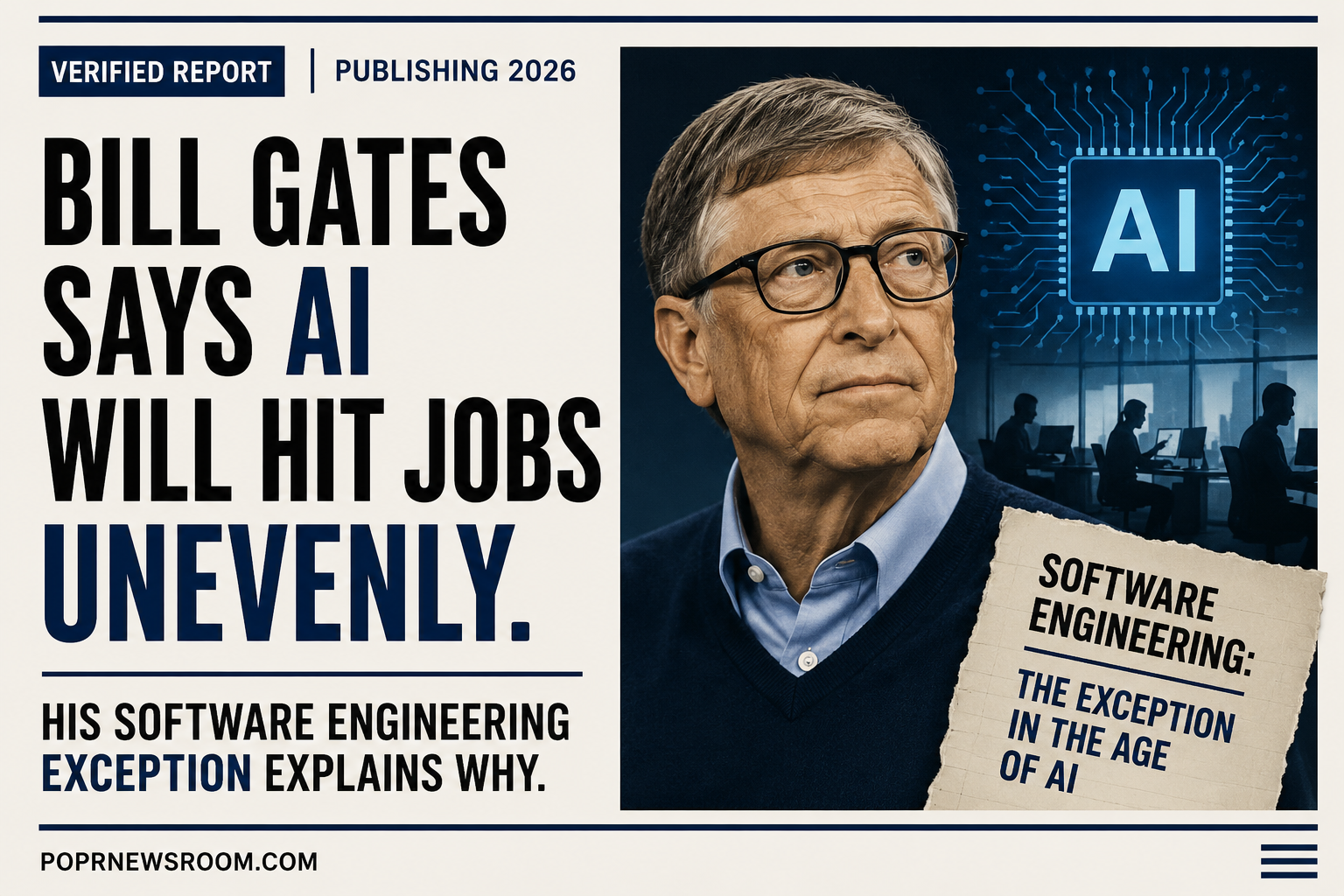
Bill Gates expects artificial intelligence to eliminate work. He does not expect it to eliminate every kind of work in the same way. That distinction is one of the most important parts of Gates’s August 26 essay on what he calls the turbulent AI era. Gates identifies sales and customer support, software engineering, paralegal work, loan assessment, data analysis and medical triage among the areas he believes face significant initial exposure to AI.
Then he makes an exception that complicates the entire argument. “A few areas like software engineering will generate new demand as the costs go down,” Gates writes, “so the net job loss in those areas will be less than in others as long as some tasks, such as design, are better done by humans.” Gates is making a forecast, not reporting an established labor-market outcome.
But the mechanism behind his forecast matters. Artificial intelligence can reduce the amount of human labor required to produce something without necessarily reducing the total number of humans employed producing it by the same proportion. If AI makes software dramatically cheaper to create, the world could simply demand much more software.
That means the central question in Gates’s labor argument is not just whether AI can perform human work. It is what happens to demand after the cost of that work falls.
Bill Gates Thinks This AI Transition Is Different From Earlier Ones
Gates published “The turbulent AI era is here. The choices we make now are critical” as a broad assessment of both the potential benefits and disruptions artificial intelligence could create. His labor concerns sit inside a larger argument about why he believes this technological transition may differ from previous ones. Earlier technological advances frequently replaced particular forms of physical labor while creating demand for new kinds of cognitive work.
Gates believes AI reaches directly into cognition itself. It also runs through technological infrastructure that already exists and can communicate with people through ordinary language. “We don’t have to adapt to it because it can adapt to us,” Gates writes.
That combination, in Gates’s interpretation, lowers some of the barriers that slowed earlier technologies. A business does not necessarily need to construct an entirely new physical system before beginning to use generative AI. The technology can enter existing workflows through computers and software employees already use. If Gates is right, that makes the labor transition potentially faster.
It does not tell us what the final employment outcome will be.
Gates Names Specific Jobs He Thinks Are Exposed
Gates does not confine his employment argument to a general warning about “white-collar jobs.” He identifies particular categories. Sales and customer support.
Software engineering. Paralegal work. Loan assessment.
Data analysis. Medical triage. These occupations contain substantial amounts of cognitive work that AI systems can increasingly assist with or perform.
Gates also looks beyond today’s generative-AI systems. He expects physical robots to create competition in construction and hospitality by the end of the decade. That is a forecast. It should not be reported as an established timetable for job losses in those industries.
But it shows the breadth of the transition Gates is contemplating. The first wave involves intelligence delivered largely through software. The next could increasingly combine artificial intelligence with machines capable of acting in the physical world.
Why Does Gates Treat Software Engineering Differently?
Software engineering is particularly useful for understanding Gates’s argument because it appears on both sides of the AI equation. AI can automate portions of software development. At the same time, AI can make software less expensive to create.
Those statements are not contradictory. Imagine that a particular software project once required substantially more human time than it does after AI tools become integrated into development. At the task level, human labor has been displaced.
But lower development costs can also make previously uneconomic projects viable. Companies can build internal software they once could not justify. Small businesses can commission tools they previously could not afford.
Developers can attempt more products. Existing products can add more features. Entirely new markets can emerge.
Gates’s argument is that this additional demand could offset some of the employment pressure created by greater productivity. He does not claim it will eliminate that pressure. His wording is narrower: net job loss in areas such as software engineering could be less than in others.
That is an important distinction.
AI Exposure Is Not the Same Thing as Job Elimination
Much of the public discussion about AI employment collapses several different events into one. They should be separated. An AI system performing a task previously completed by a person is one event.
An employer consequently eliminating a position is another. An entire occupation shrinking across the economy is another. And the total employment effect after businesses respond to lower costs and changing demand is another still.
Gates’s software-engineering exception makes those differences visible. An occupation can experience extensive automation without disappearing. Workers can become substantially more productive while demand for their output rises.
An employer can reduce staffing for one activity while expanding somewhere else. Or productivity gains can fail to generate sufficient new demand, leaving fewer workers necessary overall. The technology alone does not determine which outcome occurs.
The economic response matters.
Gates Is Not Predicting a Specific Unemployment Rate
This is another important boundary around his argument. Gates’s essay does not establish a specific percentage of workers who will lose their jobs to AI. It should not be converted into one.
His named occupations represent his assessment of exposure and expected disruption, not verified future employment counts. That matters because technological capability is easier to demonstrate than economy-wide labor substitution. A model may prove capable of performing a task without employers immediately reorganizing around it.
Businesses face costs, regulations, reliability requirements, customer preferences, organizational inertia and other constraints. Workers also adapt. Jobs themselves change.
New tasks appear. Demand changes. Gates expects substantial disruption.
The magnitude remains uncertain.
Emerging Labor Research Makes the Entry-Level Question Harder to Ignore
Independent research adds another dimension to Gates’s argument. Research associated with the Stanford Digital Economy Lab has reported evidence of employment pressure among entry-level workers in occupations more exposed to artificial intelligence. The finding is important.
Its broader interpretation remains contested. Economist Daron Acemoglu has publicly disagreed with Erik Brynjolfsson over how the emerging labor evidence should be understood. Brynjolfsson himself has distinguished an observed entry-level effect from a much broader claim that AI is already producing a generalized job apocalypse.
That disagreement should remain visible. The current evidence does not justify turning an early labor-market signal into proof of mass technological unemployment. But the entry-level pattern raises a question that fits directly inside Gates’s argument about uneven effects.
AI may not affect everyone inside an occupation equally.
Gates’s Uneven-Impact Argument May Apply Inside Jobs Too
The conventional question is which professions AI will replace. Gates’s reasoning suggests that may be too coarse. The more revealing unit could eventually be the task.
Or the level of experience. Consider how many professional careers traditionally begin. Junior workers often perform routine tasks.
They research. Draft. Review documents.
Write basic code. Analyze straightforward cases. Prepare initial materials.
Handle repetitive customer interactions. Perform work that experienced employees supervise and refine. Those tasks create economic value.
They also create experience. If artificial intelligence becomes particularly effective at the routine work historically assigned to beginners, companies could have less reason to hire as many beginners even while continuing to value experienced professionals. The result would not necessarily be the disappearance of the profession.
It could be pressure on the route into it. That possibility is an inference from the labor pattern under discussion, not a labor-market outcome Gates establishes in his essay. But it is one of the most consequential implications of an entry-level effect.
What Happens to a Profession If AI Removes Its Training Ground?
This creates a problem that ordinary automation statistics may miss. A company can become more productive in the short term by automating junior work. But professions reproduce themselves through experience.
Senior software engineers were once junior engineers. Experienced lawyers once performed beginner legal work. Senior analysts learned by doing analysis they were not yet expert at.
Expertise requires some mechanism through which inexperienced people become experienced. If AI removes a significant portion of that work, businesses may eventually need a different mechanism for developing experts. The paradox is straightforward.
AI could make experienced workers more productive while simultaneously reducing the economic incentive to hire the people who would eventually replace them. That does not mean such a shortage will occur. It means employment counts alone may not capture the full structural change.
Software Engineering Could Become the Test Case
Gates’s software-engineering exception makes the field particularly interesting. Suppose AI dramatically increases developer productivity. Several outcomes could occur simultaneously.
Companies might need fewer engineers for existing projects. Software might become cheap enough that companies commission far more projects. Individual engineers might produce substantially more.
Entry-level coding tasks might become increasingly automated. Human design, architecture, judgment or other higher-level work might remain valuable. The occupation could therefore grow in output while changing dramatically in composition.
Gates explicitly conditions his optimism on some tasks, such as design, continuing to be better performed by humans. That condition matters. If AI capability eventually changes that assumption too, the employment calculation changes again.
Gates’s exception is therefore not a permanent guarantee for software engineers. It is an economic argument about demand under a particular set of assumptions.
Customer Support May Have a Different Demand Curve
Compare software with customer support. Making software cheaper can plausibly create demand for more software. Making customer support cheaper does not necessarily cause customers to seek vastly more support interactions.
That difference illustrates why Gates expects uneven employment effects. The economic value created by automation can behave differently depending on what is being produced. Some falling prices unlock new markets.
Others primarily reduce the cost of delivering an existing service. That distinction can influence whether productivity growth produces expansion or workforce reduction. The same AI capability can therefore create different employment outcomes in different industries.
This is why a universal statement such as “AI replaces jobs” explains very little. The harder question is what happens to the market after AI changes the cost of the work.
Gates Expects the Question to Move Into Physical Labor
Gates’s discussion also reaches construction and hospitality. Here the technological requirements are different. A language model can produce text without navigating a physical environment.
Construction requires machines to operate in dynamic physical spaces. Hospitality frequently combines physical tasks with human interaction. Gates nevertheless forecasts physical robots competing for work in those sectors by the end of the decade.
That prediction remains a forecast. But if physical AI advances as he expects, the distinction he draws for cognitive work will become relevant there too. A robot performing a construction task does not automatically establish the net employment effect on construction.
Costs could fall. Projects could become cheaper. Demand could change.
Different trades could experience different levels of automation. New technical roles could appear. Other roles could shrink.
Again, capability is only the beginning of the economic calculation.
This Is Why Gates Also Wants to Change the Tax System
Gates’s employment argument connects directly to another proposal in his essay. He has advocated a robot tax for years, and in his 2026 essay he again argues for rebalancing taxation between human labor and automation. The connection becomes clearer once his employment forecast is understood.
If AI changes how much human labor is required to generate economic output, then the distribution of income between workers, companies and owners of productive technology could change too. Gates is therefore not treating employment disruption as an isolated labor-market issue. His proposed response extends into taxation, governance and his Human Reserved framework for activities society might deliberately choose to keep human.
The pieces form one argument. AI can produce enormous benefits. It can also alter where work exists, how economic value is distributed and which human activities remain economically competitive.
Gates wants institutions to begin responding before the final shape of that transition is known.
Gates’s Argument Is More Complicated Than “AI Will Take Your Job”
The simplest version of the AI labor story imagines a competition. Human versus machine. The machine becomes better.
The human loses the job. Gates’s own essay describes something more complicated. Artificial intelligence can automate tasks.
Automation can increase productivity. Productivity can lower costs. Lower costs can increase demand.
Increased demand can create additional work. But those effects will not necessarily be strong enough in every occupation to offset the labor being automated. And even where total demand remains strong, the distribution of opportunity between junior and senior workers can change.
That is not a cleaner answer to the AI jobs question. It is probably a more accurate question.
The First Major AI Labor Divide Could Be Between Workers, Not Professions
The emerging evidence makes one possibility especially important to watch. The first meaningful division created by AI may not be between occupations that survive and occupations that disappear. It may appear between people doing different kinds of work inside the same occupation.
Experienced workers may use AI to multiply their productivity. Entry-level workers may find that some of the tasks that once justified hiring them can now be automated. Certain professions may expand because lower costs create new demand.
Others may contract because productivity gains primarily reduce labor requirements. Gates does not claim to know precisely where every occupation will land. His software-engineering exception is valuable because it acknowledges that uncertainty.
The AI employment transition is unlikely to produce one universal outcome. And if the emerging entry-level evidence proves durable, the most consequential question may not initially be whether artificial intelligence eliminates entire careers. It may be whether AI changes how people get into them.
A profession can survive while its traditional entry point weakens. A career ladder can remain standing while its bottom rung disappears. If that begins happening at scale, Bill Gates’s warning about an unusually disruptive AI transition will have to be measured not only by how many jobs remain.
It will have to be measured by who still gets the opportunity to become experienced enough to do them.
Fact Summary
Bill Gates published “The turbulent AI era is here. The choices we make now are critical” on August 26, 2026. Gates identifies sales and customer support, software engineering, paralegal work, loan assessment, data analysis and medical triage among areas he believes face significant initial AI exposure.
He makes a specific exception for software engineering, arguing that falling costs could generate additional demand and therefore produce less net job loss than in some other exposed fields, provided certain tasks such as design remain better performed by humans. That is Gates’s interpretation and forecast. It is not an established future employment outcome.
Gates also forecasts physical-robot competition in construction and hospitality by the end of the decade. That timing is a forecast, not a verified future event. Research associated with the Stanford Digital Economy Lab has reported employment pressure among entry-level workers in AI-exposed occupations. Interpretation of that evidence remains contested, including disagreement involving Erik Brynjolfsson and Daron Acemoglu.
The available evidence does not establish a generalized AI-driven “job apocalypse,” nor does Gates provide a specific future unemployment percentage. The possibility that automation of entry-level tasks could weaken traditional career-development pathways is an analytical implication, not an outcome established by Gates or the labor research cited here.
Evidence Status
Confirmed: Gates names specific occupations he believes are exposed to AI and explicitly gives software engineering a demand-growth exception. Gates’s interpretation: AI differs from previous technological transitions because it can substitute directly for cognition, operate through existing infrastructure and communicate through natural language.
Gates’s forecast: The occupations he identifies will experience different degrees of disruption, with physical robots potentially competing in construction and hospitality by the end of the decade. Independent evidence: Stanford Digital Economy Lab research provides evidence of employment pressure among some entry-level workers in AI-exposed occupations, but its broader interpretation remains academically contested.
Unresolved: The scale of future AI-driven job displacement, the occupations in which new demand will offset automation, and whether current entry-level effects will persist or broaden. POPR analysis: If AI disproportionately automates work traditionally assigned to junior employees, some professions could face a career-pipeline problem even without disappearing. Current evidence does not establish that this has already occurred across the labor market.