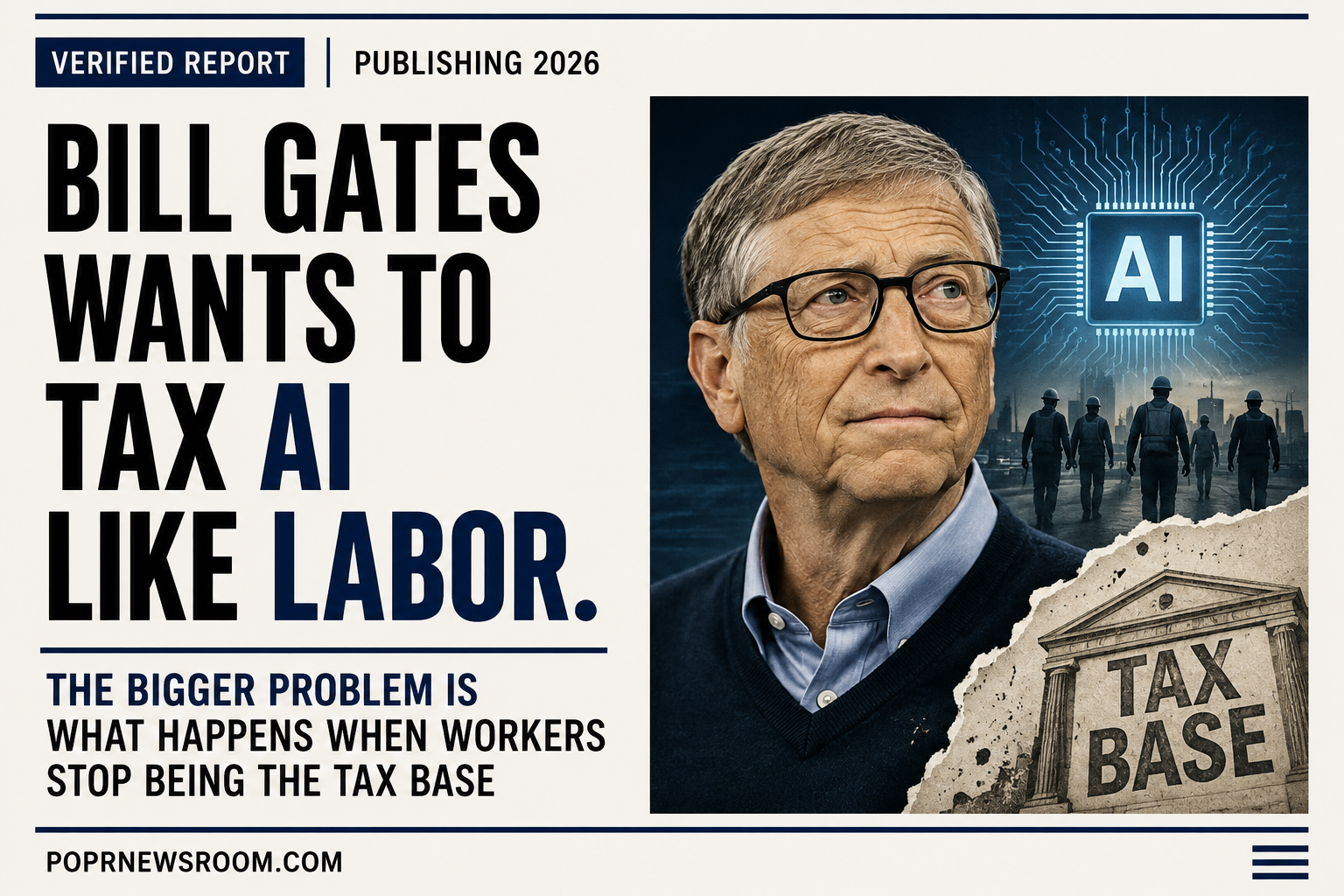
Bill Gates’s latest proposal to tax artificial intelligence and robots is not actually new. He says so himself. “I proposed a robot tax years ago,” Gates writes in his August 26 essay on what he calls the turbulent AI era.
What has changed is the technology surrounding the proposal. The earlier robot-tax debate largely imagined machines replacing particular forms of human labor. Gates is now considering artificial intelligence capable of competing across cognitive work, running on infrastructure businesses already possess and communicating through ordinary language. That creates a larger economic question than whether a robot should pay taxes.
Modern governments collect substantial revenue from economic systems in which human beings work, earn income and pay taxes. Employers also make payments connected to human employment. Workers then spend their earnings throughout the broader economy. If AI materially reduces the amount of labor income being generated, governments could eventually confront an uncomfortable mismatch: greater demand to help people through technological displacement alongside pressure on parts of the revenue system historically connected to human work. Gates’s answer is to reconsider the balance between taxing labor and taxing automation.
His essay does not establish how large future AI displacement will be, how much tax revenue would be lost, or exactly how an AI tax should be calculated. But it identifies a problem that becomes more important if his underlying forecast proves correct. What happens to a tax system built around human economic activity when increasingly valuable economic activity no longer requires as many humans?
Gates Has Been Talking About a Robot Tax for Years
It would be misleading to present Gates’s 2026 tax proposal as a sudden response to the current AI boom. He explicitly identifies it as a position he has held for years. The underlying principle is that automation should not receive an artificial economic advantage simply because a company can replace taxable human labor with machines.
In his new essay, that position appears as one component of a much larger response to AI disruption. Gates proposes three broad interventions. He calls for new domestic and international governing institutions capable of overseeing AI across multiple sectors.
He proposes Human Reserved, his term for deliberately preserving certain activities for people even if artificial intelligence becomes capable of performing them. And he returns to the taxation question, arguing for a rebalancing between the taxation of labor and automation. Those proposals address different parts of the same problem.
Governance addresses how AI is controlled. Human Reserved asks what society may choose not to automate. Tax policy asks how societies finance themselves if automation proceeds anyway.
The Real Question Is Not Whether a Robot Can Literally Pay Taxes
“Robot tax” is memorable language. It can also obscure the economic issue. A machine does not receive a paycheck in the same sense as a human worker. It does not file an ordinary personal income-tax return. An AI model does not become a taxpayer merely because it performs economically valuable work.
Any real policy would therefore have to identify what is actually being taxed. The company deploying the automation? The profits attributable to automation?
AI computation? AI-generated output? Capital investment?
A reduction in payroll? Some measure of labor displaced? Gates’s essay does not provide a complete tax code for answering those questions.
That distinction matters because a general principle can be considerably easier to articulate than a workable tax mechanism. The principle is clear enough: Gates does not want tax policy to encourage companies to replace people merely because human labor carries tax obligations that automated labor avoids. Designing a system that accomplishes that without discouraging productive investment is considerably harder.
AI Makes Gates’s Old Robot-Tax Argument More Complicated
The artificial-intelligence economy does not map neatly onto an image of a factory robot taking one person’s job. AI can alter work at the level of tasks. One employee may use AI to become more productive without losing a job.
A company may use AI to increase output while keeping the same workforce. An occupation may shrink while surviving. New demand may appear because falling costs expand a market.
Some jobs may disappear while new ones emerge elsewhere. And the effects may differ dramatically across industries. Gates himself makes one important distinction involving software engineering.
He writes that areas such as software engineering could generate new demand as costs fall, resulting in less net job loss than in other fields as long as some tasks, including design, remain better performed by humans. That qualification is important. Gates is not presenting a model in which every productivity improvement automatically destroys a corresponding job.
Nor does the evidence supporting his essay establish a specific future unemployment rate. The economic problem is therefore not as simple as counting AI systems and assigning each one the tax bill of a worker it supposedly replaced.
Gates Thinks Cognitive Work Faces a Different Kind of Automation
The tax argument sits downstream from Gates’s larger thesis about why artificial intelligence could produce a different transition from previous technologies. Earlier technologies frequently automated physical activity or changed the tools humans used while creating demand for new forms of cognitive labor. Gates argues that AI can substitute directly for cognition itself.
He also points to the speed with which the technology can spread. Businesses already possess computers, networks and software infrastructure. Users do not necessarily need specialized training to communicate with generative AI because natural language itself can function as the interface. “We don’t have to adapt to it because it can adapt to us,” Gates writes.
That is Gates’s interpretation of the transition, not an established measurement of its eventual economic effect. But if he is right about the direction, it explains why an old robot-tax argument has returned inside a much larger discussion. Automation is moving beyond machines that perform repetitive physical operations.
It is competing for pieces of the knowledge economy.
The Jobs Gates Names Reach Deep Into White-Collar Work
Gates identifies several areas he believes face particularly significant initial exposure. They include sales and customer support, paralegal work, loan assessment, data analysis, medical triage and software engineering, although he gives software engineering the important demand-growth qualification. He also anticipates physical robotics creating competition in construction and hospitality by the end of the decade.
These are forecasts and interpretations. They should not be confused with verified future job losses. Research on current labor effects remains contested.
The Stanford Digital Economy Lab has reported evidence of employment pressure among entry-level workers in AI-exposed occupations. But the broader interpretation of those findings remains disputed, including public disagreement involving economists Erik Brynjolfsson and Daron Acemoglu. Brynjolfsson himself has distinguished evidence of an entry-level effect from a generalized “job apocalypse.” That distinction is crucial for tax policy.
A government designing an automation tax around the assumption of mass unemployment would be building policy on an outcome that has not been established. The more defensible question is whether tax systems should begin preparing for a labor share that could change materially even without an immediate employment collapse.
Productivity Can Rise Without Workers Receiving the Same Share
Artificial intelligence could create enormous economic value without necessarily distributing that value in the same way as the labor economy it alters. That possibility is what gives the tax question its significance. If a company can produce more with fewer workers, productivity can rise.
Profits can rise. Output can rise. Prices can fall.
New demand can emerge. None of those outcomes automatically guarantees that labor income rises proportionately. And if economic value migrates away from wages toward capital, software, computation and ownership, the location of taxable economic activity changes with it.
Gates’s proposal is fundamentally an argument that the tax system may have to follow that movement. It is not evidence that such a migration has already occurred at the scale his proposal anticipates. It is preparation for the possibility.
Governments Could Face a Two-Sided Problem
The most difficult version of the AI transition would create fiscal pressure from both directions. On one side would be revenue. If fewer people receive taxable labor income, governments could collect less through tax mechanisms connected to employment than they otherwise would have.
On the other side would be expenditure. Workers experiencing displacement could require retraining, income support, health care, education, transition assistance or other public services. The result could be an inversion of the economic bargain.
The technology producing the disruption could increase overall wealth while the government responsible for managing the disruption becomes more dependent on a shrinking or changing tax base. That is a structural possibility derived from Gates’s proposal, not a quantified outcome established in his essay. How much revenue would actually be affected would depend on employment, wages, productivity, corporate profits, tax policy, ownership structures and the wider economic response.
Those quantities remain unknown.
Taxing Automation Could Create Its Own Problems
There is an obvious counterargument to Gates’s approach. Societies generally want productivity improvements. Automation can lower costs, increase output, reduce dangerous work and create products and services that were previously uneconomical.
A poorly designed tax could punish companies for becoming more productive. It could slow useful technological adoption. It could be especially difficult to administer when AI augments workers instead of replacing them.
And countries that tax automation aggressively could potentially place their own businesses at a disadvantage relative to jurisdictions that do not. Those problems become even harder when artificial intelligence is delivered through software that crosses borders. A robot bolted to a factory floor has a physical location.
A model accessed through cloud infrastructure may serve workers and customers across multiple countries. Determining where the economically productive automation occurred could therefore become part of the tax problem itself. Gates’s essay identifies the direction of the imbalance more clearly than it resolves these implementation questions.
The Tax Debate Cannot Be Separated From Gates’s Governance Proposal
This is where the different parts of Gates’s essay begin to connect. He does not treat AI as merely a domestic employment technology. His first stated policy priority is the creation of new governing institutions, including international coordination.
He explicitly argues that cooperation between the United States and China will be necessary. That international dimension matters for taxation too. If AI becomes a highly mobile form of productive capital, governments may have difficulty addressing its economic effects independently.
Tax automation heavily in one jurisdiction and economic activity may shift. Tax it nowhere and governments could face pressure if labor’s contribution to the tax base falls. Coordinate internationally and the political problem becomes considerably larger.
Gates does not solve that equation. He is identifying why AI governance eventually extends beyond model safety. It reaches into the architecture of the economy itself.
Human Reserved and the Robot Tax Solve Opposite Sides of the Same Problem
Gates’s Human Reserved proposal asks society to consider deliberately protecting some human activities from automation. His tax proposal assumes that considerable automation will nevertheless occur. Those ideas are not contradictory.
They address opposite sides of the boundary. Human Reserved asks: Where should substitution stop?
The automation-tax proposal asks: Where substitution continues, how should the resulting economic value support society? That pairing reveals something important about Gates’s broader argument.
He is not proposing to preserve the existing labor market unchanged. He appears to accept substantial technological substitution as likely. His policy architecture is instead designed around managing a transition he expects to continue.
Some work may be protected because human participation itself has value. Other work may be automated. If the second category becomes large enough, the financial system supporting the first category and the rest of society may need to change with it.
The Hardest Question Is Who Owns the Productivity
Taxation is downstream from ownership. If AI allows one worker to produce what five workers once produced, the resulting productivity gain has economic value. Where that value ultimately goes matters.
It could appear in higher wages. It could produce lower consumer prices. It could finance additional hiring.
It could create new businesses. It could increase corporate profits. It could flow to the owners of AI infrastructure or intellectual property.
Different distributions create different tax consequences. Gates’s robot-tax proposal implicitly recognizes that technological productivity does not automatically arrive in the same taxable form as human wages. But his essay does not establish how future AI productivity will actually be divided among workers, consumers, companies and capital owners.
That is one of the largest unanswered economic questions in the entire AI transition.
AI Could Force Governments to Decide What They Are Actually Taxing
For much of modern economic life, labor has been relatively easy to observe. A person works. An employer pays wages.
Income is reported. Taxes attach to the transaction. Artificial intelligence complicates that visibility.
A company may deploy software that improves thousands of employees simultaneously. Another may automate an entire workflow. Another may purchase an AI service from a foreign provider.
Another may build its own models. Another may use robotics and AI together. Another may eliminate no jobs at all while dramatically increasing productivity.
Calling all of those activities “robot labor” would conceal more than it explains. A serious automation-tax regime would eventually need to distinguish augmentation from substitution, productive investment from labor displacement, and ordinary software from economically autonomous systems. The current evidence does not establish that policymakers know how to do that reliably.
Gates’s Old Proposal Has Arrived at a Much Bigger Question
The phrase “robot tax” dates the argument to an earlier technological imagination. The 2026 version of the problem is broader. Artificial intelligence does not need a humanoid body.
It does not need to occupy a workstation. It does not need to replace one identifiable employee. It can diffuse through an organization and alter the amount of human labor required to produce an economic result.
That makes Gates’s old proposal simultaneously more relevant and more difficult. The central problem is no longer: Should we tax the robot that replaced a worker?
It is: How should society tax economic production when human labor is no longer necessarily the primary scarce input? Gates does not provide the final answer.
But if AI produces the abundance he expects, governments may eventually have to answer it. Because the paradox of successful automation is that a society can become more productive while the economic mechanisms built around human work become less representative of where that productivity resides. The AI tax debate is ultimately about following the value.
And if the value moves, the tax system may have to move with it.
Fact Summary
Bill Gates published “The turbulent AI era is here. The choices we make now are critical” on August 26, 2026. Gates’s proposal to change the taxation of automation is not new. In the essay he explicitly writes, “I proposed a robot tax years ago.”
His current argument calls for rebalancing taxation between labor and automation as part of a broader response to potential AI-driven economic disruption. Gates identifies sales and customer support, paralegal work, loan assessment, data analysis, medical triage and software engineering among areas exposed to AI, while specifically arguing that software engineering could experience less net job loss because falling costs may generate additional demand.
Those occupational outcomes are Gates’s interpretations and forecasts. They are not established future employment results. Current research suggesting employment pressure among some entry-level workers in AI-exposed occupations does not establish a general AI-driven job apocalypse, and interpretation of the labor evidence remains contested.
Gates’s essay does not specify a complete mechanism for taxing AI, calculate future tax-revenue losses or establish a particular unemployment rate.
Evidence Status
Confirmed: Gates has advocated a robot tax previously and explicitly acknowledges that history in his 2026 essay. Gates’s interpretation: AI could disrupt cognitive work unusually quickly because it can substitute for cognition, use existing digital infrastructure and interact through natural language.
Forecast: The scale and timing of future occupational displacement remain uncertain. Policy proposal: Rebalancing taxation between human labor and automation is Gates’s proposed response. It is not presented here as enacted policy.
POPR analysis: A sufficiently large migration of economic value away from human wages could force governments to reconsider where taxable productive value resides. The magnitude and timing of such a shift are not established by the evidence currently available.